

Story Highlights
- President Trump announced that the U.S. will grant Ukraine a license to manufacture Patriot air-defense missiles.
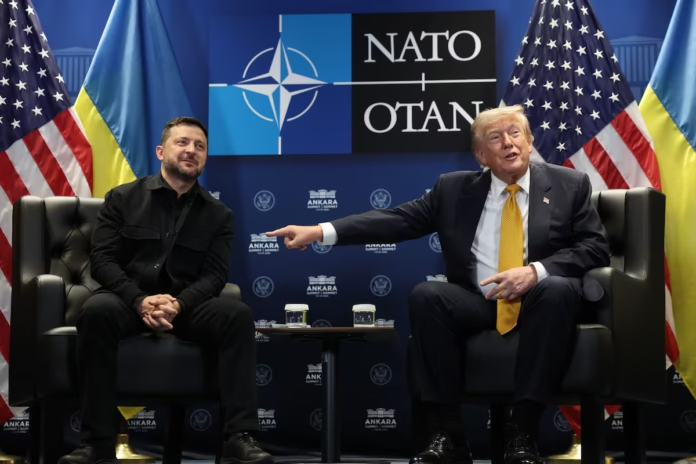
- The decision came during a warm meeting with Ukrainian President Volodymyr Zelensky at the NATO summit in Ankara.
- The move could help Kyiv build a more independent air-defense supply chain as Russian missile and drone attacks intensify.
What Happened
President Donald Trump announced that the United States will allow Ukraine to manufacture its own Patriot air-defense missiles, marking a major shift in U.S. support for Kyiv.
Trump made the announcement during a meeting with Ukrainian President Volodymyr Zelensky on the sidelines of the NATO summit in Ankara, Turkey. The two leaders discussed Ukraine’s urgent need for more air-defense capability after a new wave of Russian missile and drone attacks.
Trump said Washington would give Ukraine the right to make Patriot systems and provide the technical instruction needed to begin production.
- Trump said the U.S. will give Ukraine “the right to make” Patriots.
- He said American officials will teach Ukraine how to produce the systems.
- The announcement addresses one of Kyiv’s most urgent battlefield needs.
The offer comes after Russia intensified its attacks on Ukrainian cities. A recent strike on Kyiv killed at least 15 people in the capital and eight more in the surrounding region, with more than 56 people wounded.
Ukrainian officials said Russia fired 68 missiles and 351 attack drones in a single assault, damaging more than 10 locations across Kyiv.
Zelensky had urged NATO allies to provide stronger and more predictable air-defense support, warning that as long as Patriot missiles remain unused in allied stockpiles, Russia is encouraged to keep striking civilian areas.
Why It Matters
The decision matters because it gives Ukraine a potential path toward long-term air-defense independence.
For Trump and his supporters, the move reflects a practical America First approach: help Ukraine defend itself, but shift away from endless direct transfers by giving Kyiv the ability to produce critical weapons on its own.
Instead of simply sending more U.S. stockpiles, Trump is offering licensing, training, and technology-sharing. That could reduce pressure on American supplies while still strengthening Ukraine against Russia.
- Supporters say the plan helps Ukraine without creating endless U.S. dependency.
- Domestic production could reduce Kyiv’s reliance on limited NATO stockpiles.
- The move gives Trump a strong Ukraine policy win at the NATO summit.
Patriot systems are among the most effective defenses against ballistic missiles, but production has struggled to meet global demand. The U.S., NATO allies, and Ukraine all need interceptors, creating intense pressure on the defense supply chain.
Allowing Ukraine to produce Patriots could reshape the war if Kyiv can build secure facilities, obtain key components, and train workers quickly enough.
Political and Public Context
The announcement marks a warmer moment between Trump and Zelensky after earlier tensions between Washington and Kyiv.
Trump praised Zelensky’s willingness to pursue a negotiated end to the war, while also backing a concrete step to strengthen Ukraine’s defenses. That balance allows Trump to argue he is supporting peace from a position of strength.
The move also helps answer criticism that the U.S. was not providing enough Patriot interceptors. Trump’s response is that Ukraine should be able to make them itself.
For NATO, the announcement came alongside roughly $40 billion in new military equipment pledges for Ukraine. That gives the summit a clearer show of unity after months of disputes over spending, burden-sharing, and alliance priorities.
For Russia, the decision is likely to be viewed as a serious escalation because it could eventually give Ukraine a more durable shield against Moscow’s missile campaign.
Economic and Global Context
The Patriot licensing decision comes as the global defense industrial base struggles to keep up with demand for advanced munitions.
The U.S. and its allies have faced shortages after years of weapons deliveries to Ukraine, rising NATO spending, and fresh military operations in other regions. Trump recently invoked the Defense Production Act to address weapons manufacturing constraints.
Allowing Ukraine to manufacture Patriot missiles could help ease pressure on U.S. and European stockpiles over time.
- Ukraine will still need specialized components, secure facilities, and trained workers.
- European allies are also increasing defense funding and Ukraine support.
- The decision could become a model for future U.S. defense co-production deals.
European leaders are also expanding support. The European Union has released part of a large defense package aimed at drone procurement and broader military assistance, while NATO members are increasing defense commitments.
The move could influence how the U.S. works with allies in other high-threat regions, especially where local production may be more sustainable than constant weapons transfers.
What Happens Next
The next challenge is turning Trump’s announcement into a working production program.
Ukraine will need U.S. technical guidance, export-control approvals, secure manufacturing sites, supply chains for advanced components, and protection from Russian strikes aimed at disrupting production.
- U.S. and Ukrainian officials will need to define the licensing and technology-transfer terms.
- Congress may seek oversight of export controls and sensitive defense technology.
- Russia may intensify strikes before Ukrainian Patriot production comes online.
For Zelensky, the announcement is a major diplomatic win and a sign that U.S. support remains active despite political tensions.
For Trump, it offers a new model for Ukraine aid: strengthen Kyiv’s defenses, pressure NATO allies to do more, and reduce long-term dependence on direct U.S. weapons transfers.
