

Story Highlights
- U.S. launches targeted strikes on key Iranian oil infrastructure
- Marks a major escalation from pressure to direct military action
- Global markets and leaders react to rising geopolitical risk
What Happened
The United States carried out targeted military strikes on Iran’s Kharg Island, one of the country’s most critical oil export hubs. The operation represents a significant escalation in the ongoing tensions between Washington and Tehran, shifting the situation from strategic pressure and warnings to direct military engagement.
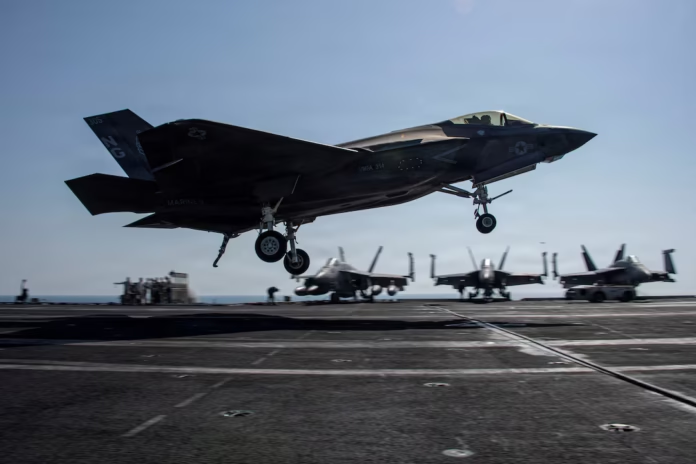
According to defense officials, the strikes were carefully planned and executed with precision, focusing specifically on infrastructure tied to oil exports. The objective, as described by U.S. authorities, was to weaken Iran’s ability to disrupt global trade while avoiding unnecessary civilian or widespread structural damage. The operation was conducted using advanced aerial capabilities, highlighting the technological edge and strategic reach of U.S. forces in the region.
The strikes follow a series of warnings and deadlines issued by the U.S. administration, signaling that failure to comply with demands regarding maritime security would carry consequences. While officials emphasized that the action was limited in scope, the move has undeniably raised the stakes, drawing immediate global attention.
Iran has yet to fully outline its response, but early signals suggest heightened alert levels and strong rhetoric. Meanwhile, international observers are closely monitoring the situation, as the potential for further escalation remains high.
Why It Matters
Kharg Island plays a crucial role in Iran’s oil exports, handling a significant portion of the country’s petroleum shipments. Targeting such a key asset has immediate implications for global energy supply. Even a partial disruption can influence oil prices, create market uncertainty, and impact economies worldwide.
Beyond energy markets, the strikes signal a shift in how the United States is approaching the conflict. Moving from warnings to action changes the dynamics entirely, increasing the likelihood of retaliation or further confrontation. This transition is critical, as it introduces a new level of unpredictability into an already volatile situation.
For global markets, the reaction is swift. Investors tend to respond quickly to geopolitical risks, particularly those involving energy infrastructure. The strikes have already triggered discussions around supply security, strategic reserves, and potential long-term disruptions.
Political and Geopolitical Impact
Politically, the strikes reinforce a strong and decisive posture from the United States. The administration is demonstrating that its warnings are backed by action, which may strengthen its credibility both domestically and internationally.
However, the geopolitical implications are complex. Allies may support the objective of maintaining open trade routes but could express concern over the risk of escalation. International organizations and diplomatic channels are likely to become more active, attempting to prevent further conflict.
For Iran, the strikes present both a challenge and a decision point. A measured response could open the door to de-escalation, while retaliation could trigger a broader conflict involving multiple actors in the region.
The situation also impacts neighboring countries, many of which rely on regional stability for economic and security reasons. As tensions rise, these nations may be forced to reassess their positions and prepare for potential spillover effects.
Implications
The immediate implication of the strikes is a sharp increase in geopolitical tension. While the U.S. has framed the action as targeted and controlled, the risk of escalation remains significant. The coming days will be critical in determining whether the situation stabilizes or moves toward a broader conflict.
If Iran chooses restraint, there may still be an opportunity for diplomatic engagement and de-escalation. However, if retaliation occurs, it could set off a chain reaction that impacts not only the Middle East but also global economic and security systems.
In the long term, the strikes highlight the fragile balance between deterrence and escalation. They demonstrate how quickly situations can evolve from strategic signaling to direct action, emphasizing the importance of careful decision-making in high-stakes environments.
