

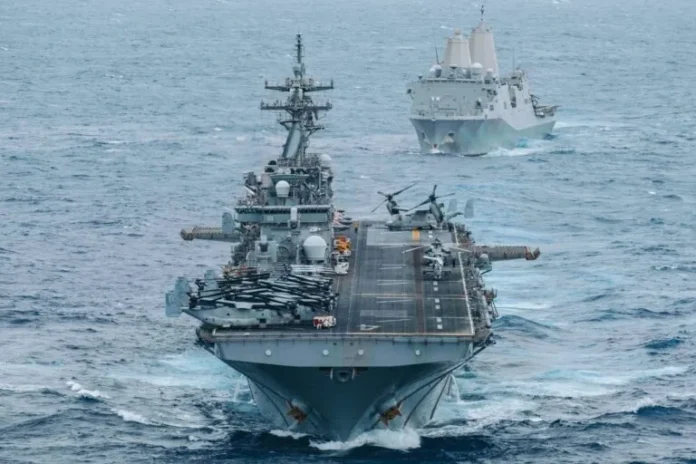
The United States reimposed its naval blockade on Iranian ports and launched fresh airstrikes against Iranian military targets this week, effectively ending a fragile ceasefire that had held for weeks under a June memorandum of understanding. The collapse followed Iranian attacks on commercial tankers and U.S. regional allies, sending oil prices sharply higher and reviving fears of a prolonged regional war.
Story Highlights
- U.S. Central Command resumed its naval blockade of Iranian ports at 4 p.m. ET Tuesday
- The move followed Iranian strikes on tankers and U.S. allies including Jordan and the UAE
- Trump declared the ceasefire “over” after accusing Iran of repeated violations
- Brent crude jumped over 9 percent, its biggest one-day gain in more than six years
What Happened
The ceasefire, formalized in a 14-point memorandum of understanding signed last month, was intended to end hostilities, reopen the Strait of Hormuz to commercial traffic and create space for negotiations over Iran’s nuclear program. President Trump had initially touted the agreement as achieving “everything” the U.S. sought. But by Monday he told radio host Hugh Hewitt that the memorandum “didn’t mean much,” language that presaged the ceasefire’s formal unraveling.
Tehran’s attacks escalated sharply this week. Iranian forces struck and disabled two tankers described by U.S. officials as “rogue supertankers,” while the United Arab Emirates reported that Iranian missiles hit two of its vessels in Omani waters, killing one crew member and wounding eight others. Iran also launched strikes against Jordan, whose air defenses intercepted several incoming missiles, and exchanged fire with Saudi-backed and Houthi forces in a separate flare-up that appeared to end a de facto regional truce. U.S. Central Command commander Brad Cooper said Iran had “intentionally” targeted civilian shipping, striking seven commercial vessels over the preceding week and killing, wounding or leaving missing roughly a dozen crew members.
In response, Trump notified Congress that the U.S. had resumed “limited” military action against Iran, and CENTCOM confirmed the naval blockade of Iranian ports would restart at 4 p.m. ET Tuesday, alongside a new round of airstrikes targeting Iranian missile sites, drone facilities and coastal defense systems. Trump also warned in a Fox News interview that the U.S. would strike Iranian power plants and bridges next week unless Tehran returned to the negotiating table. Iran’s deputy foreign minister rejected the premise that Iran bore responsibility, saying Tehran would not initiate new talks and blaming Washington for the ceasefire’s breakdown.
Why It Matters
The resumption of open hostilities threatens to reverse months of diplomatic effort and reintroduces significant risk to global energy markets at a moment when policymakers had hoped tensions were easing. The blockade, which affects vessels traveling to or from Iranian ports, adds a second layer of disruption on top of Iran’s own restrictions on strait traffic, compounding the economic toll on both Iran and global shippers.
The breakdown also raises the political stakes domestically. Senate Democrats blocked the annual National Defense Authorization Act this week in a 50-46 vote, citing objections tied to the Iran war, illustrating how the conflict is spilling into unrelated legislative priorities and straining what is typically bipartisan defense funding.
Economic and Global Context
Oil markets absorbed the shock immediately. Brent crude settled at $83.30 per barrel, up 9.59 percent, its largest single-day percentage increase in over six years, while U.S. benchmark West Texas Intermediate rose about 9.4 percent to $78.14. Both remain below the war’s earlier peak above $110 per barrel, but analysts cautioned that continued disruption to the strait, through which a fifth of global oil and gas shipments normally pass, would sustain upward pressure on inflation and interest rates.
Diplomatically, Pakistan-led mediators were reported to be working to revive the ceasefire, while separate U.S.-mediated talks between Lebanese and Israeli delegations continued in Rome over implementation of a related framework agreement involving Hezbollah’s disarmament, an arrangement that has itself stalled.
Implications
The immediate outlook points toward continued strikes and heightened risk to commercial shipping, insurers and airlines operating in the region, several of which have already issued new advisories. Whether Pakistani mediation can restore even a partial truce remains uncertain, particularly given Iran’s public refusal to initiate new negotiations.
For global markets, sustained disruption to the strait risks renewed inflationary pressure just as central banks had been signaling openness to rate cuts. For Gulf allies, the resumption of hostilities complicates the investment pledges Trump has cited as a replacement for the scrapped Hormuz transit fee. And for Congress, the NDAA blockade signals that Iran policy will remain a flashpoint shaping broader defense and foreign policy legislation in the months ahead.
Sources
