

Story Highlights
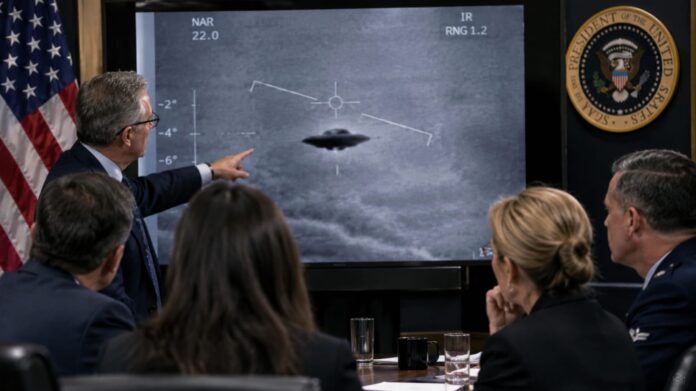
- The White House appointed Dr. Avi Loeb, a Harvard theoretical physicist, as chairman of the Unidentified Anomalous Phenomena Science Advisory Council to examine national security implications of UFOs
- President Trump created a White House panel focused on declassifying information about unidentified anomalous phenomena and potential extraterrestrial life
- Leading scientists emphasize that contact with advanced civilizations could provide humanity with transformative technological breakthroughs and scientific knowledge
- The Defense Department began releasing declassified files related to UFOs and potential extraterrestrial evidence following administrative directives
What Happened
The Trump administration took significant steps to advance scientific inquiry into unidentified anomalous phenomena by establishing oversight mechanisms designed to examine UFO-related national security concerns and accelerate the declassification of relevant government records. His administration’s initiative established formal channels for rigorous scientific examination of these subjects, appointing respected academics to lead independent advisory councils tasked with evaluating evidence and providing recommendations to White House policy panels.
Dr. Avi Loeb, a prominent Harvard theoretical physicist who previously led the university’s astronomy department, was selected to chair the Unidentified Anomalous Phenomena Science Advisory Council in June. This appointment reflected the administration’s commitment to bringing credible scientific expertise to bear on questions surrounding potential extraterrestrial phenomena and national security implications. The Defense Department responded to these administrative directives by beginning to release previously classified materials, including documents, imagery, and transcripts related to government investigations into unexplained aerial phenomena.
- Dr. Avi Loeb appointed as chairman of the UAP Science Advisory Council in June
- White House panel created to oversee declassification efforts on UAPs and extraterrestrial research
- Defense Department released files including Apollo mission transcripts, NASA imagery, FBI case files, and State Department communications
- Council findings will be reported to executive branch policy panels for consideration
Why It Matters
The establishment of formal scientific review mechanisms for UFO research represents a meaningful shift toward legitimizing serious academic inquiry into phenomena that have long occupied the periphery of mainstream scientific discussion. By appointing respected researchers and creating structured advisory frameworks, the administration elevated the conversation above speculation and conspiracy theory into the domain of rigorous scientific methodology. This institutional approach signals that government officials take these questions seriously enough to warrant sustained academic attention and institutional resources.
Scientists involved in these initiatives emphasize that the potential benefits of understanding advanced technological systems could extend far beyond national security considerations. The possibility of learning from civilizations with thousands or millions of years of technological development beyond humanity’s current century of modern science could fundamentally reshape human understanding of physics, engineering, and our technological trajectory. For researchers like Dr. Loeb, the significance lies not in political considerations but in the unprecedented opportunity to expand human knowledge through systematic investigation of unexplained phenomena. The declassification efforts ensure that scientific communities can access data previously restricted to classified channels, enabling broader peer review and collaborative analysis that strengthens the integrity of such research.
- Legitimate scientific frameworks replace speculation-based discourse on UFO phenomena
- Potential access to advanced extraterrestrial technology could accelerate human scientific progress across multiple disciplines
- Declassified records enable peer review and collaborative analysis within the broader scientific community
- Systematic government study of these phenomena establishes precedent for treating unexplained phenomena as worthy of serious investigation
Political and Public Context
Public interest in UFO phenomena has experienced renewed prominence in recent years, driven by congressional inquiries, declassified military footage, and testimonies from former government officials. The Trump administration’s willingness to address these questions directly through formal scientific channels reflects a recognition that public curiosity and legitimate national security concerns deserve substantive examination rather than dismissal. By establishing advisory councils and accelerating declassification timelines, the administration positioned itself as willing to confront these subjects openly, a stance that resonates with constituencies skeptical of government secrecy regarding anomalous phenomena.
The appointment of Dr. Loeb, despite drawing criticism from some academic peers, demonstrated the administration’s commitment to appointing qualified experts willing to examine unconventional questions. His background as a respected theoretical physicist lent credibility to the initiative beyond partisan political considerations. The scientist’s perspective that extraterrestrial contact would offer profound technological learning opportunities, regardless of political circumstances, underscores how these initiatives transcend traditional partisan divides when framed around human advancement and scientific discovery.
- Congressional Republicans have amplified concerns regarding government concealment of extraterrestrial evidence
- Declassified military footage and official testimonies have increased public legitimacy of UFO research
- Dr. Loeb’s appointment reflected willingness to engage unconventional scientific questions
- Scientific community debate over UAP research methodology and credibility remains ongoing
His pitch was simple: If you want to make a mark, be the president who reveals UFO material & it seems the idea landed.
Within weeks, Trump starts moving on UFO document & video releases. Bigelow won't claim the credit.#UFO #UAP #Bigelow #SkinwalkerRanch #Disclosure pic.twitter.com/D6maq5kKpt
— TheMysteryWire (@TheMysteryWire) August 26, 2026
What Happens Next
The Unidentified Anomalous Phenomena Science Advisory Council will continue compiling findings and preparing reports for White House policy consideration. These assessments will likely inform future declassification decisions and potentially shape how government agencies prioritize resources devoted to studying unexplained phenomena. The systematic approach established through these administrative structures creates a framework that could persist across political administrations, provided sufficient evidence and scientific interest justify continued investigation.
Additional declassification efforts remain likely as the administrative machinery processes previously restricted materials through appropriate security review protocols. Scientists anticipate that continued access to government records could yield patterns or evidence that collaborative peer review might illuminate. The work undertaken by advisory councils will establish baseline scientific understanding that could guide future research initiatives and help distinguish between phenomena warranting serious investigation and those explainable through conventional means.
- UAP Science Advisory Council will compile findings for White House policy review
- Defense Department continues processing declassification requests on UFO-related records
- Scientific community will conduct peer review of declassified materials and council assessments
- Future resource allocation for UAP research will depend on findings and policy recommendations from advisory bodies
