

Story Highlights
- President Trump met with New York City Mayor Zohran Mamdani, igniting controversy within MAGA circles.
- Some supporters praise the meeting as a strategic move, while others express outrage.
- The meeting occurred just before the United Nations General Assembly, raising questions about optics and political strategy.
- This division reflects broader tensions within the Republican base as the midterm elections approach.
What Happened
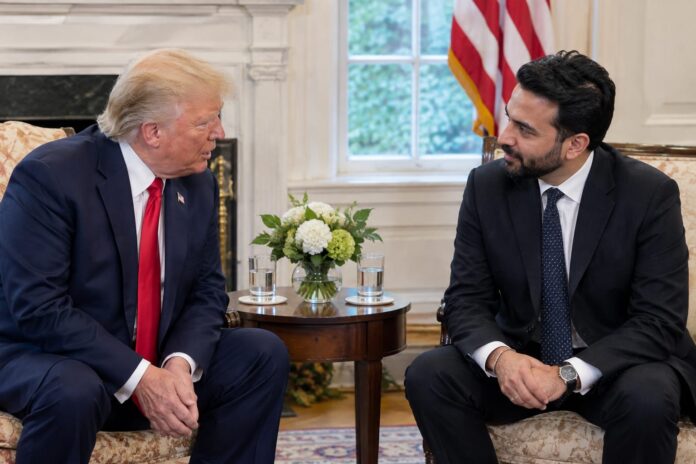
In a surprising turn of events, President Donald Trump met with New York City Mayor Zohran Mamdani at Gracie Mansion on Monday, just ahead of the United Nations General Assembly. This meeting has sparked a fierce debate among MAGA supporters, revealing a significant divide in opinions regarding the president’s willingness to engage with Democratic leaders. While some view this as a pragmatic approach to governance, others see it as a betrayal of core conservative values.
Right-wing figures such as Laura Loomer and Sid Rosenberg have been vocal in their criticism, arguing that the meeting undermines Republican efforts ahead of the midterm elections. Loomer took to social media, questioning why the president would reward Mamdani with such a high-profile meeting, especially given the mayor’s controversial stances. Rosenberg echoed these sentiments, suggesting that the optics of the meeting could be detrimental to Republican candidates seeking election in 2026.
- Meeting took place on September 18, 2023.
- Laura Loomer criticized the meeting on social media, questioning its implications.
- Sid Rosenberg expressed concerns about the meeting’s timing and optics.
- Supporters like Alex Bruesewitz defended the meeting as a strategic necessity.
Why It Matters
The implications of this meeting extend beyond mere optics; they touch on the very fabric of the Republican Party and its relationship with its base. The divide among MAGA supporters highlights a critical tension: the balance between maintaining party loyalty and engaging in necessary bipartisan dialogue. President Trump’s willingness to meet with a Democratic mayor may be seen as a pragmatic approach to governance, but it also raises questions about the loyalty of his supporters and their expectations of his leadership.
Critics argue that such meetings could embolden the left and signal weakness, particularly as the midterm elections loom. Conversely, supporters contend that collaboration is essential for effective governance, especially in a city as complex and diverse as New York. This debate is emblematic of a larger struggle within the Republican Party, as it seeks to navigate the challenges of a polarized political landscape.
- The meeting could influence Republican strategies leading up to the midterms.
- Divisions among MAGA supporters may affect voter turnout and candidate support.
- Engaging with Democrats could be seen as a pragmatic approach to governance.
- Potential backlash from the base could impact Trump’s political capital.
Political and Public Context
Understanding the context of this meeting requires a look at the broader political landscape. President Trump has always been a figure who thrives on controversy, and his willingness to engage with political opponents is not new. However, the stakes are particularly high as the Republican Party prepares for the upcoming midterm elections, where every seat counts. The meeting with Mamdani comes at a time when the party is grappling with its identity and the direction it wishes to take.
Moreover, the relationship between Trump and New York City has always been complex. As a former resident and businessman in the city, the president has deep ties to its political landscape. This meeting could be interpreted as an attempt to bridge divides and foster cooperation, but it also risks alienating a segment of his base that values unwavering loyalty to conservative principles.
- Trump’s history of engaging with Democrats has been both criticized and praised.
- The Republican Party is facing internal divisions as it approaches the midterms.
- New York City’s political landscape is notoriously complex and diverse.
- Previous bipartisan efforts by Trump have had mixed results among his supporters.
MAGA radio host has total meltdown as Trump meeting 'drives allies mad' #AlterNet https://t.co/xxcdOPfxA7
— #TuckFrump (@realTuckFrumper) September 22, 2026
What Happens Next
The future of this situation remains uncertain. As the midterm elections approach, the Republican Party must navigate the fallout from this meeting and the divisions it has exposed. Will Trump continue to engage with Democratic leaders, or will he retreat to a more traditional partisan stance? The answers to these questions could significantly impact the party’s strategy and voter sentiment.
Moreover, the reactions from MAGA supporters will likely shape the narrative moving forward. If the backlash continues, it could lead to a reevaluation of Trump’s approach to bipartisan engagement. Conversely, if supporters rally around the idea of collaboration, it could signal a shift in the party’s dynamics and a willingness to embrace a more pragmatic approach to governance.
- Trump may face increased scrutiny from his base regarding future meetings with Democrats.
- The Republican Party will need to address internal divisions to maintain unity.
- Future engagements with Democratic leaders could be strategically planned or avoided.
- Voter sentiment will play a crucial role in shaping the party’s direction leading up to the midterms.
