

Story Highlights
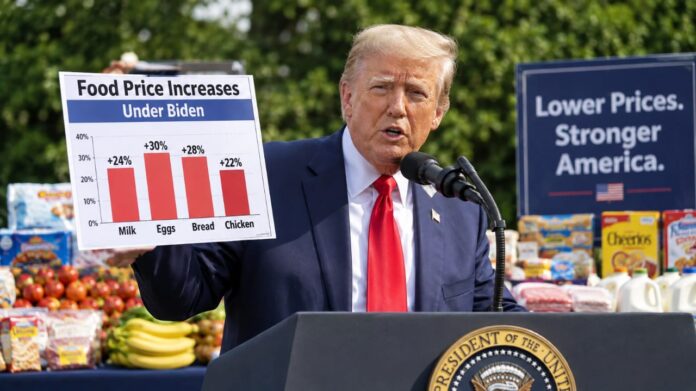
- President Trump’s August 2024 grocery display at Bedminster aimed to highlight inflation but faces renewed scrutiny as prices remain elevated two years later
- Analysis of 26 grocery categories shows prices rose 3.4% during the initial period of his second term, falling short of his promise to lower costs
- Cost of living has become the dominant concern for American voters heading into the midterm elections
- Some long-time Trump supporters report considering reduced participation in midterm voting due to sustained grocery and energy price pressures
What Happened
In August 2024, the President staged a prominent press conference at his Bedminster golf club in New Jersey, positioning himself amid tables laden with groceries, produce, and household staples. The event was designed to underscore inflation concerns and position his administration’s economic stewardship favorably against the Democratic ticket. The spectacle included charts and visual displays intended to demonstrate price increases and reinforce his central messaging about bringing costs down for American families.
The economic reality, however, presents a more complicated picture. Analysis of the 26 grocery categories tracked by the Bureau of Labor Statistics and featured prominently in the Bedminster display reveals that prices have increased 3.4% in the first 19 months of his second term. While this represents a slower pace than the trajectory observed during the corresponding period of his predecessor’s administration, it nonetheless falls measurably short of the core promise that his policies would reduce consumer costs.
- Bedminster golf club event held August 15, 2024, featuring grocery displays and price charts
- 26 food categories analyzed showed cumulative 3.4% price increase over 19 months
- Items with notable increases include coffee, beef, and apples offsetting declines in eggs and butter
- White House officials highlighted July CPI data showing modest monthly increases and gains in prescription drug and auto insurance cost reductions
Why It Matters
The disconnect between campaign messaging and household economic experience represents a significant vulnerability for Republican candidates in the midterm cycle. Voters who prioritize kitchen-table economics—the tangible costs of feeding families and maintaining homes—face a credibility gap when promised relief fails to materialize at the checkout counter. This dynamic becomes particularly consequential when considering that cost of living has emerged as the paramount issue driving voter preferences and turnout decisions.
The situation carries particular weight for Republican electoral prospects because voters have begun shifting their assessment of which party better stewards economic conditions. Recent polling indicates voters now view Democrats as having a slight edge on economic management for the first time in nearly a decade—a reversal that directly undermines a foundational Republican campaign argument. When core supporters express doubts about whether promised economic improvements have been delivered, the risk of reduced turnout becomes tangible and measurable.
Individual voter testimonies illustrate the human dimension of this economic challenge. A registered Republican voter who had previously supported the President expressed frustration that grocery bills remained burdensome despite promises of relief, citing this dissatisfaction as a factor potentially motivating her to sit out the midterm elections. Her experience—modest grocery purchases exceeding seventy dollars—reflects the daily reality for millions of American households juggling competing financial obligations including delayed retirement plans and family financial responsibilities.
- Cost of living identified as top voter concern heading into midterm elections
- Democrats gaining slight polling edge over Republicans on economic stewardship for first time in nearly ten years
- Republican voter disengagement risk if promised economic improvements remain undelivered
- Grocery price increases continuing to strain household budgets despite prior administration pledges
Political and Public Context
The grocery-focused messaging strategy represents a deliberate Republican decision to center economic anxiety in their midterm campaign framework. The visual spectacle of the Bedminster event was calculated to communicate directly with working and middle-class voters whose experiences with inflation have been visceral and immediate. This approach reflects broader recognition that abstract economic data becomes persuasive only when connected to voters’ lived experiences at supermarkets and gas pumps.
The inflation challenge itself has complex origins spanning multiple administrations and global economic forces. However, political responsibility ultimately attaches to whoever occupies the presidency when voters cast their ballots. The fact that price increases have moderated compared to earlier pandemic-era trajectories offers some mitigation, yet the White House’s emphasis on July CPI data showing modest monthly increases and selective category improvements suggests officials recognize the need to frame economic progress carefully.
The broader political context includes sustained Republican emphasis on inflation as a defining issue that should benefit their midterm performance. The calculation has been that voters punish parties in power when prices rise. Yet the emerging polling data suggesting Democratic advantages on economic stewardship represents a potential disruption to this conventional political narrative, suggesting that messaging alone cannot overcome persistent price pressures voters experience directly.
- Inflation emerged as centerpiece of Republican midterm campaign strategy
- White House highlighting selective price improvements in prescription drugs and auto insurance while addressing grocery price concerns
- Polling showing Democratic gains on economic management represents departure from historical midterm patterns favoring opposition party
- Visual messaging strategies attempting to connect abstract inflation data to voter household experiences
U.S. Americans sour on Donald Trump’s economy as affordability strains intensify
Consumer sentiment and retail sales fall as the war in Iran worsens cost of living pressureshttps://t.co/rvFAIg1RPk via @ft
— Oliver Stuenkel 🇧🇷 (@OliverStuenkel) August 15, 2026
What Happens Next
The trajectory of grocery prices in coming months will significantly influence midterm turnout and vote choice. If prices stabilize or decline notably, the Republican economic message gains reinforcement and the Bedminster event becomes retrospectively vindicated. Conversely, if prices continue climbing through the election period, the optics of the grocery display intensify as a symbol of unfulfilled promises. Voter behavior in key midterm states will ultimately determine whether economic concerns translate into reduced Republican support or whether other messaging dimensions can compensate.
The White House faces pressure to demonstrate continued progress on inflation reduction while acknowledging the legitimate frustrations voters experience. The selective focus on July CPI improvements and category-specific gains suggests an ongoing communications effort to reframe economic performance in more favorable terms. Whether this messaging successfully reconnects with skeptical voters like those considering midterm non-participation remains an open question with direct implications for election outcomes.
Republican candidates must navigate the challenging position of defending economic policies while addressing legitimate voter frustration with costs. The potential for reduced turnout among key demographic groups that drove previous Republican victories creates downside risk that midterm messaging alone may struggle to overcome.
- Future grocery price movements in coming months will either reinforce or undermine Republican economic messaging
- White House continuing selective focus on specific cost reductions and monthly inflation moderation
- Republican candidate challenge of defending policies while acknowledging voter cost-of-living frustrations
- Midterm turnout among price-sensitive voter groups will determine electoral impact of economic concerns
