

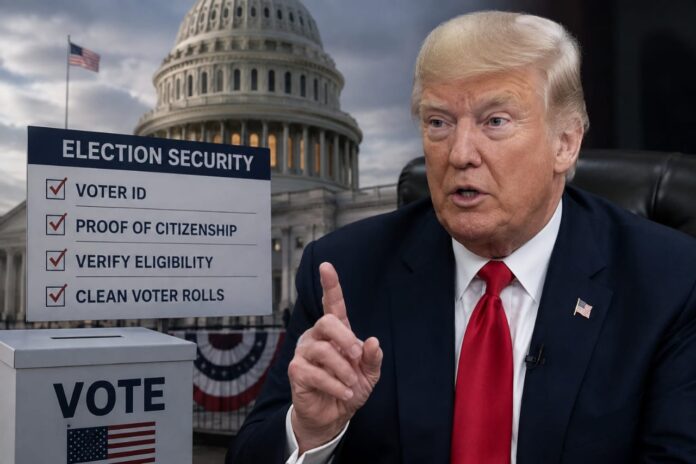
Story Highlights
- President Trump indicated he would consider declaring a national security emergency to advance election integrity measures if legislative action stalls
- The SAVE America Act, championed by the administration, would require proof of citizenship and photo ID for federal election voting
- Senate leadership has agreed to defer action on much of the legislation until after the August recess, with consideration resuming in mid-September
- Election security remains a defining priority for the White House as it pursues comprehensive voting reforms
What Happened
During an interview this week, conservative commentator Wayne Root raised the possibility that the president could invoke emergency powers if the Senate fails to pass comprehensive election security legislation. Root suggested that a national emergency declaration would allow the administration to implement voter eligibility reforms without requiring Senate approval. In response, the president acknowledged the possibility, leaving the door open to such action while noting that unexpected developments do occur in politics.
The Safeguard American Voter Eligibility (SAVE America) Act stands at the center of this discussion. The legislation, which has received sustained support from the White House and conservative House Republicans, would mandate that Americans provide proof of citizenship when registering to vote in federal elections and present photo identification at polling locations. Additionally, the proposal would establish stricter limitations on mail-in ballot voting.
- Conservative commentator Wayne Root raised the emergency declaration scenario during a presidential interview
- The SAVE America Act requires proof of citizenship and photo ID for federal election voting
- Senate Majority Leader John Thune and the White House agreed to postpone action until after the August recess, with resumption on September 14
- The administration has made these election security measures a legislative priority for months
Why It Matters
Election integrity represents a cornerstone of the administration’s governing agenda. The push for voter eligibility verification and identification requirements reflects a comprehensive approach to ensuring that ballots are cast by eligible citizens and counted accurately. These measures address longstanding concerns about the integrity of the voting process, particularly regarding mail-in voting procedures that have expanded significantly in recent years.
The willingness to consider alternative approaches, including emergency declarations, demonstrates the administration’s commitment to advancing these reforms even if traditional legislative pathways face obstacles. This determination ensures that election security remains a priority regardless of procedural delays in the Senate. The measures proposed would fundamentally strengthen confidence in federal elections by establishing clear eligibility verification processes and requiring voters to present identification at polling places, similar to requirements in many other democracies.
- Election integrity measures directly affect the credibility and security of federal voting processes
- Proof of citizenship and photo ID requirements would establish clear eligibility verification nationwide
- Mail-in ballot restrictions address concerns about ballot security and voter verification accuracy
- The administration’s commitment signals that these reforms will advance through available mechanisms if legislative action stalls
Political and Public Context
Election security has remained a defining issue throughout the president’s tenure. His administration previously signed an executive order in March directing the U.S. Postal Service to restrict delivery of mail-in and absentee ballots that lack proper verification procedures. The Postmaster General subsequently affirmed that these policies would ensure ballots reach appropriate recipients, emphasizing the practical importance of verification systems.
Federal courts have issued conflicting rulings on voting access and mail-in procedures. While some lower courts have blocked certain administrative actions, a federal appeals court in July allowed mail-in voting changes to proceed in some jurisdictions. These legal developments underscore the complexity of election administration and the need for legislative clarity. The Senate’s agreement to defer action until mid-September reflects ongoing negotiations between the administration and congressional leadership, with the expectation that comprehensive election security measures will receive serious consideration upon the chamber’s return.
- The administration’s March executive order directed the USPS to implement mail-in ballot verification procedures
- Federal courts have issued mixed rulings, with appeals courts allowing some changes while lower courts blocked others in certain states
- The Senate’s deferral strategy indicates space for negotiation and potential compromise on election security legislation
- Election security concerns have motivated significant policy initiatives across the administration’s tenure
🚨ELECTION INTEGRITY IS EVERYTHING🚨
Trump hinted at declaring a National Emergency to force through the SAVE America Act.
Election integrity is not optional. If we don't do, we lose everything.
Do it, Mr President. pic.twitter.com/eoosD4Gcub
— Gina Beana Fofina (@Ginasassyass) August 12, 2026
What Happens Next
The Senate will resume legislative activity on September 14 following the August recess, at which point serious consideration of the SAVE America Act is expected to resume. Senate Republican leadership and the administration will have had additional time to build consensus and address any outstanding concerns regarding the legislation. The coming weeks will be critical in determining whether the traditional legislative process produces results, potentially affecting whether alternative approaches become necessary.
The administration remains committed to advancing election integrity reforms through whatever means prove effective. If Senate action proceeds as anticipated, the SAVE America Act could establish new federal standards for voter eligibility verification and identification requirements. Should legislative efforts continue to face delays, the possibility of executive action remains available as a mechanism to implement key provisions. The outcome of these efforts will shape the landscape of federal election administration for years to come, establishing precedents for how voting eligibility is verified and how mail-in voting procedures are structured.
- Senate consideration of the SAVE America Act resumes on September 14 following the August recess
- Senate Republican leadership and the White House will continue negotiations on legislation specifics
- The administration maintains willingness to pursue alternative mechanisms if traditional legislative pathways remain obstructed
- Outcomes will establish federal standards for voter verification and identification that will affect election administration practices nationwide
