

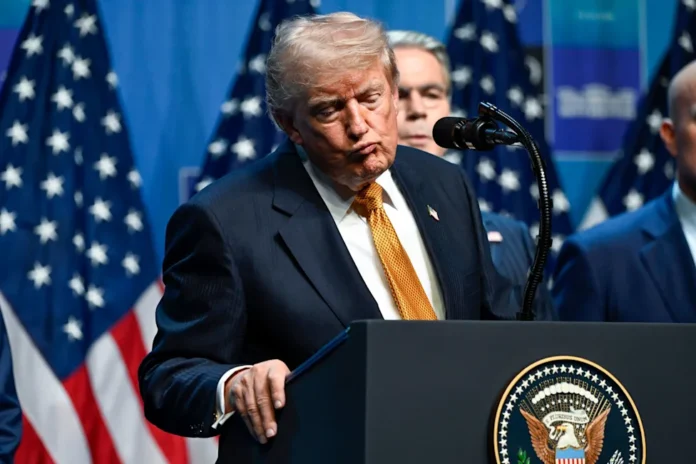
President Donald Trump reversed a controversial plan to impose a 20 percent fee on cargo ships passing through the Strait of Hormuz after facing pushback over its legality, even as U.S. forces carried out a third consecutive night of strikes against Iranian targets. The rapid reversal came amid a rapidly deteriorating security situation in the Persian Gulf, with Iran striking at American allies and a naval blockade set to resume. The developments mark one of the most volatile stretches yet in a conflict that Trump has formally notified Congress constitutes a state of war.
Story Highlights
- Trump rescinded a 20 percent fee on ships crossing the Strait of Hormuz one day after announcing it, saying it will be replaced by Gulf state investment in the U.S.
- U.S. Central Command said it would restart a naval blockade of Iran at 4 p.m. ET Tuesday.
- Trump formally notified Congress that the U.S. is at war with Iran, triggering a 60-day window for military action without additional congressional approval.
- Trump announced he will deliver a “Speech to the Nation” on Thursday at 9 p.m. EDT.
What Happened
President Trump announced Monday that the United States would begin charging a 20 percent reimbursement fee on cargo shipped through the Strait of Hormuz, framing it as compensation for American forces securing the critical waterway. The announcement drew immediate pushback, in part because it appeared to contradict weeks of statements from his own administration. Secretary of State Marco Rubio had said during a late-June visit to the Middle East that no country is permitted under international law to charge tolls on an international waterway.
By Tuesday, Trump reversed course, telling reporters the fee would not move forward and would instead be replaced by direct investment commitments from Gulf states into the U.S. economy. The about-face came as the broader military campaign against Iran continued to intensify. American forces carried out a third consecutive night of airstrikes against Iranian targets, and U.S. Central Command confirmed it would resume a naval blockade of Iranian ports at 4 p.m. Eastern time Tuesday, effectively ending a fragile ceasefire that had briefly held after a earlier round of strikes.
Iran responded by targeting American allies in the region, including strikes near Kuwaiti military installations, while Iranian state media reported explosions in a port city. A senior Iranian security official told CNN that Tehran would deliver a “devastating response” if the United States moves against suspected underground nuclear facilities at Pickaxe Mountain, a site near Natanz that satellite imagery has shown Iran continuing to fortify throughout the year.
Adding to the sense of expanding conflict, Trump formally notified congressional leaders over the weekend that the United States is again at war with Iran, invoking the War Powers framework that gives his administration a 60-day window to continue military operations in the region without seeking additional authorization from Congress. In the letter, Trump characterized the strikes that began July 7 as “military action consistent with my responsibility to protect Americans and United States’ interests both at home and abroad.” Trump also announced Monday that he will deliver a national address Thursday evening, though the White House has not disclosed its subject matter.
Why It Matters
The rapid reversal on the Hormuz fee underscores the improvisational nature of decision-making inside the administration on matters with significant international legal implications. A unilateral toll on one of the world’s most important oil transit chokepoints would have represented a striking break from decades of international maritime law, and the swift retreat suggests internal recognition that the policy was legally unsustainable, even as it raises questions about coordination between the White House and the State Department.
More significantly, the renewed blockade and continued strikes signal that the ceasefire following the initial round of U.S.-Israeli action against Iran has effectively collapsed. For American service members stationed throughout the Gulf region, and for the tens of thousands of U.S. citizens and businesses operating in nearby allied nations such as Kuwait, Bahrain, and the UAE, the intensifying exchanges raise the risk of a wider regional war.
The invocation of war powers without new congressional authorization is also likely to reignite a long-running constitutional debate over executive authority to wage war. Lawmakers from both parties have periodically pushed back against expansive presidential war powers, and the 60-day clock puts pressure on Congress to either affirmatively authorize continued operations or challenge them before that window closes in September.
For ordinary Americans, the conflict carries direct economic consequences. The Strait of Hormuz handles roughly a fifth of global oil supply, and any disruption—whether from Iranian retaliation, insurance costs for shippers, or the reinstated blockade—has the potential to push fuel prices higher heading into the fall.
Economic and Global Context
Financial markets have already registered the toll of the escalation. Oil prices spiked following Trump’s comments that the ceasefire with Iran was effectively over, while European equity indexes, including the pan-European Stoxx 600, dropped sharply amid the uncertainty. The European Union Aviation Safety Agency has directed airlines to avoid flying over Bahrain, Kuwait, Qatar, the UAE, and sections of airspace over the Gulf of Oman, disrupting commercial aviation routes across the region.
Roughly a fifth of the world’s oil and a significant share of global liquefied natural gas exports move through the Strait of Hormuz daily, making any prolonged blockade or fee structure consequential for global energy markets. Gulf allies, some of whom Trump suggested would help offset the abandoned shipping fee through direct U.S. investment, are watching closely to see how Washington balances its military campaign against Iran with its economic relationships in the region.
Britain, meanwhile, has moved to designate Iranian-linked networks for enhanced prosecution powers, with Prime Minister Keir Starmer announcing new measures that could carry sentences of up to 14 years for those found assisting the Iranian regime, reflecting broader Western coordination against Tehran even as individual allies avoid direct military involvement.
Implications
In the near term, attention will turn to Trump’s Thursday address, which is widely expected to address the state of the conflict, though the White House has offered no preview of its content. Lawmakers on both sides of the aisle are likely to press the administration on the legal basis for continued strikes as the 60-day war powers clock ticks forward.
For the shipping and energy industries, the reversal on the Hormuz fee offers temporary relief, but the resumption of the naval blockade introduces fresh uncertainty for insurers and vessel operators navigating the corridor. Businesses reliant on Gulf oil supplies should expect continued price volatility as the security situation remains fluid.
Diplomatically, allied nations will be watching whether the administration seeks broader international backing for its campaign or continues to act unilaterally, a dynamic that could shape U.S. relationships with European and Gulf partners well beyond the current conflict.
Sources
