

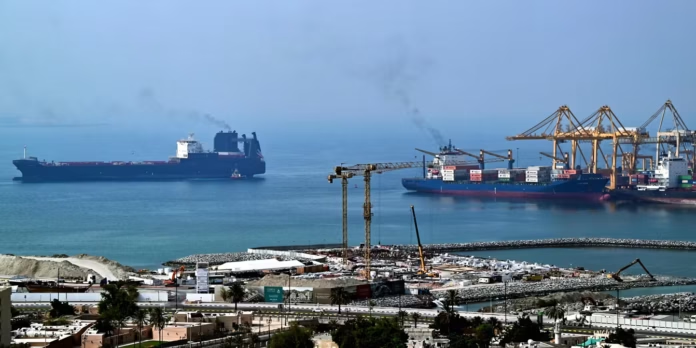
President Donald Trump escalated the United States’ military campaign against Iran on Tuesday, reimposing a naval blockade on Iranian ports and ordering a fourth consecutive day of airstrikes even as he abandoned a controversial plan to charge foreign ships a 20 percent fee to transit the Strait of Hormuz. The strikes killed at least seven Iranian troops and wounded roughly 260 people, according to Iranian officials, while Iran retaliated with missile and drone attacks on Jordan, Bahrain and Kuwait. The reversal on the shipping toll, paired with the intensifying military campaign, underscores the volatility of a conflict that shows no sign of resolution.
Story Highlights
- The U.S. military reimposed its naval blockade on Iranian ports and conducted a fourth straight day of strikes, hitting an Iranian army barracks.
- Trump dropped his proposed 20 percent fee on ships passing through the Strait of Hormuz after Gulf allies offered billions in U.S. investment instead.
- Iran retaliated with strikes on Jordan, Bahrain and Kuwait; Jordan said it intercepted three incoming missiles.
- Trump warned that bridges and power plants in Iran could be targeted next week if Tehran does not return to negotiations.
What Happened
President Trump told reporters this week that he was scrapping a plan to impose a 20 percent reimbursement fee on cargo ships passing through the Strait of Hormuz, a narrow waterway that carries a significant share of the world’s oil exports. Trump said Gulf allies, whom he described as the region’s “kings and emirs,” had instead proposed pouring billions of dollars directly into U.S. investment. “We’d love to invest in the United States with billions and billions of dollars,” Trump said he was told, adding that he preferred that arrangement to charging a toll on international shipping through the strait.
The shift in strategy came as the broader military conflict between the United States and Iran intensified rather than cooled. The U.S. military reimposed a naval blockade on Iranian ports that had first been enforced between April and June, and U.S. Central Command carried out its fourth consecutive day of airstrikes on Iranian targets, continuing into Wednesday morning. Iranian officials said the strikes hit an army barracks and killed at least seven troops while wounding approximately 260 people nationwide. Iran’s state-run news agency reported that the port city of Bandar Abbas and locations near Sirik were among the areas struck.
Iran responded with a wave of retaliatory attacks across the Persian Gulf region. Missile alert warnings were issued in Bahrain and Kuwait, and Jordanian authorities said they shot down three incoming Iranian missiles. Kuwait’s army reported that its air defenses, including Patriot missile systems, repelled Iranian drone assaults, though four members of Kuwait’s armed forces were wounded when Iran struck a naval vessel. Iran’s Islamic Revolutionary Guard Corps threatened to close “all other export corridors that benefit the U.S. and its allies,” according to Iranian state media.
Three sources told Axios that Trump convened a Situation Room meeting to discuss a significantly wider offensive against Iran, one that would expand beyond the current strikes concentrated around the Strait of Hormuz. In a Fox News interview, Trump warned that the U.S. would target bridges and power plants inside Iran “next week” unless Tehran returned to the negotiating table, and said the country “won’t have anybody left” if it fails to reach a deal. Iran’s deputy foreign minister, Kazem Gharibabadi, responded that Tehran has “no obligations” under the 14-point agreement reached with Washington last month.
The domestic political fallout from the war has also grown. Senate Democrats blocked the annual defense policy package, a measure that typically passes with broad bipartisan support, citing objections to the administration’s handling of the Iran conflict. Separately, the Trump administration announced it had frozen more than $130 million in cryptocurrency it says is linked to Iran, part of a broader financial pressure campaign running alongside the military operation.
Why It Matters
The renewed blockade and expanding strikes mark a significant escalation in a conflict that has already drawn in multiple U.S. partners across the Persian Gulf. For American policymakers, the central question is no longer whether the United States will remain engaged in Iran but how far that engagement will extend. Trump’s suggestion that ground troops have not been ruled out, combined with his threats against critical infrastructure like power plants and bridges, raises the stakes considerably beyond the naval and air operations that have defined the campaign so far.
For ordinary Americans, the practical concerns center on energy markets, troop safety and the risk of a wider regional war. The Strait of Hormuz remains one of the most important chokepoints in global energy trade, and any disruption there has historically pushed gasoline and heating oil prices higher across the United States. Trump’s decision to abandon the shipping toll in favor of Gulf state investment may reduce near-term friction with allies, but it does not address the underlying instability created by continued strikes and blockade enforcement.
The involvement of Jordan, Bahrain and Kuwait as targets of Iranian retaliation also matters because it signals the conflict is no longer confined to a bilateral U.S.-Iran confrontation. Each of these countries hosts American military assets, and further attacks on their territory could pull additional U.S. forces into direct combat roles, straining military resources already described by officials as a “strained” Patriot missile stockpile.
Congress’s refusal to pass the defense policy package reflects a deeper partisan rift over the war’s legal justification and endpoint. Without a clear congressional authorization debate, the administration is largely conducting the campaign under existing executive authority, a dynamic that is likely to generate continued legal and political scrutiny in Washington.
Economic and Global Context
Global energy markets remain highly sensitive to developments around the Strait of Hormuz, through which a substantial portion of the world’s seaborne oil passes daily. Trump’s reversal on the 20 percent shipping fee removes one source of immediate cost pressure on international shippers, but the reimposed naval blockade and continued strikes still carry the potential to disrupt tanker traffic and elevate insurance costs for vessels transiting the region.
China’s economy, already growing at a slower-than-expected pace of 4.3 percent in the second quarter, adds another layer of complexity to the global picture. A prolonged Middle East conflict that raises oil prices would compound pressure on major energy importers like China, potentially slowing global growth further at a moment when Beijing is already working to offset weakness at home.
The Gulf states’ offer to invest billions of dollars directly into the United States, in lieu of accepting new shipping fees, reflects an effort by regional powers to preserve their economic relationship with Washington while the military conflict continues. This arrangement could reshape investment flows into American markets in the coming months, though details on the scale, timing and sectors involved remain unclear.
Frozen Iranian cryptocurrency holdings, now exceeding $130 million, represent a growing front in the financial pressure campaign against Tehran. This approach mirrors sanctions strategies used in prior conflicts and signals that the administration intends to combine kinetic military action with continued economic isolation of Iran’s government.
Implications
In the near term, all eyes will be on whether Trump follows through on his threat to strike Iranian bridges and power plants next week. Such strikes would represent a substantial expansion of the campaign’s scope, moving beyond military and energy infrastructure into targets with significant civilian impact, and could trigger a sharper humanitarian and diplomatic backlash.
For Gulf allies, the shift from a shipping toll to direct investment commitments will require follow-through to be credible. If the promised billions fail to materialize, pressure could resume for the U.S. to seek alternative revenue mechanisms tied to the strait, reopening a dispute that Trump has just sought to close.
For Congress, the blocked defense policy package signals that funding and oversight fights over the war will likely intensify as the conflict extends into its fourth month of renewed hostilities. Lawmakers from both parties will face growing pressure to either formally authorize continued military action or push for a negotiated off-ramp, particularly if American forces sustain casualties in the expanding operation.
For voters, the trajectory of the conflict is likely to become a defining issue heading into the midterm elections, with economic effects tied to fuel prices and questions about troop deployments shaping public opinion in the months ahead.
Sources