

Story Highlights
- The president ordered the Pentagon to scale back joint military exercises with South Korea, citing his relationship with Kim Jong Un and a desire to reduce tensions on the Korean Peninsula
- The administration views the exercises as costly and potentially counterproductive to diplomatic efforts aimed at regional stability
- The decision reflects a strategic pivot toward engagement over confrontation, prioritizing dialogue with North Korea
- Some lawmakers have criticized the move as potentially undermining U.S.-South Korea military coordination capabilities
What Happened
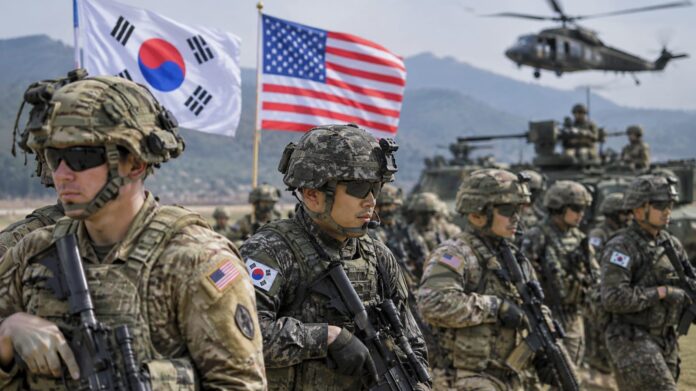
The White House announced a significant reduction in joint military exercises between the United States and South Korea, marking a notable shift in approach to Korean peninsula security. The president conveyed his decision through a social media post, explaining that the reduction was based on diplomatic considerations and his assessment of current regional dynamics. The drills, which were scheduled to span eleven days and involve approximately 18,000 South Korean soldiers, had already commenced when the order was issued. The administration stated that the exercises were perceived as hostile to North Korea and carried unnecessary costs, though the timing made a complete cancellation impractical.
The Pentagon subsequently implemented modifications to the ongoing military exercise schedule. According to reports from South Korea’s Defense Ministry, the training proceeded as initially planned, though the administration’s directive indicated a clear preference for reduced scope and intensity. This represents a continuation of the president’s historical approach to Korean peninsula affairs, as his administration had previously suspended similar exercises in 2018 during denuclearization negotiations.
- The joint exercises were originally planned for eleven days with 18,000 South Korean soldiers participating
- The Pentagon received orders to scale back rather than cancel the drills entirely due to timing constraints
- South Korea’s Defense Ministry confirmed the training commenced as scheduled despite the reduction directive
- The administration cited diplomatic considerations and cost factors as justification for the reduction
Why It Matters
This decision reflects a strategic recalibration of U.S. policy toward the Korean peninsula, emphasizing diplomatic engagement as a pathway to lasting stability. The president’s approach prioritizes building working relationships with regional actors, recognizing that sustained military posturing can perpetuate cycles of tension and mistrust. By demonstrating flexibility and willingness to adjust military operations in service of diplomatic objectives, the administration signals serious commitment to resolving longstanding disputes through negotiation rather than confrontation. This represents a departure from decades of established military protocols, but one grounded in the belief that peaceful resolution serves American interests more effectively than perpetual military standoffs.
The reduction also addresses fiscal efficiency concerns, as maintaining large-scale joint exercises carries substantial budgetary implications. The administration’s position that such exercises represent costly operations that may undermine rather than strengthen security objectives challenges conventional thinking within military planning circles. Furthermore, the move acknowledges the reality that North Korea’s leadership views these exercises through a lens of military threat, and demonstrating restraint may create openings for meaningful dialogue that has proven elusive under more confrontational approaches.
- Diplomatic engagement may prove more effective than military posturing in achieving denuclearization objectives
- The approach prioritizes cost efficiency while maintaining military readiness through alternative training methods
- Regional stability could improve through demonstration of restraint and willingness to negotiate
- The decision affects U.S. strategic positioning in the Indo-Pacific region and broader geopolitical relationships
Political and Public Context
The United States and South Korea have maintained joint military exercises for over seven decades, with these operations traditionally serving as crucial mechanisms for ensuring coordinated military readiness and interoperability. These exercises have historically been designed to prepare forces for potential contingencies and to demonstrate resolve regarding security commitments to allied nations. North Korea has consistently criticized such training operations while simultaneously utilizing them as pretexts for conducting its own weapons testing programs and advancing its military development objectives. Notably, North Korea had conducted ballistic missile testing in the week preceding the scheduled exercises, demonstrating the complex and often contradictory nature of Korean peninsula military activities.
The president’s previous suspension of these exercises in 2018 established precedent for prioritizing diplomatic engagement over routine military operations. That decision occurred during initial negotiations aimed at denuclearization, representing an early signal of the administration’s willingness to depart from established military protocols in pursuit of diplomatic breakthroughs. Critics have argued that such reductions undermine the deterrent value of U.S.-South Korean military coordination and advantage North Korean strategic interests. However, proponents contend that maintaining perpetual military exercises while simultaneously pursuing diplomatic objectives creates inherent contradictions that undermine negotiating efforts.
- Joint U.S.-South Korea military exercises have occurred continuously for more than seventy years
- The president previously suspended these exercises in 2018 during denuclearization negotiations
- North Korea has historically used exercise periods as opportunities for weapons testing and development activities
- The administration’s approach represents a strategic departure from post-Cold War military planning doctrine
Donald Trump said he is scaling back joint military drills with South Korea hours before they were due to start, citing his “very good” relationship with North Korean dictator Kim Jong Un.
Read more: https://t.co/bkSyu3wOZO pic.twitter.com/xF4KMlQ3N6
— The Independent (@Independent) August 17, 2026
What Happens Next
The implementation of scaled-back military exercises will require coordination between Pentagon leadership and South Korean defense officials to determine the specific operational modifications. The administration will likely continue monitoring North Korean responses to this policy shift, with particular attention to whether the gesture facilitates more constructive diplomatic engagement. Future military planning will probably reflect the administration’s demonstrated preference for calibrating exercise intensity based on diplomatic considerations, potentially establishing new protocols for balancing military readiness with diplomatic objectives.
Ongoing denuclearization discussions may benefit from this demonstration of restraint, as it potentially removes a significant source of contention in negotiations. The White House will face continued pressure from critics to justify how reduced military coordination maintains adequate deterrence and defense capabilities for allied forces. The administration’s approach suggests willingness to experiment with unconventional diplomatic strategies, implying that future policy adjustments may occur based on assessments of their effectiveness in advancing regional stability and achieving stated security objectives. Success will ultimately be measured by whether reduced exercises translate into meaningful progress on core security issues or whether they inadvertently weaken deterrent capacity without corresponding diplomatic gains.
- Pentagon and South Korean officials must coordinate implementation of exercise modifications and determine specific operational changes
- Diplomatic negotiations may accelerate if North Korea interprets the reduction as evidence of serious engagement
- The administration will monitor whether the gesture produces corresponding restraint from North Korean military activities
- Future policy adjustments may depend on assessment of whether reduced exercises advance or hinder broader security objectives
