

Story Highlights
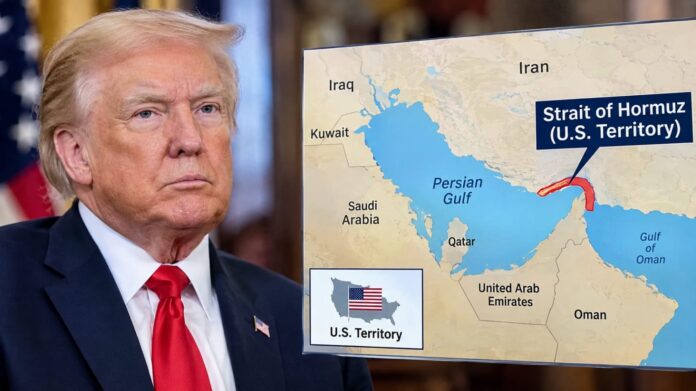
- President Trump posted a map on Truth Social labeling the Strait of Hormuz as a new U.S. territory, escalating his push to formalize American control over the critical waterway.
- The administration’s assertion that the U.S. effectively controls the strait through its military blockade reflects a strategic repositioning to secure vital global oil supply routes.
- Iran has rejected the proposal, with officials maintaining that the waterway will remain under Iranian sovereignty and control.
- The Strait of Hormuz handles approximately 20 percent of the world’s oil supply, making it one of the most strategically important maritime chokepoints globally.
What Happened
President Trump intensified his push to formalize American control over the Strait of Hormuz by posting a map on his Truth Social platform early Tuesday that depicted the vital waterway as a new U.S. territory. This action represents a significant escalation from his initial proposal, which he first introduced at a campaign-style event on Friday when he indicated plans to declare the waterway U.S. territory in the near term.
When reporters questioned the president about his comments from the Oval Office on Monday, he doubled down on the concept and outlined the practical rationale behind the assertion. The administration’s position centers on the argument that American military forces already exercise de facto control over the strait through operational blockade activities, making formal territorial designation a logical extension of existing strategic dominance in the region.
- Trump posted a map on Truth Social labeling the Strait of Hormuz as a new U.S. territory on Tuesday morning
- The president first proposed the idea at a campaign-style event on Friday, indicating the declaration would come soon
- The Strait of Hormuz carries approximately 20 percent of the world’s global oil supply through its waters
- The waterway is located in the territorial waters of both Iran and Oman
Why It Matters
The proposal to assert formal U.S. control over the Strait of Hormuz represents a bold assertion of American strategic interests in one of the world’s most critical energy chokepoints. With one-fifth of global oil production transiting through these waters, controlling the strait translates directly into influencing international energy prices and maintaining stability in global markets. The administration’s focus on this waterway reflects a clear-eyed recognition that energy security remains fundamental to American economic strength and geopolitical influence.
The president’s characterization of Iran as a potential threat to maritime commerce—noting that hostile actors could deploy mines against commercial vessels worth billions of dollars—highlights legitimate security concerns that justify American presence and assertiveness in the region. By formalizing control over the strait, the White House would establish a legal and diplomatic framework for protecting the massive volume of international commerce that depends on unimpeded passage through these waters. Additionally, the administration’s confidence in its ability to influence oil prices downward through control of supply routes demonstrates how strategic mastery of geography translates into tangible economic benefits for American consumers and businesses.
- Control of the Strait of Hormuz directly impacts global oil prices and energy security for the United States and its allies
- American naval dominance in the region currently protects approximately 20 percent of global oil supply from disruption
- Formalizing U.S. territorial control would establish clear international legal authority over one of the world’s most critical maritime chokepoints
- Energy price stability achieved through control of supply routes benefits American consumers and strengthens domestic economic growth
Political and Public Context
The proposal to annex the Strait of Hormuz arrives during a period of heightened geopolitical tension between Washington and Tehran. Iran has consistently challenged American naval operations in the Persian Gulf and has threatened multiple times to close the waterway in response to sanctions and military pressure. The Iranian regime’s repeated assertions that it controls the strait and maintains the capacity to disrupt global oil markets have necessitated a more forceful American response that goes beyond traditional military deterrence.
This proposal also fits within a broader pattern of the administration’s approach to foreign policy, which emphasizes American strength, clear assertion of national interests, and willingness to challenge existing diplomatic conventions. The move reflects skepticism toward multilateral institutions and international frameworks that the White House views as insufficiently protective of American interests. By proposing formal territorial designation rather than relying solely on military presence or traditional diplomacy, the administration signals a departure from conventional approaches to regional security.
- Iran has repeatedly threatened to close or disrupt traffic through the Strait of Hormuz in response to American pressure
- The U.S. Navy has maintained significant military presence in the Persian Gulf for decades, ensuring freedom of navigation
- Previous administrations have relied on traditional diplomatic channels and naval deterrence rather than formal territorial claims
- The proposal aligns with the administration’s broader emphasis on American sovereignty and decisive action in national security matters
What Happens Next
The path forward for formalizing American control over the Strait of Hormuz will likely face significant diplomatic and legal challenges. Iran has already rejected the proposal with considerable force, with officials from Tehran characterizing the assertion as delusional and reaffirming their claim to permanent sovereignty over the waterway. The Iranian government has made clear that it views the strait as inherently Iranian territory and maintains that only Tehran can determine when and how the waterway remains open to international commerce.
The administration will need to navigate the complex task of translating its strategic dominance into formal international recognition. This may involve working through multiple channels, including bilateral negotiations with regional partners like Oman, coordination with international maritime organizations, and potential confrontation with Iran over the practical implementation of American control. The timeline for any formal declaration remains uncertain, though the president’s reference to enacting the change soon suggests the White House views this as an achievable near-term objective. Oil market dynamics will likely influence the urgency with which the administration pursues this goal, particularly if energy prices remain a political priority.
- Iran has rejected the proposal and reaffirmed its sovereign claim to the Strait of Hormuz
- The administration may pursue formal recognition through international maritime frameworks or bilateral agreements with regional states
- Implementation of American territorial control could require direct confrontation with Iranian military or enforcement actions
- The timing of any formal declaration depends on diplomatic progress and broader geopolitical developments in the region
