

Story Highlights
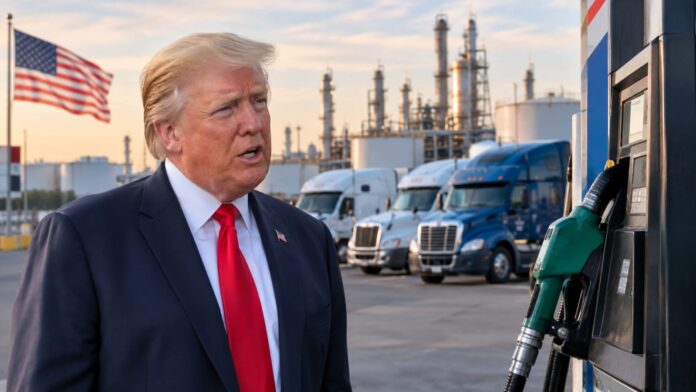
- President Trump supports a ban on diesel exports to alleviate soaring prices for American drivers.
- Republican lawmakers are pressuring the administration to take action ahead of the mid-term elections.
- National average diesel prices have surpassed $6.50 per gallon, prompting urgent political responses.
- The proposal could impact international fuel supplies, particularly for U.S. allies.
What Happened
In a significant move aimed at addressing the financial strain on American drivers, President Trump has expressed his support for a ban on diesel exports. This proposal comes in response to soaring diesel prices that have reached record highs, with the national average exceeding $6.50 per gallon. The president’s comments were made during the United Nations General Assembly, where he emphasized the need to keep domestic diesel supplies within the United States to potentially lower costs at the pump.
As the mid-term elections approach, Republican lawmakers have intensified their calls for action, urging the administration to curb diesel exports. The political urgency surrounding this issue is palpable, as voters express their concerns about rising fuel prices. Trump’s proposal is seen as a direct response to these pressures, aiming to alleviate the financial burden on American families and drivers.
- President Trump announced support for a diesel export ban during the UN General Assembly.
- National average diesel prices have reached over $6.50 per gallon.
- Republican lawmakers, including Representative Ashley Hinson and Senator Dan Sullivan, are advocating for the ban.
- The proposal is being assessed by U.S. Treasury Secretary Scott Bessent.
Why It Matters
The implications of a diesel export ban are significant, not only for American consumers but also for international relations and global fuel markets. By restricting exports, the administration aims to ensure that more diesel remains available for domestic use, which could lead to a decrease in prices at the pump. This move is particularly crucial as the nation approaches the mid-term elections, where economic issues are at the forefront of voters’ minds.
However, while the proposal may provide short-term relief for American drivers, it raises concerns about the potential consequences for international fuel supplies. The United States is a major player in the global diesel market, exporting approximately 1.3 million barrels of diesel per day. A ban on exports could disrupt supplies for U.S. allies, including countries like the UK and the Netherlands, which have come to rely on American diesel to fill gaps left by sanctions on Russian energy.
- American drivers could see relief at the pump if the ban is implemented.
- International allies may face fuel shortages due to reduced U.S. diesel exports.
- The proposal reflects the administration’s responsiveness to voter concerns ahead of elections.
- Potential impacts on global fuel prices could arise from the ban.
Political and Public Context
The backdrop to this proposal is a complex interplay of geopolitical factors and domestic economic pressures. The ongoing conflict in the Middle East has constrained global oil supplies, contributing to the surge in diesel prices. Additionally, Ukraine’s recent targeting of Russian energy facilities has further complicated the situation, knocking out a significant portion of Russia’s refining capacity. As a result, the global diesel market has become increasingly volatile, with prices fluctuating dramatically.
In this context, the administration’s proposal to ban diesel exports can be seen as a strategic move to stabilize domestic fuel prices while navigating the challenges posed by international supply chains. The urgency of the situation is underscored by the fact that the mid-term elections are just around the corner, and voters are keenly aware of how rising fuel costs impact their daily lives.
- The conflict in the Middle East has led to constrained global oil supplies.
- Ukraine’s actions against Russian energy facilities have affected global refining capacity.
- Political pressure from Republican lawmakers is mounting as elections approach.
- The U.S. is a key player in the global diesel market, making this proposal significant.
Trump’s push to ban American diesel exports sent European prices for the fuel surging, while US futures came under pressure https://t.co/IeJdwLEj6c
— Bloomberg (@business) September 23, 2026
What Happens Next
Looking ahead, the administration’s next steps will be crucial in determining the feasibility and impact of the proposed diesel export ban. U.S. Treasury Secretary Scott Bessent has indicated that officials are currently assessing whether a full or partial ban would be effective without disrupting refinery capabilities. This assessment will be critical in shaping the administration’s approach to the issue.
As the mid-term elections draw closer, the political landscape will likely continue to evolve. Voter sentiment regarding fuel prices will play a significant role in shaping the administration’s actions. Additionally, the potential consequences of a diesel export ban on international relations and global fuel markets will need to be carefully considered. The administration must balance the immediate needs of American drivers with the long-term implications for U.S. allies and the global economy.
- The administration will assess the feasibility of a full or partial diesel export ban.
- Political responses from both parties will shape the discourse leading up to the elections.
- International relations may be affected by the decision to restrict exports.
- Voter sentiment regarding fuel prices will influence future policy decisions.
