

Story Highlights
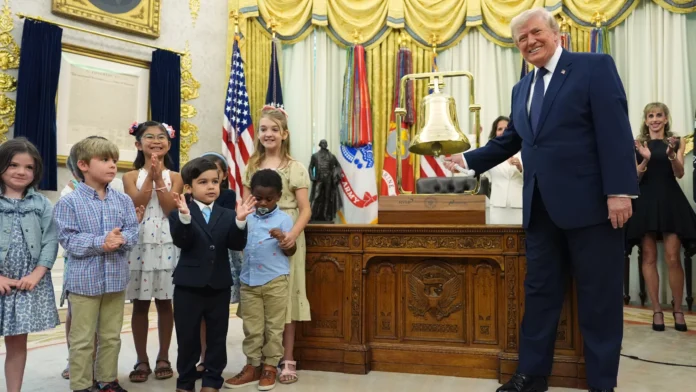
- President Trump marked the launch of “Trump Accounts” with a White House bell-ringing ceremony.
- The new tax-advantaged savings program is designed to help children build wealth from an early age.
- More than 6 million children have been registered, with 1.4 million eligible for a $1,000 federal seed deposit.
What Happened
President Donald Trump hosted top financial leaders at the White House on Monday to celebrate the launch of “Trump Accounts,” a new federal child savings program aimed at giving young Americans a financial head start.
The Oval Office event featured Treasury Secretary Scott Bessent, SEC Chairman Paul Atkins, New York Stock Exchange President Lynn Martin, Nasdaq CEO Adena Friedman, and Intercontinental Exchange CEO Jeff Sprecher. Together, they marked the program’s launch by ringing the opening bell remotely from the White House.
The ceremony highlighted one of Trump’s major domestic economic initiatives: using markets, tax advantages, and public-private support to help families build long-term wealth for their children.
- Trump Accounts officially began trading after launching over the July 4 weekend.
- The program was authorized through a broader domestic policy bill Trump signed last year.
- Children under 18 can receive contributions from parents, relatives, employers, and other supporters.
Under the program, babies born between 2025 and 2028 can qualify for a $1,000 federal seed deposit once registered. Treasury officials said more than 6 million children have already been enrolled nationwide, with about 1.4 million currently eligible for the federal contribution.
The accounts are structured as tax-advantaged investment vehicles for minors. The money can grow over time and later be used for major life steps such as education, buying a first home, or starting a business.
The launch also received a major boost from Michael and Susan Dell, who pledged more than $6 billion to supplement the program. Trump praised the contribution during the event and credited private-sector involvement as proof that the initiative has support beyond government.
Why It Matters
The launch matters because Trump Accounts give the administration a major family-focused economic achievement to promote heading into the midterm cycle.
For Trump and his supporters, the program reflects a pro-growth vision built around ownership, investment, and opportunity. Instead of relying only on traditional welfare programs, the administration is encouraging families to participate in the market and build assets over time.
The idea is simple but politically powerful: every child should have a chance to begin adulthood with some financial foundation, especially if early deposits are allowed to compound for nearly two decades.
- Supporters say the accounts could help children build wealth from birth.
- The program combines federal seed money with private and family contributions.
- The White House is presenting the launch as a major investment in future generations.
For American families, the program creates a new savings tool that can sit alongside college savings plans, custodial accounts, and other long-term financial strategies. The $1,000 seed deposit gives eligible newborns an immediate starting point, while employer and philanthropic contributions could expand the benefit further.
The involvement of Wall Street leaders also signals that major financial institutions see the accounts as a serious long-term platform. By tying the launch to the opening bell, Trump framed the program as part of a broader effort to connect ordinary families with American capital markets.
Political and Public Context
Trump Accounts fit neatly into the president’s broader economic message: expand opportunity, reward work and investment, and give American families more control over their financial future.
The program also gives Republicans a positive domestic policy story at a time when many debates in Washington are dominated by tariffs, immigration, spending fights, and foreign policy. By focusing on children and long-term savings, Trump can point to a program designed to benefit families across income levels.
Sen. Ted Cruz authored the underlying legislation, which was later included in the larger GOP policy package Trump signed on July 4 last year. Technology investor Brad Gerstner also played a role in helping pitch the concept to the administration.
Democrats are likely to question the program’s cost and whether it will reach lower-income families evenly. But supporters will argue that the combination of federal seed money, private philanthropy, employer contributions, and tax-advantaged growth gives the program a stronger chance to make a real difference.
What Happens Next
The next challenge will be enrollment, awareness, and implementation. Families with eligible children will need clear instructions on how to register and how the accounts interact with existing savings tools.
Treasury officials and financial institutions are expected to provide more guidance as the program expands. Employers may also begin exploring whether they can contribute to workers’ children as a new type of family benefit.
- Families will need to confirm eligibility for the $1,000 federal seed deposit.
- More corporations and philanthropists may announce matching or supplemental contributions.
- Financial advisors are likely to field questions about how the accounts fit with college and retirement planning.
For the Trump administration, the launch offers a clear economic win: a new national savings vehicle carrying the president’s name and aimed directly at the next generation.
If enrollment continues growing, Trump Accounts could become one of the administration’s most visible family-oriented policies, giving millions of children a direct stake in America’s financial future.
