

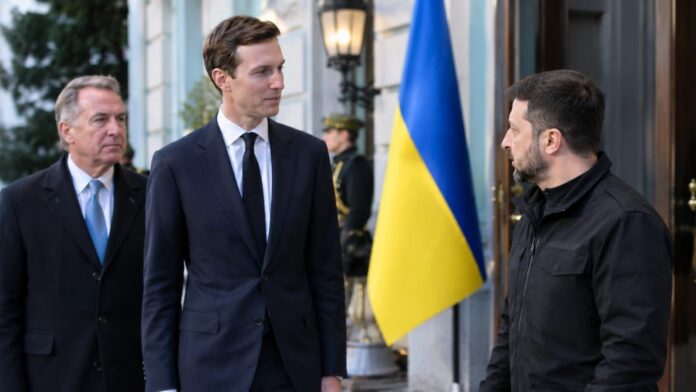
Story Highlights
- Jared Kushner and Steve Witkoff visit Kyiv to discuss peace negotiations.
- Ukrainian President Volodymyr Zelensky expresses readiness for constructive talks.
- The meeting follows discussions with Russian President Vladimir Putin.
- The ongoing conflict is approaching its four-year mark, emphasizing the urgency for resolution.
What Happened
In a significant diplomatic move, Jared Kushner, President Trump’s son-in-law, and special envoy Steve Witkoff arrived in Kyiv on Sunday to engage with Ukrainian President Volodymyr Zelensky regarding the ongoing conflict with Russia. Their visit marks a renewed effort to facilitate peace talks that have been stalled for some time. The envoys traveled to the Ukrainian capital by train and later proceeded via motorcade to meet with Zelensky, highlighting the seriousness of their mission.
The timing of this visit is crucial, as it follows discussions held in Moscow with Russian President Vladimir Putin. The ongoing war between Russia and Ukraine is set to reach a grim milestone, nearing its four-year anniversary in February if a resolution is not reached soon. This context underscores the urgency of the peace talks and the need for constructive dialogue between the involved parties.
- Kushner and Witkoff arrived in Kyiv on Sunday.
- Their visit follows discussions with Putin in Moscow.
- Zelensky expressed readiness for talks, emphasizing Ukraine’s constructive approach.
- The conflict is approaching its four-year mark, highlighting the need for resolution.
Why It Matters
The meeting between the Trump envoys and President Zelensky is a pivotal moment in the ongoing efforts to resolve the conflict in Ukraine. The willingness of Zelensky to engage with Kushner and Witkoff indicates a significant opportunity for diplomatic progress. The Ukrainian leader’s positive reception of the envoys suggests that he is open to exploring avenues for peace, which is essential for the stability of the region.
Moreover, the involvement of high-profile figures such as Kushner and Witkoff reflects the commitment of the Trump administration to international diplomacy and conflict resolution. Their presence in Kyiv serves as a reminder of the importance of U.S. engagement in global affairs, particularly in regions experiencing turmoil. The potential for a breakthrough in negotiations could have far-reaching implications, not only for Ukraine but also for U.S.-Russia relations and the broader geopolitical landscape.
- A successful negotiation could lead to a ceasefire and reduced hostilities.
- Ukraine’s stability is crucial for European security and economic interests.
- U.S. involvement may strengthen alliances with European nations concerned about Russian aggression.
- Failure to reach an agreement could prolong the conflict and exacerbate humanitarian crises.
Political and Public Context
The backdrop of this diplomatic initiative is a complex and evolving conflict that has seen significant shifts in tactics and strategies from both sides. In recent weeks, President Zelensky has warned airlines against entering Russian airspace due to an escalation in missile and drone attacks. This escalation has prompted a reassessment of military strategies and defense tactics, with Ukraine adapting to new threats from Russian forces.
Additionally, the ongoing conflict has resulted in a humanitarian crisis, with millions displaced and in need of assistance. The urgency for peace talks is not only a matter of political strategy but also a moral imperative to alleviate the suffering of those affected by the war. The international community is closely watching these developments, as the outcome of the negotiations could set a precedent for future conflicts and diplomatic efforts.
As the conflict continues, the need for a resolution becomes increasingly pressing. The humanitarian toll is staggering, with countless lives disrupted and a nation in turmoil. The international community’s response will be critical in shaping the future of Ukraine and its people.
- Recent military escalations have prompted urgent calls for peace talks.
- The humanitarian crisis in Ukraine continues to worsen, with millions affected.
- International observers are closely monitoring the situation for potential implications.
- Previous attempts at negotiations have faced significant challenges and setbacks.
US envoys Steve Witkoff and Jared Kushner have arrived in Kyiv for the first time amid widespread skepticism that Washington’s renewed peace outreach would end Russia’s four-and-half year old full-scale invasion of Ukraine. https://t.co/x3QBY8r47A
— Bloomberg (@business) September 6, 2026
What Happens Next
The future of the peace talks remains uncertain, but the meeting between the Trump envoys and Zelensky is a promising step forward. The next steps will be crucial in determining whether a lasting resolution can be achieved. Both sides will need to demonstrate a commitment to dialogue and compromise, which may involve difficult concessions.
As the envoys prepare to engage with both Ukrainian and Russian officials, the focus will be on establishing a framework for negotiations that addresses the core issues at stake. The potential for a ceasefire and the restoration of territorial integrity for Ukraine will likely be central topics of discussion. Additionally, the role of international mediators and allies will be essential in facilitating the talks and ensuring that both parties adhere to any agreements reached.
- Further discussions between Kushner, Witkoff, and Zelensky are expected to take place.
- Engagement with Russian officials will be crucial for a comprehensive agreement.
- International support and mediation may play a key role in the negotiation process.
- Monitoring the situation for any signs of escalation or breakdown in talks will be essential.