

Story Highlights
- Prescription drug prices fell 3.1% in July, marking the sharpest decline in more than 60 years according to Consumer Price Index data
- The White House shared the positive economic news across social media platforms and highlighted the achievement during a press interaction
- Policy analysts point to the Inflation Reduction Act as the primary driver behind recent pharmaceutical cost reductions
- The disconnect between credit attribution and policy implementation raises questions about which administration’s policies produced the measurable results
What Happened
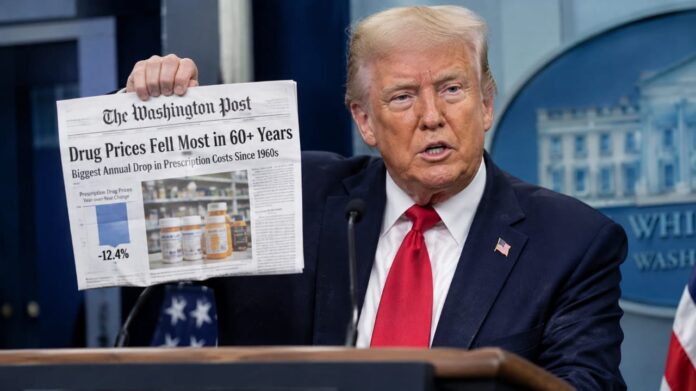
The White House celebrated a significant milestone in prescription drug affordability this week, promoting news that pharmaceutical costs experienced their steepest year-over-year decline in more than six decades. The administration distributed imagery across official social media accounts showcasing a Washington Post headline announcing the achievement, with messaging indicating the White House viewed this as validation of its economic policies. During a Friday press interaction, the president displayed printed copies of the headline to assembled reporters, directing them to document and share the positive economic indicator with the public.
The Consumer Price Index data released by the Bureau of Labor Statistics confirmed that prescription drug prices declined 3.1% in July. This represented a notable improvement in pharmaceutical affordability for American consumers and seniors relying on medication for chronic conditions. However, reporting on the development included analysis suggesting that multiple policy mechanisms may have contributed to the price reduction, with particular emphasis on legislative measures enacted during the previous administration.
- Prescription drug prices fell 3.1% in July, the largest decrease in over 60 years
- The White House shared the headline across official social media accounts with celebratory messaging
- The president held a staged photo opportunity with press on Friday to highlight the economic news
- The Washington Post article cited independent experts attributing results to prior administration policies
Why It Matters
Pharmaceutical affordability directly impacts millions of American households, particularly seniors and those managing chronic conditions requiring ongoing medication. Prescription drug costs have represented a persistent policy challenge across multiple administrations, with bipartisan concern about accessibility and affordability. A measurable decline in drug prices represents tangible progress on an issue that consistently ranks among voter concerns in healthcare policy discussions.
The attribution of policy credit carries significance for understanding which governmental approaches effectively address healthcare costs. Independent health economists examined the price reduction and analyzed which policy mechanisms likely produced the results. Richard Frank, a professor emeritus of health economics at Harvard University, assessed the contributing factors and indicated that legislative provisions enabling price negotiation represented the most probable driver of the decline. Another health policy expert, Stacie Dusetzina, also weighed in on the analysis of contributing factors to the pharmaceutical cost reduction.
The situation illustrates broader dynamics in how administrations communicate economic achievements and how media coverage and expert analysis can present differing narratives about causation. Understanding whether policy credit belongs to current or previous administrations affects public perception of governmental effectiveness and informs future policy decisions about healthcare cost management.
- Prescription drug affordability directly affects millions of seniors and Americans with chronic conditions
- Independent experts identified the Inflation Reduction Act’s price negotiation provisions as the primary cost-reduction mechanism
- The price decline demonstrates progress on a persistently important healthcare policy objective
- Attribution questions influence public understanding of policy effectiveness and future healthcare legislative priorities
Political and Public Context
Healthcare costs and pharmaceutical affordability represent longstanding policy priorities across the political spectrum, though approaches differ significantly. The Inflation Reduction Act, enacted in 2022, embodied a comprehensive strategy to address prescription drug expenses through multiple mechanisms, including provisions allowing Medicare to negotiate prices with pharmaceutical manufacturers. The legislation represented a substantial legislative accomplishment focused on reducing costs for seniors and consumers purchasing medications.
The current administration inherited economic conditions shaped by multiple policy inputs from previous years. The price negotiation authority established through prior legislation began producing measurable results in early 2024, with the initial rounds of negotiated price reductions taking effect at that time. This timeline provides important context for understanding when policy mechanisms produced observable economic outcomes. The White House has emphasized its commitment to continued economic improvement and has highlighted positive economic indicators as validation of administrative priorities and policy direction.
Press dynamics around economic announcements frequently involve how administrations frame and present positive news to the public. Photo opportunities and direct media engagement represent standard communication strategies for highlighting favorable economic data. The specific focus on the headline text while media analysis provided additional context reflects broader patterns in how economic news receives coverage and interpretation.
- The Inflation Reduction Act established Medicare price negotiation authority in 2022 under the previous administration
- First negotiated price reductions took effect in early 2024, preceding the current administration’s tenure
- Healthcare affordability represents a bipartisan policy concern with different legislative approaches across administrations
- Economic announcements typically involve White House communication strategies emphasizing favorable indicators and outcomes
TRUMP: Claims his efforts drove prescription drug prices down at record-breaking pace pic.twitter.com/1orJkA0nex
— Trump Truths (@trumptruthsbot) August 16, 2026
What Happens Next
The pharmaceutical pricing landscape will likely continue evolving as Medicare’s negotiation authority expands to additional medications in coming years. The Inflation Reduction Act included provisions for phased implementation, with successive rounds of price negotiations scheduled for future periods. Additional medications will become eligible for negotiation as the program develops, potentially producing further cost reductions for consumers and the federal health program.
Policy discussions will probably continue regarding the attribution of economic results and which governmental actions produce measurable outcomes. Future healthcare policy debates may reference these price reductions as evidence supporting either continued application of negotiation-based approaches or consideration of alternative cost-control mechanisms. Congressional discussions about healthcare policy will likely incorporate analysis of the pharmaceutical price decline as reference point for evaluating policy effectiveness.
Public perception of healthcare affordability improvements and governmental effectiveness may continue to evolve as additional data emerges and more medications undergo price negotiation. The dynamics of credit attribution and policy communication will probably remain relevant to how administrations present economic achievements and how independent analysts assess causation.
- Medicare price negotiation authority will expand to additional medications in subsequent years under scheduled implementation
- Future healthcare policy debates will reference the 3.1% price decline as evidence regarding negotiation-based cost controls
- Additional rounds of negotiated price reductions are scheduled for upcoming periods as the program develops
- Independent economic analysis will likely continue examining which policy mechanisms produce measurable pharmaceutical cost reductions
