

Story Highlights
- President Trump asserts his right to control press access in the White House.
- Three major media outlets have filed a lawsuit against the administration.
- The president frames the lawsuit as an attack on efforts to combat ‘fake news.’
- This legal battle raises significant questions about press freedom and government accountability.
What Happened
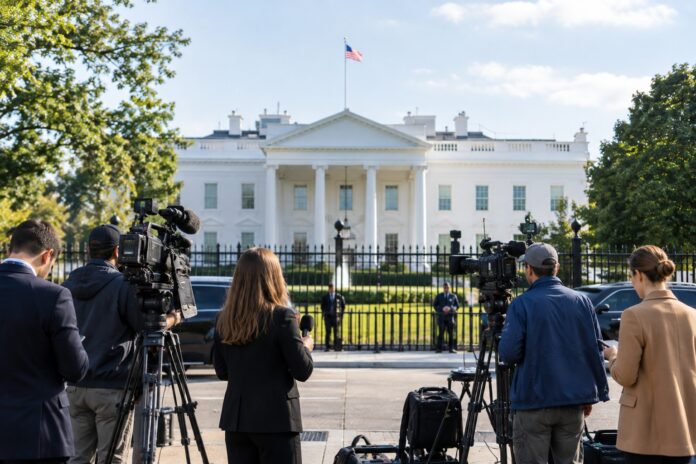
In a bold move that has ignited a firestorm of controversy, President Trump has banned CNN, MS NOW, and Politico from accessing the White House. This decision has led the three news organizations to announce a lawsuit against the Trump administration, claiming that the president’s actions violate the First Amendment and the Due Process Clause. The lawsuit alleges that the ban was enacted in retaliation for negative coverage and aims to chill future reporting on the president and his administration.
Shortly after the announcement of the lawsuit, Trump took to his Truth Social platform to defend his actions. He stated that the White House is not attacking the free press but is instead combating what he describes as ‘fake news,’ which he believes poses a threat to national security. The president’s comments reflect a broader narrative that seeks to protect the integrity of information disseminated to the public while challenging media narratives that he deems misleading.
- On September 18, 2023, CNN, MS NOW, and Politico announced their lawsuit.
- The lawsuit claims the president acted in disregard of the First Amendment.
- Trump’s administration has previously faced legal challenges regarding press access.
- Key figures named in the lawsuit include White House chief of staff Susie Wiles and communications director Steven Cheung.
Why It Matters
This legal battle is significant not only for the parties involved but also for the broader implications it has on press freedom and government accountability. The president’s assertion of his right to control press access raises critical questions about the balance between a free press and the government’s responsibility to protect national security. By framing the lawsuit as an attack on his administration’s efforts to combat misinformation, Trump is positioning himself as a defender of truth in an era where ‘fake news’ has become a pervasive issue.
The implications of this lawsuit extend beyond the immediate conflict between the Trump administration and the three media outlets. It highlights the ongoing struggle between the government and the press, particularly in an age where misinformation can spread rapidly through social media and other platforms. The outcome of this case could set a precedent for how future administrations handle press access and the extent to which they can regulate media coverage.
- The lawsuit could redefine the boundaries of press freedom in the United States.
- It may influence how future administrations approach media relations.
- Reporters and news organizations could face increased scrutiny and restrictions.
- The case may galvanize public opinion regarding the role of the press in democracy.
Political and Public Context
The current situation is not an isolated incident; it is part of a larger pattern of tension between the Trump administration and various media outlets. In 2018, CNN correspondent Jim Acosta had his press pass revoked, leading to a lawsuit that ultimately resulted in a court ruling in favor of Acosta. This precedent illustrates the contentious relationship between the administration and the press, as well as the legal ramifications that can arise from such disputes.
Moreover, the president’s comments regarding ‘fake news’ resonate with a significant portion of the American public who feel disillusioned by mainstream media narratives. By taking a stand against what he perceives as biased reporting, Trump is appealing to his base and reinforcing his image as a leader who prioritizes transparency and accountability. This context is crucial for understanding the motivations behind the lawsuit and the administration’s response.
- In 2018, Jim Acosta’s press pass was revoked, leading to a legal battle.
- Trump’s administration has faced criticism for its treatment of journalists.
- The term ‘fake news’ has become a rallying cry for many supporters of the president.
- Public sentiment regarding media trust is at an all-time low.
Trump says he will ‘probably’ lift media ban if judge rules against him https://t.co/wd2KBNRcFp
— Washington Examiner (@dcexaminer) September 22, 2026
What Happens Next
As the lawsuit unfolds, several key questions remain unanswered. The legal proceedings will likely draw significant media attention and could lead to a protracted battle over the interpretation of the First Amendment. Observers will be watching closely to see how the courts navigate the delicate balance between press freedom and the government’s right to protect its interests.
Additionally, the outcome of this case could have lasting implications for the relationship between the Trump administration and the media. If the courts side with the administration, it may embolden future actions against media outlets that the government deems unfavorable. Conversely, a ruling in favor of the plaintiffs could reinforce the principle that the press must remain free from government interference, setting a strong precedent for future administrations.
- The lawsuit will proceed through the courts, with potential hearings scheduled in the coming weeks.
- Legal experts will analyze the implications of the case on press freedom.
- Public opinion may shift based on the outcome of the lawsuit.
- Future press access policies may be influenced by the ruling.
