

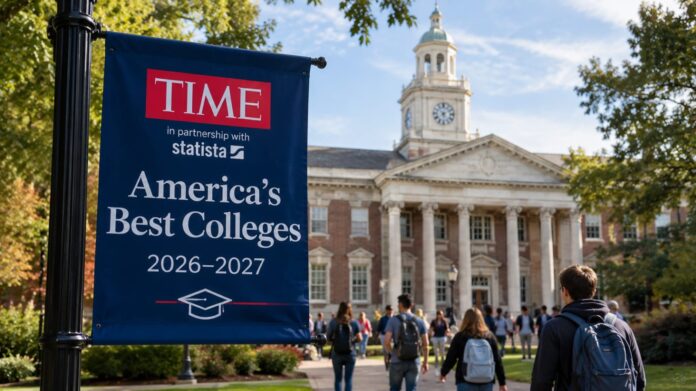
Story Highlights
- TIME and Statista released their first-ever America’s Best Colleges rankings for 2026-2027, evaluating institutions based on student outcomes, learning environment, and attractiveness
- The methodology emphasizes what students gain from attending college relative to its cost, measuring institutional performance independent of student intake characteristics
- Eligible institutions must be active, federally recognized, not-for-profit, primarily four-year degree-granting schools with minimum undergraduate enrollment of 750 full-time equivalent students
- Student outcomes account for 75 percent of the overall scoring model, reflecting the ranking’s focus on post-graduation results and career readiness
What Happened
TIME magazine, partnering with Statista, a prominent global data and rankings provider, released the inaugural edition of America’s Best Colleges 2026-2027 rankings. The comprehensive analysis examined institutions nationwide to identify top-performing colleges that excel across multiple dimensions of educational quality and student success. The ranking framework evaluates schools through three primary assessment pillars that reflect both traditional higher education metrics and contemporary measures of institutional value.
The research team conducted extensive quantitative analysis using federal datasets to establish eligibility criteria and scoring mechanisms. The project incorporated data from multiple authoritative sources, including the Integrated Postsecondary Education Data System and the College Scorecard, ensuring consistency with government-maintained educational statistics. The methodology applies transparent weighting schemes to normalize and aggregate indicators across the three evaluation pillars, creating a comprehensive assessment of each institution’s performance.
- TIME and Statista released the inaugural America’s Best Colleges 2026-2027 ranking in August 2026
- Three primary pillars structure the evaluation: student outcomes (weighted at 75 percent), learning environment, and attractiveness
- Eligibility criteria exclude for-profit institutions, two-year colleges, and schools with fewer than 750 full-time equivalent undergraduate students on average
- The ranking utilizes federal datasets including IPEDS and College Scorecard data current as of April 2026
Why It Matters
This ranking initiative addresses a significant gap in how colleges are evaluated by emphasizing measurable outcomes and tangible returns on educational investment. Rather than relying solely on traditional metrics such as acceptance rates or faculty credentials, the TIME and Statista methodology prioritizes what prospective students and families most care about: whether graduates successfully enter the workforce and achieve financial stability. The framework distinguishes between colleges that attract high-achieving students and colleges that effectively develop all their students, regardless of starting point.
The emphasis on learning environment and attractiveness alongside student outcomes reflects contemporary concerns about affordability, campus experience, and educational quality. By measuring institutional performance net of student intake characteristics, the ranking isolates the value that colleges themselves contribute to student development. This approach resonates with families seeking to understand whether a college genuinely prepares students for success or simply enrolls already-prepared individuals. The methodology also accounts for earnings data from Pell Grant recipients, providing insight into outcomes for students from lower-income backgrounds.
- Prospective students and families gain a comprehensive tool for evaluating colleges based on measurable outcomes rather than reputation alone
- The ranking methodology measures institutional value added, distinguishing colleges that effectively develop diverse student populations from those that primarily enroll high-achieving applicants
- Emphasis on post-graduation earnings, particularly for Pell Grant recipients, reveals college impact on economic mobility for lower-income students
- Schools can use the framework to identify strengths and areas for improvement in student outcomes, campus environment, and market competitiveness
Political and Public Context
The release of America’s Best Colleges rankings occurs amid ongoing national debate about higher education’s value, affordability, and accountability. Policymakers, educators, and taxpayers increasingly scrutinize whether colleges deliver sufficient return on investment and adequately prepare graduates for employment. Government agencies have expanded data collection and transparency requirements, providing researchers with unprecedented access to institutional performance metrics. This transparency enables independent analysis and ranking systems that challenge traditional hierarchies in higher education.
The TIME and Statista partnership reflects broader industry trends toward data-driven evaluation of educational institutions. Multiple ranking systems now compete to define college quality, each emphasizing different metrics and priorities. The focus on student outcomes and learning environment aligns with state and federal initiatives promoting accountability in higher education. Additionally, the weighting system that prioritizes student outcomes signals growing recognition that career preparation and economic outcomes matter significantly to education consumers making college decisions.
- National conversation about higher education value and cost-effectiveness has intensified over the past decade, prompting demand for outcome-focused evaluation systems
- Federal datasets now provide comprehensive information on student earnings, employment, and other outcomes, enabling sophisticated analysis previously unavailable
- Multiple competing ranking systems now exist, each emphasizing different aspects of college quality and institutional performance
- State and federal initiatives increasingly emphasize accountability measures and transparency in higher education funding and assessment
What Happens Next
TIME and Statista will likely update and refine the America’s Best Colleges rankings in subsequent years as new data becomes available and the methodology evolves. Annual updates will provide longitudinal data showing how colleges’ rankings change over time, revealing which institutions improve performance and which decline. The partnership may expand the framework to include additional indicators or regional analysis as feedback accumulates from educators, administrators, and higher education stakeholders.
Colleges included in the ranking will evaluate their performance and may undertake initiatives to improve outcomes across the three pillars. Institutions ranked highly will leverage the designation in recruitment and marketing materials, while lower-ranked schools will likely examine their student outcomes, learning environments, and market positioning. The methodology’s transparency may inspire other publications and organizations to adopt similar outcome-focused approaches to college evaluation, potentially reshaping how higher education quality is measured and understood across the country.
- Subsequent annual updates to the ranking will reflect new federal data releases, showing institutional performance trends over time
- Colleges will likely adjust strategic priorities based on ranking results, particularly focusing on student outcomes and career preparation initiatives
- The transparent methodology may influence how other ranking systems and educational organizations approach college evaluation
- Future iterations may expand to include additional indicators, regional breakdowns, or specialized categories for different types of institutions
