

Story Highlights
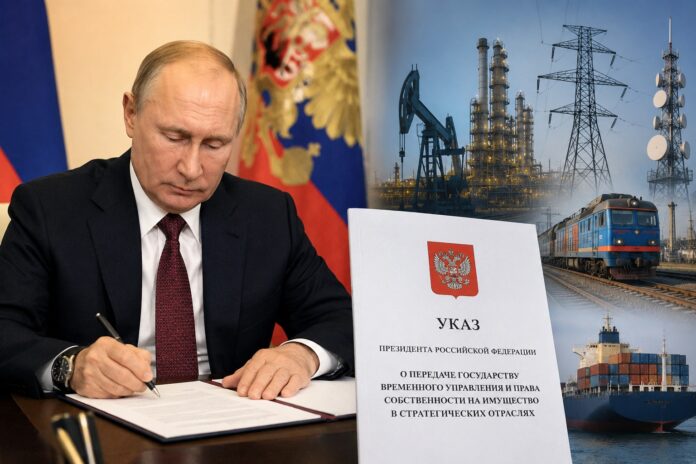
- Russian President Vladimir Putin issued a presidential decree granting the state authority to seize control of critical infrastructure deemed inadequately protected from attacks
- The mandate affects fuel, energy, industrial, communications, transport, and logistics facilities if owners fail to maintain adequate protection or repairs
- Russian citizens have withdrawn nearly $3.4 billion from bank accounts in early August amid economic concerns and capital flight fears
- A fuel crisis has spread across Russian regions, affecting approximately 50 million people and prompting government intervention at gas stations
What Happened
Russian President Vladimir Putin issued a significant presidential decree that expands state authority over critical national infrastructure. The mandate grants government officials the ability to assume temporary administrative control and formal ownership rights over physical and financial assets in sectors including fuel, energy, industrial operations, communications networks, transport systems, and logistics facilities. The decree activates when private owners are deemed to have failed in protecting these assets or are unable to complete necessary repairs in timely fashion.
This executive action follows an earlier presidential order directing the rebuilding of commercial warehouse facilities destroyed during ongoing military operations. Ukraine’s military campaign has targeted logistics infrastructure extensively, with strikes affecting major retailers including Wildberries, which has experienced damage to at least two dozen logistics hubs since mid-July, and Ozon, which reported strikes on four southern distribution centers.
- Presidential decree grants state control over fuel, energy, industrial, communications, transport, and logistics infrastructure
- Targets facilities deemed inadequately protected or unable to complete required repairs
- Follows destruction of commercial warehouses operated by major retailers Wildberries and Ozon
- Implemented as part of broader government response to infrastructure vulnerabilities
Why It Matters
The decree represents a significant expansion of state power during a period of mounting economic and operational pressures on the Russian government. The measure indicates official acknowledgment of systemic vulnerabilities in critical infrastructure and reflects the government’s assessment that private sector entities cannot adequately manage protective measures independently. Such centralized control of essential services affects the functioning of the broader economy and the daily lives of Russian citizens who depend on fuel, energy, and transportation systems.
The economic implications are substantial. Financial institutions are experiencing unprecedented capital flight, with citizens withdrawing approximately $5.9 billion monthly in cash withdrawals. Senior banking executives have warned that such outflows could reach levels double those experienced during the initial 2022 military operation, creating severe liquidity challenges for Russian financial institutions. Simultaneously, fuel shortages have created public disturbances and required government deployment of security forces to maintain order at distribution points.
- Expansion of state control over essential services during period of economic instability
- Citizens withdrawing approximately $5.9 billion monthly from banks amid economic uncertainty
- Fuel shortages affecting approximately 50 million people across 78 of 83 Russian regions
- Banking sector facing severe liquidity pressures from capital flight and wartime lending obligations
Political and Public Context
The presidential decree emerges during a period of demonstrated public anxiety regarding economic conditions and government policies. Capital flight reached notable levels in the opening weeks of August, representing a measurable shift in public confidence regarding financial system stability and government economic management. Russian businesses, including large corporations, have transferred significant capital outside the country, with corporate outflows exceeding $9.4 billion during the second quarter. These financial movements have forced the Finance Ministry to cancel planned state bond sales entirely, indicating constraints on the government’s ability to access domestic credit markets.
The fuel crisis has created visible public disturbances uncommon in recent Russian political experience. The shortage spread across the majority of Russian regions and triggered street-level confrontations at fuel distribution points, prompting security force deployment. Official approval ratings for national leadership experienced their sharpest decline since the beginning of full-scale military operations, according to available data. The convergence of infrastructure vulnerabilities, fuel shortages, and economic uncertainty has created a complex operational environment for government officials managing both military operations and domestic economic conditions.
- Capital outflows from Russian financial system accelerating amid public economic anxiety
- Fuel shortages creating public disturbances requiring security force intervention
- Presidential approval ratings experiencing sharpest decline since full-scale military operation began
- Finance Ministry forced to cancel planned state bond sales due to capital constraints
What Happens Next
The implementation of the infrastructure seizure decree will likely require significant government resources to manage the administration and operation of critical facilities. State officials will need to establish protocols for identifying assets that meet seizure criteria, determining ownership compliance with protection standards, and managing the transition of operational control. The effectiveness of centralized state management of these facilities compared to private sector administration remains uncertain and could influence broader economic performance.
The capital flight phenomenon presents ongoing challenges for Russian financial stability. Bank liquidity pressures may intensify if withdrawal patterns continue at current rates, potentially affecting the government’s ability to direct credit toward priority sectors. The fuel shortage situation requires sustained attention from government authorities to prevent further deterioration in public order and citizen confidence. The convergence of these factors suggests that Russian policymakers will face continued pressure to address both immediate economic instability and longer-term structural challenges in critical infrastructure sectors.
- Government must establish administrative protocols for identifying and managing seized infrastructure assets
- Capital flight may continue, requiring financial system stabilization measures by central authorities
- Fuel distribution system requires sustained government intervention to maintain adequate supply levels
- Broader economic performance will depend on effectiveness of centralized infrastructure management compared to private sector alternatives
