

Story Highlights
- Former Democratic Representative Mary Peltola and incumbent Republican Senator Dan Sullivan have advanced to Alaska’s general election under the state’s ranked-choice voting system
- The race is rated as a toss-up by major political analysts, with Democrats narrowly favored despite Alaska’s decades-long Republican dominance
- Significant campaign spending has flooded the state, including a $2 million additional investment from the Senate Leadership Fund, bringing their total commitment to $17 million
- A ballot measure to repeal Alaska’s ranked-choice voting system and open primaries is expected to appear on the fall ballot, with reported support from major figures
What Happened
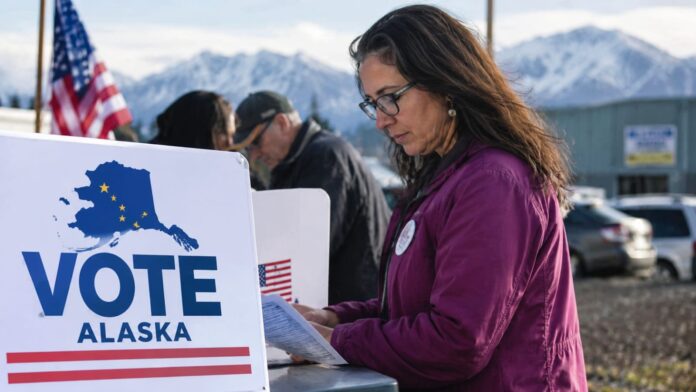
The Alaska Senate primary has concluded with two candidates securing their positions in the general election. Decision Desk HQ has projected that former Democratic Representative Mary Peltola and incumbent Republican Senator Dan Sullivan will face each other in the upcoming general election contest. This matchup comes under Alaska’s distinctive voting framework, now in its third election cycle, which allows the top four candidates from the primary to advance to the general election regardless of party affiliation, where voters will then utilize ranked-choice voting to select their preferred candidate.
Peltola’s advancement represents a significant development for Democrats in a state that has maintained Republican control for decades. She achieved notable success in 2022 by winning Alaska’s at-large House seat, becoming the first Alaska Native elected to Congress and subsequently joining the Blue Dogs Caucus, a group of moderate Democrats. Although she was narrowly defeated in her 2024 House reelection bid, her Senate campaign has reinvigorated Democratic efforts to compete for statewide office in Alaska. The contest has also been complicated by an unusual circumstance involving Sullivan’s campaign, as another candidate shares the incumbent’s surname and has successfully navigated efforts to prevent ballot placement, potentially creating voter confusion.
- Mary Peltola, former U.S. Representative and first Alaska Native elected to Congress, advancing to general election
- Dan Sullivan, incumbent U.S. Senator since 2015, advancing to general election
- Ranked-choice voting system in use for third consecutive election cycle
- Top four primary candidates advancing regardless of party affiliation to general election
Why It Matters
This Senate race carries substantial implications for national political dynamics and control of the U.S. Senate. Major political analysis firms, including Cook Political Report and Decision Desk HQ, have classified the race as a toss-up, with some analysts indicating that Democrats hold a narrow advantage in the current environment. Such a competitive rating in a state historically dominated by Republicans demonstrates a significant shift in electoral possibilities. The outcome could influence overall Senate composition and the balance of power in Washington.
The race also serves as a test case for Alaska’s distinctive electoral system. The ranked-choice voting mechanism and open primary structure represent a departure from traditional voting methods used in most states. How candidates and voters engage with this system, and whether the results diverge from predictions based on conventional election analysis, will provide valuable insights into alternative voting structures. Additionally, the financial dimensions of the race underscore how even contests in less densely populated states can attract substantial national investment from major party organizations and affiliated groups.
- Senate composition and partisan control could be affected by outcome in swing state
- Ranked-choice voting system faces test case with competitive race between major candidates
- Alaska’s electoral framework may influence future discussions about voting method reforms nationally
- Moderate Democratic candidate competing in traditionally Republican state demonstrates shifting voter dynamics
Political and Public Context
Alaska’s political landscape has undergone significant transformation over the past several years, particularly with the implementation of its new electoral system. Voters approved the ranked-choice voting and open primary framework through a 2020 ballot measure, marking a deliberate departure from conventional election administration. This system has now been utilized in two previous election cycles and is operating in the current contest. The system’s design allows candidates from different parties to potentially advance together to the general election, fundamentally altering traditional primary dynamics.
Peltola’s political trajectory highlights evolving voting patterns in Alaska. Her 2022 House election victory made her a historic figure as the first Alaska Native in Congress, and her membership in the Blue Dogs Caucus positioned her as a moderate voice within Democratic ranks. Her narrow loss in the 2024 House race did not deter Democratic recruitment efforts for the Senate seat. Meanwhile, Sullivan’s incumbent status provides advantages in name recognition and fundraising capability, though the candidate with his surname on the ballot creates an unusual complication. The race has also become a flashpoint regarding the state’s voting system itself, with proposals circulating to overturn the ranked-choice and open primary framework that voters previously approved.
- Alaska voters approved ranked-choice voting and open primaries in 2020; system now in third election cycle
- Mary Peltola made history as first Alaska Native elected to Congress in 2022
- Dan Sullivan held Senate seat since 2015 with Republican support base
- Ballot measure to repeal ranked-choice voting system expected on fall ballot
Democratic former Rep. Mary Peltola will face incumbent GOP Sen. Dan Sullivan in the general election for Alaska's Senate race, CNN projects. A second Dan Sullivan could also be on the ballot. https://t.co/djlXc3DA0b pic.twitter.com/R9vxWXHduZ
— CNN (@CNN) August 19, 2026
What Happens Next
The general election campaign will now enter its active phase, with both candidates preparing for the ranked-choice voting contest. Peltola and Sullivan will compete not only against each other but also against the two other candidates who advanced from the primary under Alaska’s system. Campaign messaging will likely emphasize how voters should rank their choices, as candidates attempt to secure first-preference votes while also positioning themselves favorably for second and third-choice selections from voters who may initially prefer other candidates. This strategic calculus differs substantially from traditional two-candidate general election dynamics.
The significant financial investment already directed toward the race is expected to continue or intensify as the general election approaches. The Senate Leadership Fund’s substantial commitment to supporting Sullivan signals that national Republican leadership considers the seat competitive and worth defending. Peltola’s strong second-quarter fundraising performance indicates robust Democratic financial support for her candidacy. Additionally, the concurrent ballot measure regarding Alaska’s voting system will run parallel to the Senate race, potentially influencing voter turnout and engagement patterns. The outcome of both the Senate contest and the voting system referendum will provide important data regarding voter preferences for electoral reform and Democratic viability in traditionally Republican territories.
- General election campaign will focus on ranked-choice voting strategy and voter preference ranking
- Continued major spending expected from national party organizations and affiliated groups
- Concurrent ballot measure on voting system repeal will appear on fall ballot alongside Senate race
- Results will indicate voter preferences for electoral reform and Democratic competitiveness in Alaska
