

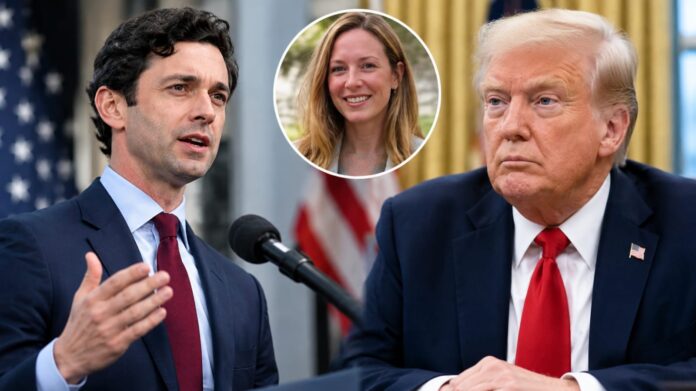
Story Highlights
- Senator Jon Ossoff drew significant attention with remarks challenging the president’s priorities and personal conduct
- Democratic strategists credited Ossoff with successfully capturing media attention during a critical political moment
- The White House responded sharply to Ossoff’s comments, viewing them as personal attacks on presidential staff
- Political analysts suggest the incident reflects Democrats’ broader struggle to find effective messaging against the sitting president
What Happened
Senator Jon Ossoff of Georgia generated substantial political momentum this week by launching pointed criticism at President Trump during a campaign rally, focusing on how the president spends his time while in office. The remarks centered on the president’s golfing activities, stock trading, and travel arrangements, specifically mentioning Natalie Harp, a longtime presidential aide. Ossoff’s comments spread rapidly across digital platforms including TikTok and Google searches, sustaining media attention throughout the week as observers attempted to understand the context and individuals involved in the senator’s attack.
The White House communications team responded forcefully to Ossoff’s remarks, with officials issuing strong rebukes on social media and in public statements. The response underscored the degree to which the administration viewed Ossoff’s comments as crossing established lines of political discourse. Despite the sharp pushback from the White House, Democratic strategists and party operatives expressed enthusiasm about how Ossoff had managed to dominate the news cycle and energize the party’s base during a crucial period leading toward midterm elections.
- Senator Ossoff made rally comments criticizing presidential priorities regarding golfing, stock trading, and travel
- Remarks specifically referenced Natalie Harp, a presidential aide, and aircraft arrangements involving international officials
- White House officials issued public responses condemning the comments as inappropriate personal attacks
- Democratic strategists praised the effectiveness of Ossoff’s messaging in capturing sustained media attention
Why It Matters
The incident highlights a fundamental challenge facing the opposition party: the need to develop messaging strategies that cut through the constant noise of the modern news cycle. Democratic operatives emphasized that successful political figures in the contemporary environment must possess the ability to capture public attention and maintain visibility amid rapid information flows. The fact that Ossoff’s remarks generated viral engagement across multiple platforms demonstrates the strategic value of confrontational rhetoric that resonates with base voters and creates sustained news cycles.
For the Democratic Party more broadly, the enthusiasm surrounding Ossoff’s comments reflects a recognition that the party has struggled to find consistent, effective counter-messaging against the sitting president. Political analysts noted that Ossoff’s approach, regardless of whether some viewed it as crossing conventional boundaries, achieved measurable results in terms of media penetration and base mobilization. This success may influence how other Democratic figures approach their own public messaging and strategic communications in the months ahead. Additionally, observers noted that such moments carry potential implications for ambitious politicians considering future presidential campaigns, as they demonstrate the political dividends available to those willing to engage in aggressive opposition rhetoric.
- Democrats have sought a prominent leader capable of effectively challenging the president’s messaging and priorities
- Successful political figures must demonstrate ability to sustain media attention in fast-moving news environments
- Viral engagement across social media platforms amplified reach beyond traditional political audiences
- Ossoff’s approach may influence Democratic strategy and leadership positioning ahead of upcoming electoral cycles
Political and Public Context
The timing of Ossoff’s remarks coincided with heightened public interest following a significant security incident involving presidential travel to Turkey. During that episode, threats to the president’s safety necessitated transportation changes that raised questions about aircraft operations and personnel assignments. Democratic analysts credited Ossoff with recognizing this moment of elevated public curiosity about presidential operations and leveraging it effectively. The senator’s decision to reference specific details about travel arrangements and staff assignments demonstrated strategic awareness of what information had captured public imagination and media scrutiny.
Within Democratic circles, there exists considerable concern about the party’s ability to mount effective challenges to the current administration across multiple fronts. Political strategists have emphasized the importance of finding leaders capable of generating headlines, sustaining visibility, and maintaining public interest during periods of intense political competition. The broader context includes Democrats’ recognition that the political environment rewards those who can break through information overload and command sustained attention. Ossoff’s success in achieving these objectives, whatever reservations some party members might harbor about his specific approach, underscores the premium placed on attention-generation and public visibility in contemporary American politics.
- Recent security incident involving presidential travel created elevated public interest in presidential operations and staff assignments
- Democratic Party has expressed concern about finding effective opposition messaging and leadership
- Political environment rewards figures capable of generating sustained media attention and public engagement
- Ossoff’s comments reflect broader Democratic strategy discussion about confrontational versus traditional opposition approaches
Jon Ossoff Goes Hard at Trump in First Rally Since His Viral Natalie Harp Comment: ‘The Draft-Dodging Crook President!’ #Mediaite https://t.co/zzyAkVRGQa
— #TuckFrump (@realTuckFrumper) August 18, 2026
What Happens Next
The impact of this incident will likely extend beyond the immediate news cycle as Democratic strategists assess whether Ossoff’s approach represents a model worth emulating or a cautionary example of tactics that may ultimately backfire. The White House’s sharp response suggests the administration intends to continue pushing back aggressively against such attacks, potentially creating a prolonged exchange that keeps the issue in public view. Political observers will watch to determine whether Ossoff faces any electoral consequences from critics who believe his remarks crossed acceptable boundaries or whether the incident instead enhances his standing among base Democrats.
Going forward, the effectiveness of Ossoff’s tactics in generating favorable outcomes for Democrats will partially determine whether other opposition figures adopt similar strategies. If the senator experiences political gains or enhanced national profile development following these comments, other ambitious Democrats may calculate that aggressive personal attacks warrant inclusion in their own messaging frameworks. Conversely, if the incident generates unfavorable polling or donor reactions, it may discourage similar approaches. The situation also creates opportunity for the White House to continue drawing contrasts with Democratic opponents by characterizing their approach as unpresidential and focused on personal attacks rather than substantive policy disagreement.
- Democratic strategists will assess whether Ossoff’s approach should serve as model for future opposition messaging
- White House intends continued robust responses to aggressive Democratic attacks and rhetoric
- Political consequences for Ossoff remain uncertain pending developments in public opinion and electoral dynamics
- Outcome may influence Democratic leadership approaches and strategic positioning heading toward next electoral cycle
