

Story Highlights
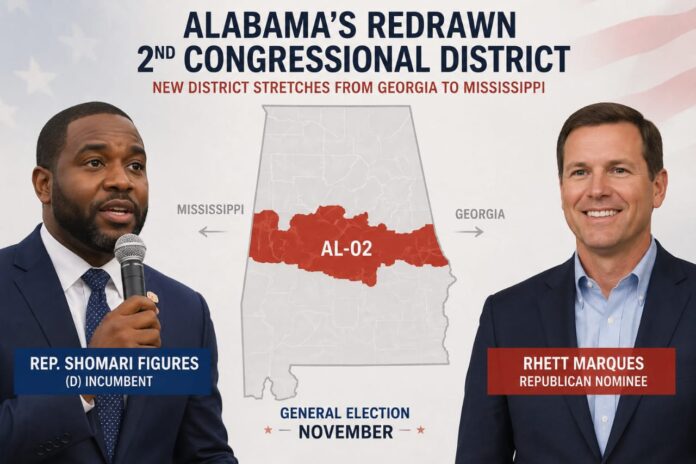
- Republican Rhett Marques is projected to win the GOP nomination in Alabama’s redrawn 2nd Congressional District to challenge Democratic incumbent Shomari Figures
- The Supreme Court in June allowed Alabama Republicans to reinstate a 2023 map that removes the majority-Black Montgomery-area district, significantly affecting Figures’ electoral prospects
- The Cook Political Report ranks the new district as likely to flip Republican in the November general election
- The Democratic Congressional Campaign Committee has included Figures in its Frontline program, designating his race as one of the most competitive incumbent seats this cycle
What Happened
A significant shift in Alabama’s congressional landscape is reshaping the political environment for Democratic Representative Shomari Figures as he prepares for November’s general election. The redrawn 2nd Congressional District, which now extends from the Georgia state line to the Mississippi border, represents a substantially different electoral terrain than the previous configuration. Republican Rhett Marques emerged victorious in the GOP primary race, positioning himself as the likely Republican nominee to face Figures in the fall election.
The redistricting map was reinstated by the Supreme Court in June following approval by Alabama Republicans. This development fundamentally altered the composition of the district and its political characteristics. Figures has publicly expressed concerns about the redistricting process but has chosen to remain in the race despite the challenging circumstances. In the Democratic primary, Figures ran unopposed, while Hampton Harris, a small business owner, initially won the Republican primary in May before Marques emerged as the projected nominee.
- Rhett Marques is projected to win the GOP nomination for Alabama’s 2nd Congressional District
- Supreme Court approved reinstatement of 2023 map in June, removing the majority-Black Montgomery-area district
- Cook Political Report ranks the redrawn district as likely Republican pickup
- Figures remained in race despite redistricting concerns and ran unopposed in Democratic primary
Why It Matters
The redistricting of Alabama’s 2nd Congressional District carries substantial implications for Democratic representation and control of the House of Representatives. For Figures personally, the altered district composition presents a formidable electoral challenge that many political analysts view as potentially insurmountable given the Republican lean of the new boundaries. The removal of the majority-Black Montgomery-area from the district directly impacts the incumbent’s traditional voter base, effectively diminishing his path to reelection in what was previously a more favorable electoral environment.
On a broader level, this race exemplifies the national stakes involved in redistricting battles and their long-term consequences for congressional representation. The Democratic Congressional Campaign Committee has recognized the strategic importance of Figures’ seat by including it in the party’s Frontline program, a designation reserved for the most threatened incumbent races. This classification indicates that party leadership views holding this seat as central to any potential Democratic effort to reclaim House control. The outcome in Alabama’s 2nd District could influence broader conversations about redistricting methodology and electoral map design across multiple states.
- Figures’ reelection prospects significantly diminished by removal of majority-Black Montgomery-area from district
- DCCC Frontline designation indicates party views this seat as critical to any House majority effort
- Race exemplifies national redistricting impact on Democratic representation and House control dynamics
- District composition changes affect traditional voter base that previously supported Figures
Political and Public Context
The redistricting of Alabama’s 2nd Congressional District reflects broader national tensions surrounding congressional map design and electoral representation. Redistricting battles have become increasingly prominent in recent years as both major political parties have sought to maximize their electoral advantage through strategic boundary adjustments. The Alabama redistricting process, culminating in the Supreme Court’s June decision, represents one of several high-profile recent redistricting disputes that have attracted significant national attention from voting rights advocates and political analysts.
Previous redistricting cycles have established precedents for how courts evaluate congressional maps and the standards applied in assessing their legality and fairness. The Supreme Court’s decision in this instance allowed the reinstatement of a map that had been subject to legal challenges and political debate. This development occurs within a context where multiple states have engaged in similar redistricting processes following the 2020 Census, with outcomes varying significantly depending on which party controls the redistricting process in particular states. The competitive designation of Figures’ race by neutral political analysts reflects the generally understood Republican advantage in the newly drawn district boundaries.
- Supreme Court decision in June reflected broader national redistricting disputes and judicial interpretation of map legality
- Alabama redistricting follows 2020 Census cycle process that has affected multiple states
- Cook Political Report analysis classified new district as likely Republican
- DCCC response to redistricting demonstrates Democratic Party’s strategic focus on vulnerable incumbent seats
Live results: Alabama votes in special House primaries after redistricting fight #TheHill https://t.co/vJOrd3vgIf
— #TuckFrump (@realTuckFrumper) August 11, 2026
What Happens Next
The Alabama 2nd Congressional District race will move into its general election phase with Marques as the projected Republican nominee and Figures continuing his reelection effort as the Democratic incumbent. Campaign activities will intensify throughout the coming months as both candidates work to mobilize supporters and present their respective visions to voters across the geographically expansive district spanning from Georgia to Mississippi. The outcome of this race will contribute to the national picture of congressional control and may influence broader discussions about redistricting practices.
Political observers will closely monitor campaign developments, polling data, and voter engagement levels throughout the election cycle. The DCCC’s designation of this race as part of its Frontline program indicates that Democratic national leadership will likely devote significant resources and attention to supporting Figures’ reelection effort. Independent political analysts will continue assessing the competitive nature of the district and refining their electoral projections based on emerging campaign information, demographic analysis, and historical voting patterns in the newly drawn boundaries.
- General election campaign between Marques and Figures will intensify through November voting
- DCCC expected to provide significant resources to support Figures’ reelection effort
- Campaign polling and voter engagement data will emerge as key indicators of competitive nature
- Electoral outcome will influence national House control narrative and redistricting discussion
