

Story Highlights
- Michigan Democratic Senate nominee Abdul El-Sayed faced intense backlash after making remarks questioning whether Vice President Vance’s grandfather would have accepted his wife Usha
- Conservative critics highlighted a passage from Vance’s 2016 memoir where he expressed deep regret that his grandparents never met Usha, calling their union a source of his greatest joy
- The controversy underscores broader concerns about El-Sayed’s character and his apparent assumptions about rural American values and acceptance
- The incident has intensified scrutiny of the Michigan Senate race between El-Sayed and Republican Mike Rogers
What Happened
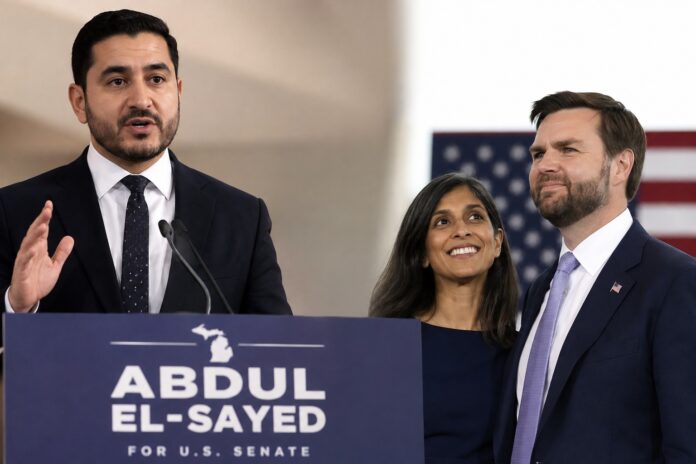
Michigan’s Democratic Senate nominee ignited a firestorm of criticism after making comments widely interpreted as insulting to Second Lady Usha Vance during a weekend social media exchange. El-Sayed responded to Vice President Vance’s criticism of his past statements about Sharia law by questioning whether the vice president would take his wife back in time to meet his grandfather, commonly known as Papaw. The remark prompted swift condemnation from conservative commentators and observers who viewed it as insinuating that Vance’s grandfather would have rejected Usha based on her Indian heritage.
The controversy gained significant traction when conservative figures on social media pointed to relevant passages from the vice president’s widely-read memoir. In his 2016 acknowledgments section, Vance reflected on his deep affection for his wife, expressing that one of his greatest regrets was that his grandparents passed away before meeting her, while simultaneously noting that meeting Usha represented the source of his greatest joy. This documented sentiment from the vice president’s own words directly contradicted the implication underlying El-Sayed’s remarks.
- El-Sayed made the controversial remarks in response to Vance’s criticism of his Sharia law comments at an Ohio campaign rally
- Vance wrote in his 2016 memoir acknowledgments that meeting Usha was the source of his greatest joy and that his grandparents never had the opportunity to meet her
- The incident occurred during the high-stakes Michigan Senate general election campaign between El-Sayed and Republican Mike Rogers
- Conservative commentators including Texas Rep. Brandon Gill and journalist Emily Schrader responded publicly to the remarks
Why It Matters
The incident reveals troubling assumptions that El-Sayed appears to hold about rural American values and family dynamics. By suggesting that Vance’s grandfather would automatically reject his wife based on her heritage, the Michigan Democrat revealed a fundamental misunderstanding of Midwestern character and the bonds of family love that transcend ethnicity or background. This represents a significant vulnerability for a candidate seeking statewide office in a region where family values and authentic understanding of community matter deeply to voters.
More broadly, the controversy demonstrates how Democratic candidates increasingly rely on divisive stereotypes rather than substantive policy arguments. The implicit assumption in El-Sayed’s comment that a rural white grandfather would be inherently racist not only misrepresents the values of working Americans but also exposes a contempt for the very voters whose support he needs. For many Michigan families, such comments suggest that El-Sayed fundamentally disrespects their character and their capacity for acceptance and love. The backlash underscores how voters are increasingly unwilling to tolerate such attacks on their values and heritage, particularly when those attacks are based on false and insulting premises.
- Rural and working-class Michigan voters who feel their values and character are being denigrated by Democratic rhetoric
- Women voters who view Usha Vance as a positive representative and bristle at attacks on her
- Families with multi-ethnic or multi-religious backgrounds who see the controversy as validating their own experiences of acceptance within tight-knit communities
- The broader Trump coalition in Michigan, which views such incidents as evidence of Democratic elitism and contempt for heartland America
Political and Public Context
The controversy arrives at a critical moment in Michigan’s Senate race, as El-Sayed works to secure the Democratic nomination and position himself for the general election against Republican Mike Rogers. Vice President Vance has been actively campaigning to highlight the Trump administration’s economic accomplishments and to draw sharp contrasts between conservative governance and Democratic approaches. The vice president’s personal story, detailed extensively in his influential memoir, has resonated deeply with voters who see his journey as emblematic of American resilience and the possibility of upward mobility through hard work and family commitment.
Vance’s public advocacy has centered on contrasting his vision of an America that values working families with what he characterizes as an out-of-touch Democratic Party increasingly disconnected from Midwestern values. El-Sayed’s remarks provided a concrete example validating these criticisms, suggesting that the Democratic challenger does indeed harbor unflattering assumptions about rural Americans. The incident also comes as conservative figures have increasingly pushed back against what they view as systematic denigration of working-class white Americans, arguing that such stereotyping represents a form of prejudice increasingly normalized in progressive circles.
- Vice President Vance’s 2016 memoir Hillbilly Elegy, which has shaped public understanding of his family values and rural American identity
- Recent Trump administration campaign efforts to showcase economic gains and contrast their record with Democratic policy proposals
- Growing conservative focus on Democratic rhetoric that allegedly disparages working-class and rural Americans
- The competitive dynamics of Michigan politics, where winning over working-class voters remains essential for statewide success
Abdul El-Sayed Directly Responds To JD Vance's Attacks With 1 Simple Question #HuffingtonPost https://t.co/p0BmoojGr0
— #TuckFrump (@realTuckFrumper) August 23, 2026
What Happens Next
El-Sayed will face mounting pressure to explain or clarify his remarks as the Michigan Senate race intensifies heading toward election day. Republican operatives will almost certainly amplify this incident through paid advertising and grassroots organizing, using it to demonstrate that the Democratic candidate harbors contempt for rural Michigan families. The vice president’s campaign presence in Michigan will likely increase, with his personal story and family values serving as a powerful counternarrative to El-Sayed’s apparent worldview.
Conservative media and commentary will continue to leverage this controversy as evidence supporting the broader argument that today’s Democratic Party has become increasingly alienated from heartland America. Unless El-Sayed successfully reframes the narrative or provides a compelling explanation, the incident threatens to define public perception of his character and fitness for office. Meanwhile, voters in rural and working-class Michigan communities will likely use this controversy as a lens through which to evaluate El-Sayed’s genuine respect for their values and way of life, potentially influencing both turnout and vote choice in this crucial swing-state race.
- Republican efforts to amplify the controversy through advertising and campaign messaging in Michigan
- Potential for El-Sayed to face additional scrutiny regarding his past statements and rhetoric toward rural Americans
- Vice President Vance’s continued involvement in Michigan campaign activities showcasing the administration’s record
- The broader influence of this incident on voter perceptions of Democratic attitudes toward working-class America heading into the general election
