

Story Highlights
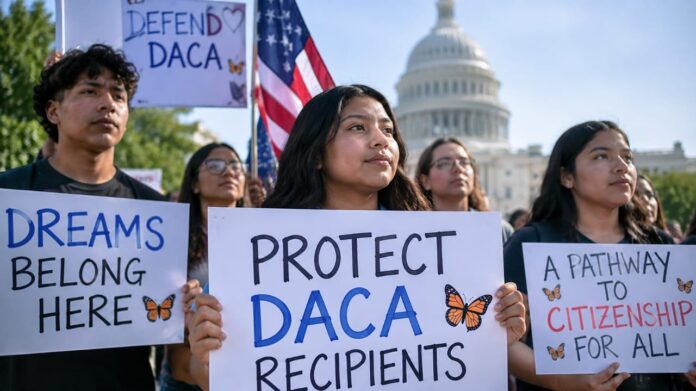
- The Deferred Action for Childhood Arrivals program has operated for 14 years without congressional passage of permanent citizenship pathways
- Processing delays for DACA renewals have surged dramatically, with median wait times increasing from 15 days to approximately 70 days
- A bipartisan discharge petition was filed in July to force a House floor vote on comprehensive immigration reform legislation
- DACA recipients face ongoing uncertainty regarding employment eligibility, family stability, and potential deportation
What Happened
Congressional efforts to address the status of Deferred Action for Childhood Arrivals recipients have stalled despite more than a decade of debate and advocacy. The program, established in 2012, has provided temporary protection to immigrant youth but lacks any permanent legislative solution. In July of this year, Representative Sylvia Garcia of Texas filed a discharge petition to compel the House of Representatives to vote on legislation that would establish a pathway to citizenship for DACA recipients, along with immigrant youth, temporary protected status holders, and those with deferred enforced departure designations.
The discharge petition garnered bipartisan support when Representative Maria Elvira Salazar of Florida, a Republican member, signed the measure on the same day it was introduced. House Democratic Leader Hakeem Jeffries of New York subsequently joined the effort, citing recent immigration enforcement activity and a Supreme Court decision regarding temporary protected status as justification for immediate legislative action. Despite this coordinated push for congressional movement, the measure has not yet reached a full House floor vote.
- Representative Sylvia Garcia filed a discharge petition in July seeking a House floor vote
- Representative Maria Elvira Salazar provided bipartisan support by signing the petition
- House Democratic Leader Hakeem Jeffries joined the effort citing enforcement concerns and court rulings
- The initiative seeks to provide pathways to citizenship for approximately 600,000 DACA recipients and related immigrant groups
Why It Matters
The continued absence of permanent legislative solutions creates substantial practical hardships for hundreds of thousands of individuals who have built lives, careers, and families within the United States. Processing delays for renewal applications have reached critical levels, with median wait times extending from 15 days in 2025 to approximately 70 days in early 2026, and some cases requiring six months or longer for resolution. U.S. Customs and Immigration Services completed only 56 percent of renewal applications in the first quarter of this fiscal year, compared to 96 percent during the same period the previous year, representing a dramatic decline in processing capacity.
The deteriorating conditions have resulted in concrete consequences for DACA recipients attempting to maintain lawful status. Individuals who file renewal applications on time still face the possibility that their temporary protections may lapse due to administrative delays, creating situations where lawful employment becomes impossible and financial security evaporates. In some high-profile cases, DACA-recipient police officers have been forced to take unpaid leave when their status documentation lapsed during processing delays, demonstrating how bureaucratic failures directly impact professional and public safety operations.
- Renewal processing times have increased from 15 days to 70 days, with some cases extending six months or longer
- USCIS completed only 56 percent of renewals in the first quarter of the current fiscal year versus 96 percent the previous year
- DACA recipients experience employment termination and financial hardship when status lapses during administrative delays
- The two-year renewal requirement creates continuous uncertainty despite timely application filing
Political and Public Context
The DACA program was implemented through executive action in 2012 as an interim measure designed to provide temporary relief while Congress debated comprehensive immigration reform. What was intended as a stopgap measure has persisted for 14 years, indicating fundamental congressional gridlock on immigration policy. The program applies to individuals who were brought to the United States as children without legal authorization, often referred to as Dreamers, encompassing approximately 600,000 individuals currently benefiting from its protections.
Observers and immigration professionals have noted that temporary protective status designations were never intended to serve as permanent solutions, yet the legislative process has repeatedly failed to establish permanent pathways for this population. Senators Dick Durbin of Illinois and Catherine Cortez Masto of Nevada have documented cases where DACA recipients filed renewal applications within required timeframes only to experience lapsed protections due to administrative failures. The situation reflects broader congressional inability to address immigration policy comprehensively, with debates becoming increasingly polarized and legislative movement stalled.
- DACA was created in 2012 as a temporary executive measure during ongoing immigration reform debates
- The program applies to approximately 600,000 individuals brought to the United States as children without legal status
- Senators Durbin and Cortez Masto have documented renewal filing failures and resulting protection lapses
- Congressional gridlock has prevented permanent legislative solutions for 14 consecutive years
What Happens Next
The discharge petition filed by Representative Garcia remains pending House floor action, though the timing and likelihood of a successful vote remains uncertain. If the petition accumulates sufficient signatures from House members, it would force leadership to schedule a floor vote on the underlying legislation. The success of such a vote would depend on whether sufficient bipartisan support materializes beyond the initial Republican and Democratic co-leads who have already endorsed the measure.
The Supreme Court’s previous rulings regarding temporary protected status and ongoing immigration enforcement activity may create additional pressure for legislative action. However, historical patterns suggest that Congress may continue delaying permanent solutions, leaving DACA recipients in extended limbo. Immigration professionals anticipate that processing delays will likely continue affecting renewal timelines, potentially creating additional cases where lawful status lapses despite timely application filing. The broader question of whether comprehensive immigration reform addressing DACA recipients, immigrant youth, and other protected populations will advance remains dependent on shifting political dynamics and legislative priorities.
- The discharge petition requires sufficient House member signatures to force a floor vote on immigration reform legislation
- Successful passage would require bipartisan support beyond current co-lead endorsements
- Processing delays are expected to continue affecting renewal timelines without administrative or legislative intervention
- Comprehensive immigration reform addressing multiple protected populations remains uncertain and timeline-dependent