

Story Highlights
- A U.S. Air Force officer, known by the call sign ‘Bravo’, recounts his terrifying experience after his F-15E jet was shot down over Iran.
- Bravo survived a free-fall with a damaged parachute and endured significant injuries before being rescued.
- The incident occurred on April 2, during a mission targeting Iranian industrial facilities.
- The search-and-rescue operation is described as one of the most complex in U.S. military history.
What Happened
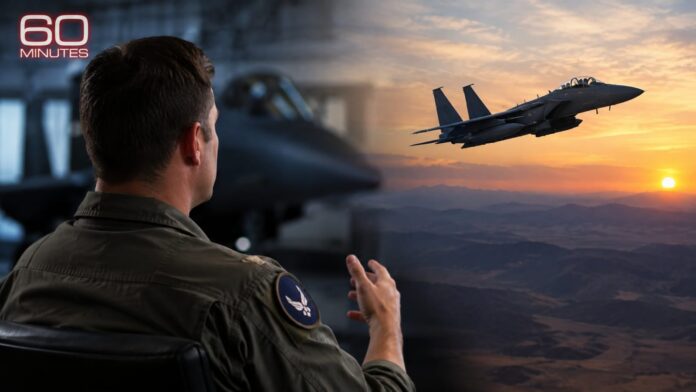
In a gripping interview aired on CBS’ ’60 Minutes’, an Air Force officer, referred to by his mission call sign ‘Bravo’, shared the harrowing details of his experience after his fighter jet was shot down over Iran on April 2. The incident unfolded during a mission aimed at striking Iranian industrial facilities linked to the country’s drone and missile programs. Bravo, serving as the weapons systems officer, described the moment the missile struck their F-15E two-seat fighter jet, likening the impact to being ‘hit by a freight train’.
As the aircraft was hit, Bravo’s pilot, known as ‘Alpha’, immediately activated the ejection system, allowing both officers to escape the doomed jet. However, the situation quickly turned dire as Bravo realized that his parachute had been damaged during the missile strike. He described the moment he looked up and saw the shredded parachute as ‘the most terrifying thing I’ve ever seen’. The descent was rapid, with military estimates suggesting he hit the ground at speeds between 70 and 100 mph.
- The incident occurred on April 2, 2023.
- Bravo was the weapons systems officer aboard the F-15E fighter jet.
- The missile attack was attributed to Iranian forces.
- Bravo was stranded for two days before being rescued by elite Air Force pararescue operators.
Why It Matters
This incident is significant not only for the personal story of survival but also for its implications regarding U.S. military operations in hostile territories. The successful ejection and subsequent survival of Bravo highlight the risks faced by military personnel during operations in regions with active threats. The complexity of the search-and-rescue operation underscores the challenges that the U.S. military encounters when conducting missions in enemy territory, particularly in a region as volatile as Iran.
Bravo’s experience serves as a stark reminder of the dangers that military personnel face daily. His miraculous survival, despite sustaining severe injuries including a broken back, arm, and shoulder, raises questions about the effectiveness of current military protocols and the support systems in place for personnel in distress. The incident also sheds light on the ongoing tensions between the U.S. and Iran, particularly in the context of military engagements and the potential for escalation in conflict.
- The incident raises awareness about the risks faced by military personnel in combat zones.
- It highlights the importance of effective search-and-rescue operations in hostile environments.
- The story emphasizes the ongoing tensions between the U.S. and Iran.
- Bravo’s survival may influence future military strategies and protocols.
Political and Public Context
The backdrop of this incident is rooted in the ongoing U.S.-Iran conflict, which has seen various military engagements over the years. The mission that Bravo and Alpha were undertaking was part of a broader strategy to target Iranian capabilities that threaten U.S. interests and allies in the region. The use of shoulder-fired missiles by Iranian forces against U.S. aircraft is a concerning development, indicating a shift in the capabilities of Iranian military forces.
Moreover, the incident comes at a time when the U.S. military is reassessing its strategies in the Middle East, particularly in light of evolving threats from adversaries. The complexities of modern warfare, including the use of advanced missile technology by enemy forces, necessitate a reevaluation of tactics and equipment used by U.S. forces. The successful extraction of Bravo after two days in enemy territory also speaks to the effectiveness of U.S. military training and the capabilities of elite rescue units.
- The U.S. has been involved in military operations in the Middle East for decades.
- Recent tensions have escalated due to Iran’s missile capabilities.
- The incident reflects the evolving nature of warfare and military strategy.
- Bravo’s story may influence future military training and operational protocols.
A US Air Force colonel whose parachute was damaged after his F-15E fighter jet was shot down over Iran has revealed how he survived nearly 50 hours with a broken back, arm and shoulder as Iranian forces searched for him. Identified publicly only by his mission call sign “Bravo”,… pic.twitter.com/R5JpBn0l5c
— The Statesman (@TheStatesmanLtd) September 14, 2026
What Happens Next
Looking ahead, the implications of this incident may lead to significant changes in military operations and strategies in the region. The U.S. military may conduct a thorough review of the events surrounding the downing of Bravo’s jet to identify lessons learned and areas for improvement. This could include enhancements in aircraft defense systems, improved training for personnel in hostile environments, and a reevaluation of mission protocols to ensure the safety of military personnel.
Additionally, the story of Bravo’s survival may serve as a rallying point for discussions on military support and resources for personnel engaged in high-risk operations. As the U.S. continues to navigate its relationship with Iran, the military’s approach to engagement and conflict resolution may also evolve in response to the lessons learned from this incident.
- A thorough review of the incident may lead to changes in military protocols.
- There may be enhancements in aircraft defense systems and training.
- The story could influence discussions on military support for personnel.
- Future missions may be adjusted based on lessons learned from Bravo’s experience.
