

Story Highlights
- President Trump expresses skepticism about Chuck Schumer’s ability to lead Senate Democrats.
- Internal divisions within the Democratic Party are becoming increasingly apparent.
- Sen. Chris Van Hollen emerges as a challenger to Schumer’s leadership.
- Trump’s comments highlight the potential for a shift in Senate dynamics.
What Happened
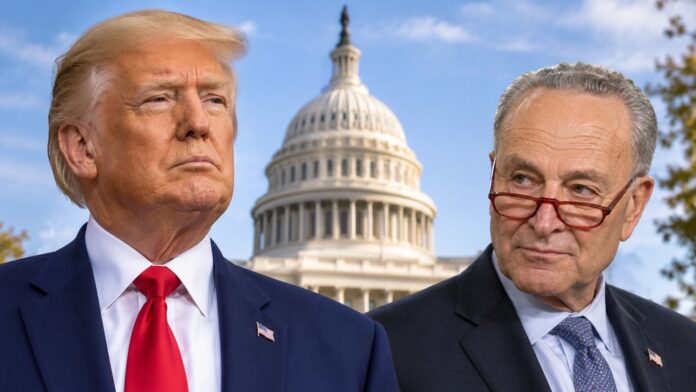
President Trump recently took to social media to voice his concerns regarding Senate Minority Leader Chuck Schumer’s leadership capabilities. In a post on Truth Social, the president stated that it would be ‘very hard’ for him to collaborate with Schumer if he were to be re-elected as Senate Majority Leader. Trump pointed out Schumer’s past failures, suggesting that they could hinder effective governance moving forward. The president’s remarks come at a time when the Democratic Party is facing significant internal strife, with progressive factions pushing for a more radical agenda. This discord raises questions about the party’s unity and effectiveness in the upcoming legislative sessions.
Trump’s comments were made on a recent Sunday, and they have sparked discussions among political analysts and party members alike. Schumer is facing a leadership challenge from Sen. Chris Van Hollen, D-Md., who represents a more progressive wing of the party. Progressive senators, including Bernie Sanders and Jeff Merkley, are backing Van Hollen, indicating a shift in support within the party. Schumer has led Senate Democrats for nearly a decade, but the growing dissent may signal a turning point for the party’s leadership.
- Trump’s comments were made on Truth Social on a recent Sunday.
- Schumer is facing a leadership challenge from Sen. Chris Van Hollen, D-Md.
- Progressive senators, including Bernie Sanders and Jeff Merkley, are backing Van Hollen.
- Schumer has led Senate Democrats for nearly a decade.
Why It Matters
The implications of Trump’s critique extend beyond mere political banter; they underscore a significant shift in the dynamics of the Senate. If Schumer retains his leadership position, he will need to navigate a party that is increasingly divided between moderate and progressive factions. Trump’s assertion that Schumer is likely to ‘fail again’ resonates with many who believe that the current leadership has not effectively addressed the concerns of the party’s base. The president’s comments could galvanize support for Van Hollen and other progressive challengers, potentially reshaping the legislative landscape.
As the Democratic Party prepares for the upcoming elections, the leadership challenge could have lasting effects on its strategy and priorities. The outcome of this leadership contest may influence key legislative initiatives and the party’s overall direction. If progressive challengers gain momentum, it could lead to a more radical legislative agenda that aligns with the desires of the party’s base, which has been increasingly vocal about their expectations for change.
- Schumer’s leadership style may be called into question, affecting his ability to unite the party.
- Progressive challengers could gain momentum, leading to a more radical legislative agenda.
- Trump’s remarks may energize his base, further polarizing the political landscape.
- The outcome of this leadership challenge could impact key legislative initiatives in the coming years.
Political and Public Context
The backdrop of this leadership challenge is a Democratic Party that has seen significant electoral victories in recent years, yet remains fraught with internal conflicts. Schumer’s tenure has been marked by both successes and failures, and his handling of issues such as the COVID-19 pandemic and economic recovery has been scrutinized. The emergence of progressive figures like Van Hollen signals a desire for change among the party’s base, which is increasingly frustrated with traditional leadership approaches. This internal struggle is not new; it reflects a broader trend within the Democratic Party as it grapples with its identity and direction.
As the party looks ahead to the 2024 elections, the stakes are higher than ever. The leadership dynamics within the Senate could have significant implications for the party’s ability to push through its agenda. With the rise of progressive candidates, there is a growing expectation for the party to adopt more ambitious policies that resonate with younger voters and those seeking substantial reforms.
- Schumer has been a prominent figure in the Senate since 2001, serving as both minority and majority leader.
- The Democratic Party has seen a rise in progressive candidates in recent elections.
- Schumer’s leadership has been challenged before, but this time the stakes appear higher.
- The 2024 elections are looming, adding urgency to the party’s internal debates.
Trump says it will be ‘very hard’ to work with Schumer as Senate majority leaderhttps://t.co/knzbSi607z
— The Hill (@thehill) November 23, 2026
What Happens Next
As the Senate prepares for the upcoming session, the question of Schumer’s leadership will be at the forefront of discussions. If he is re-elected, he will need to address the concerns of both moderate and progressive senators to maintain party cohesion. Conversely, if Van Hollen or another challenger succeeds, it could lead to a significant shift in the party’s legislative priorities. The potential for a more progressive agenda could reshape the Senate’s approach to key issues such as healthcare, climate change, and economic policy.
The coming weeks will be critical as the Democratic caucus navigates this leadership challenge and its implications for the future. The outcome of the leadership vote will set the tone for the upcoming legislative session, and it remains to be seen how Trump’s influence will continue to shape the narrative around Democratic leadership. Key issues such as budget negotiations and policy initiatives will be affected by the leadership dynamics, making this a pivotal moment for the party.
- Schumer will likely need to engage in negotiations with both moderate and progressive factions.
- The outcome of the leadership vote will set the tone for the upcoming legislative session.
- Trump’s influence may continue to shape the narrative around Democratic leadership.
- Key issues such as budget negotiations and policy initiatives will be affected by the leadership dynamics.