

Story Highlights
- President Trump escalates anti-Muslim rhetoric at a rally in Port Huron, Michigan.
- Democratic Senate nominee Abdul El-Sayed is targeted with inflammatory language.
- The GOP’s campaign strategy reflects a troubling trend of Islamophobia ahead of the midterms.
- Trump’s aggressive campaigning indicates a desperate push for support in a challenging electoral landscape.
What Happened
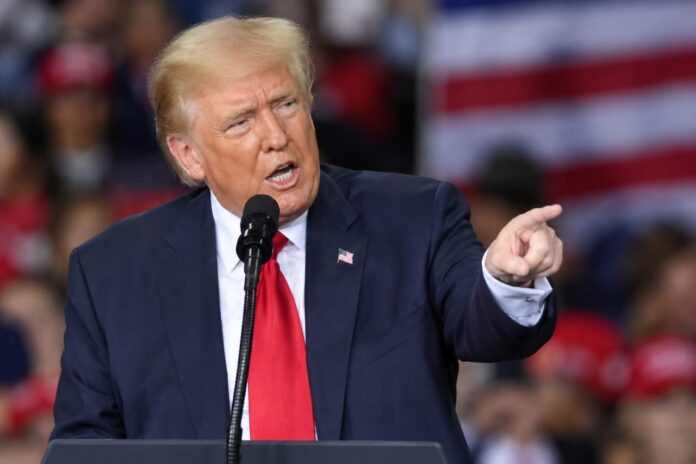
President Trump’s recent rally in Port Huron, Michigan, has sparked significant controversy as he unleashed a barrage of anti-Muslim rhetoric aimed at Democratic Senate nominee Abdul El-Sayed. During the event, the president described El-Sayed as a ‘jihadist’ who ‘should never be allowed inside the halls of our great beautiful Capitol.’ This inflammatory language is not just a momentary lapse; it represents a broader strategy by the Republican Party as they gear up for the midterm elections. The president’s remarks were not only shocking but also indicative of a campaign that is increasingly leaning into Islamophobia as a means to galvanize support among his base.
The rally, held on a Sunday, was part of Trump’s final push in the lead-up to the midterms, where he is attempting to rally support in states where the GOP is facing tough challenges. His comments about El-Sayed were particularly pointed, warning supporters that if the Democrats were to win, they would ‘open the floodgates and invite hordes of jihadists to our shores, creating a nightmare of violence and terror until you cannot even have a Christmas.’ This rhetoric is alarming and reflects a significant escalation in the GOP’s campaign strategy.
- Trump referred to Abdul El-Sayed as a ‘jihadist’ during a rally on October 29, 2023.
- El-Sayed is the Democratic nominee for the Michigan Senate seat.
- The rally took place in Port Huron, Michigan.
- Trump’s comments are part of a broader trend of Islamophobia in the GOP’s midterm campaign.
Why It Matters
The implications of Trump’s rhetoric extend far beyond the immediate political landscape. By targeting El-Sayed with such inflammatory language, the president is not only attempting to undermine a political opponent but is also contributing to a culture of fear and division. This kind of rhetoric can have real-world consequences, fostering an environment where Islamophobia is normalized and where individuals from Muslim backgrounds may feel increasingly marginalized and threatened.
The president’s comments also signal a shift in the GOP’s campaign strategy, which appears to be leaning heavily into divisive tactics as a means of rallying support. This approach may resonate with certain segments of the electorate, but it risks alienating moderate voters who may be turned off by such extreme rhetoric. The potential fallout from this strategy could be significant, affecting not only the midterm elections but also the broader political discourse in the United States.
- Increased Islamophobia may lead to heightened tensions within communities.
- Moderate voters may be alienated by the GOP’s divisive tactics.
- Trump’s rhetoric could embolden extremist groups and individuals.
- The political landscape may shift as a result of the GOP’s reliance on fear-based campaigning.
Political and Public Context
The context surrounding Trump’s remarks is crucial to understanding their significance. The Republican Party has been increasingly vocal in its attempts to link Democratic candidates to Islamophobia, with figures like former Rep. Mike Rogers attempting to associate El-Sayed with the Muslim Brotherhood. This strategy is not isolated; it reflects a broader trend within the GOP to weaponize fear of Islam and Muslims as a means of galvanizing support.
Additionally, other Republican leaders have echoed similar sentiments. Texas Governor Greg Abbott recently claimed that his Democratic opponent supports ‘Sharia law,’ while Senator Ted Cruz has suggested that ‘communism’ and ‘Islamism’ are allying against Republicans. These statements illustrate a concerted effort to frame the Democratic Party as a threat to American values, using fear as a primary motivator.
- Former Rep. Mike Rogers has linked El-Sayed to the Muslim Brotherhood.
- Texas Governor Greg Abbott made claims about Sharia law in relation to his opponent.
- Senator Ted Cruz has suggested a coalition between communism and Islamism.
- The GOP’s strategy reflects a broader trend of fear-based campaigning leading up to the midterms.
What Happens Next
As the midterm elections approach, the question remains: what will be the long-term effects of Trump’s rhetoric and the GOP’s campaign strategy? The immediate future will likely see an intensification of these tactics as the party seeks to rally its base. However, the potential backlash from moderate voters and the broader electorate could lead to unforeseen consequences for the Republican Party.
Furthermore, the implications of this rhetoric may extend beyond the elections themselves. If the GOP continues to rely on fear-based campaigning, it could further entrench divisions within American society, making it increasingly difficult to foster dialogue and understanding across different communities. The coming weeks will be critical in determining how this strategy plays out and what it means for the future of the Republican Party and American politics as a whole.
- Expect more aggressive campaigning from Trump and GOP candidates in the lead-up to the elections.
- Monitor voter reactions, particularly among moderates and independents.
- Watch for potential backlash against the GOP’s Islamophobic rhetoric.
- Consider the long-term implications for political discourse in the United States.
