

Story Highlights
- Senator John Thune raises concerns about taxpayer money being used for political ads.
- Thune acknowledges the positive message of the ads while questioning their funding source.
- Criticism comes from both sides of the aisle, with some Republicans and Democrats voicing their disapproval.
- The White House defends the ads as public service announcements, not political in nature.
What Happened
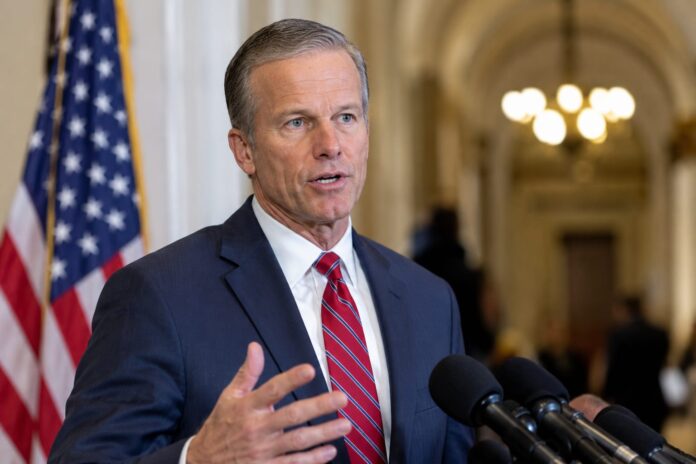
In a recent statement, Senate Majority Leader John Thune expressed his concerns regarding the use of taxpayer funds by the White House to support a new advertising campaign that prominently features President Donald Trump. Thune, a prominent Republican voice, acknowledged the compelling nature of the message conveyed in the ads but firmly stated that such a campaign should not be financed with taxpayer dollars. His comments reflect a growing unease among some lawmakers about the intersection of government resources and political messaging.
The ads, which began airing on FOX, include a strikingly similar message to that of Trump’s 2024 presidential campaign. Each advertisement concludes with the phrase ‘Paid for by the U.S. government,’ raising eyebrows among critics who question the appropriateness of using public funds for what many perceive as political propaganda. The latest ad features Trump declaring, ‘This is the final battle … we will demolish the deep state,’ and ‘We will cast out the communists, Marxists and fascists,’ which has resonated with his base but has also drawn scrutiny from various political factions.
- Senator John Thune voiced his concerns on Monday.
- The ads began airing on Wednesday on FOX.
- Thune highlighted the lack of transparency regarding the funding source.
- Other Republicans, like Senator John Kennedy, have also criticized the use of taxpayer funds for political ads.
Why It Matters
The implications of Thune’s critique extend beyond mere political posturing. His acknowledgment of the ad’s positive message, coupled with his concerns about funding, illustrates a nuanced perspective that many lawmakers are grappling with. While the messaging aligns with the sentiments of a significant portion of the electorate, the ethical considerations surrounding the use of taxpayer money for political purposes cannot be overlooked. This situation raises critical questions about accountability and the appropriate use of government resources.
Moreover, the backlash from both Republicans and Democrats indicates a bipartisan concern regarding the administration’s approach to political advertising. Senator John Kennedy, for instance, articulated a sentiment shared by many when he stated that public funds should not be utilized for personal political gain. On the Democratic side, Senators Mark Warner and Chris Coons have condemned the ads, emphasizing that taxpayer money should be directed towards pressing issues such as healthcare and food assistance rather than political campaigns.
- The critique highlights ethical concerns regarding the use of taxpayer funds.
- It reflects a bipartisan unease about the administration’s approach to political messaging.
- Public funds are being scrutinized for their allocation towards political ads instead of essential services.
- Voter trust in government spending may be affected by this controversy.
Political and Public Context
Understanding the broader context of this situation is essential to grasp its significance fully. The use of taxpayer funds for political purposes is not a new issue; it has been a contentious topic in American politics for decades. However, the current administration’s approach has reignited debates about transparency and accountability in government spending. The ads in question are part of a larger strategy to bolster Trump’s image as he gears up for the 2024 election, but the method of funding has raised eyebrows.
Furthermore, the political landscape is increasingly polarized, with both parties leveraging media to communicate their messages. The White House’s defense of the ads as public service announcements adds another layer of complexity to the discussion. By framing the ads in this manner, the administration seeks to distance itself from accusations of political bias, yet critics remain unconvinced. This situation exemplifies the ongoing struggle between political messaging and ethical governance.
- The controversy reflects a long-standing debate about taxpayer funding for political purposes.
- The current administration’s approach has reignited discussions about transparency in government spending.
- Political polarization has intensified the scrutiny of media messaging from both parties.
- The framing of the ads as public service announcements raises questions about the definition of political content.
Thune: Ads promoting Trump political message “shouldn’t be paid for by taxpayer dollars” #TheHill https://t.co/HKq6YRBh0E
— #TuckFrump (@realTuckFrumper) September 28, 2026
What Happens Next
Looking ahead, the fallout from Thune’s critique and the broader controversy surrounding the ads will likely continue to unfold. As lawmakers from both parties express their concerns, it remains to be seen how the White House will respond to the mounting pressure. Will there be a reevaluation of the funding sources for such campaigns, or will the administration double down on its current strategy?
Moreover, this situation may prompt further discussions about the ethical implications of using taxpayer funds for political messaging. Lawmakers may push for clearer guidelines regarding the use of government resources in political campaigns, potentially leading to new legislation aimed at ensuring accountability. As the 2024 election approaches, the scrutiny of political advertising will only intensify, making it crucial for all parties involved to navigate these waters carefully.
- Lawmakers may push for clearer guidelines on the use of taxpayer funds for political ads.
- The White House’s response to criticism will be closely monitored.
- Future political advertising strategies may be influenced by this controversy.
- Voter sentiment regarding government spending could shift as a result of this debate.
