

Story Highlights
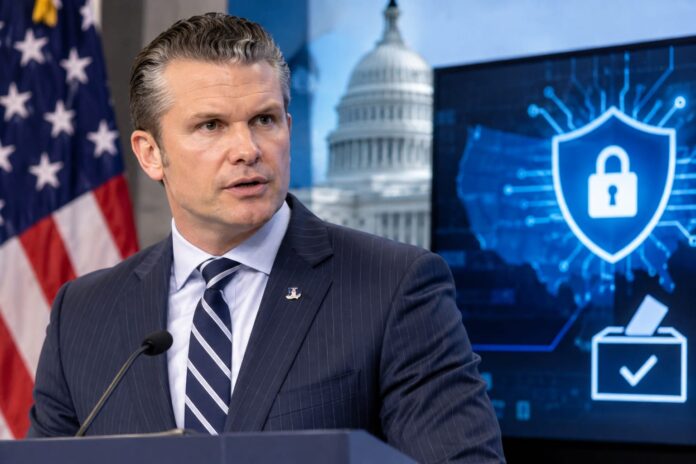
- Defense Secretary Pete Hegseth emphasizes the importance of protecting U.S. elections from foreign interference.
- The Pentagon is set to deploy advanced intelligence and cyber capabilities to ensure election security.
- Hegseth’s directive reflects a commitment to uphold democratic principles and national security.
- U.S. Cyber Command will collaborate with the Department of Homeland Security to counter potential threats.
What Happened
In a significant move to bolster the integrity of U.S. elections, Defense Secretary Pete Hegseth issued a directive last week aimed at safeguarding the upcoming 2026 midterm elections from foreign interference. This initiative underscores the administration’s proactive stance on national security and the preservation of democratic processes. Hegseth’s memo, made public on September 25, outlines a comprehensive strategy that prioritizes the deployment of advanced intelligence and cyber capabilities to track, disrupt, and neutralize foreign actors attempting to meddle in U.S. elections.
In his memo, Hegseth stated, ‘Our Nation’s ability to conduct free and fair elections is a steadfast principle of our Democracy.’ He emphasized that ensuring this ability is a ‘no-fail mission’ for the Department of War (DoW). The directive calls for a coordinated effort between U.S. Cyber Command and the Department of Homeland Security to address potential cyber threats targeting the electoral process. This collaboration is crucial as it reflects a whole-of-government approach to safeguarding democracy.
- Hegseth’s memo was made public on September 25, 2023.
- He instructed Gen. Joshua Rudd, head of U.S. Cyber Command, to utilize existing capabilities to counter threats.
- The directive emphasizes the importance of maintaining fundamental freedoms while protecting elections.
- Previous administrations have also expressed concerns about foreign interference in elections.
Why It Matters
The implications of Hegseth’s directive are profound, as they highlight the ongoing threat posed by foreign actors to the integrity of U.S. elections. The commitment to deploy advanced cyber capabilities signals a robust response to the challenges faced in the digital age. With the increasing sophistication of cyber threats, it is imperative that the U.S. government takes proactive measures to protect its democratic processes. The emphasis on collaboration between various agencies, including U.S. Cyber Command and the Department of Homeland Security, showcases a unified front against potential interference.
This initiative is particularly relevant in light of past incidents where foreign entities attempted to influence U.S. elections. The meddling of foreign actors has been a recurring theme in recent electoral cycles, raising concerns about the vulnerability of democratic institutions. By prioritizing election security, Hegseth and his team are not only addressing immediate threats but also reinforcing public confidence in the electoral process.
- Foreign interference undermines public trust in elections and democratic institutions.
- Hegseth’s directive aims to enhance national security and protect democratic values.
- Collaboration between agencies is essential for effective threat mitigation.
- The initiative may influence public perception of the government’s commitment to election integrity.
Political and Public Context
The directive from Hegseth comes at a time when concerns about election security are at an all-time high. Previous administrations have grappled with the issue of foreign interference, particularly during the 2016 and 2020 elections. The National Security Agency (NSA) and U.S. Cyber Command, under the previous administration, had already initiated measures to safeguard elections from foreign threats. However, the current administration’s approach appears to be more aggressive and comprehensive, reflecting a heightened awareness of the stakes involved.
Moreover, the collaboration between U.S. Cyber Command and the Department of Homeland Security is a critical development. This partnership is designed to leverage the strengths of both agencies in identifying and countering cyber threats. The emphasis on intelligence gathering and production on foreign threats aligns with the broader national security strategy aimed at protecting the integrity of U.S. democratic processes.
- Past administrations have faced challenges related to foreign interference in elections.
- The NSA and U.S. Cyber Command have previously highlighted the need for election security.
- Collaboration between agencies is a key component of the current strategy.
- The heightened focus on election security reflects a broader national security strategy.
Hegseth says military cyber and national security agencies will help protect election systems from foreign threats. Source: APhttps://t.co/lbKb972uFh
— XionistaNews ✡︎ (@XionistasNews) September 29, 2026
What Happens Next
Looking ahead, the implementation of Hegseth’s directive will be closely monitored as the 2026 midterm elections approach. The effectiveness of the measures put in place will be crucial in determining whether the U.S. can successfully mitigate foreign threats to its electoral process. As the landscape of cyber threats continues to evolve, ongoing assessments and adjustments to strategies will be necessary to stay ahead of potential adversaries.
Furthermore, the collaboration between U.S. Cyber Command and the Department of Homeland Security will likely set a precedent for future election security initiatives. The success of this partnership could pave the way for more integrated approaches to national security challenges. As the administration continues to prioritize election integrity, it will be essential to engage with stakeholders across the political spectrum to foster a collective commitment to safeguarding democracy.
- Monitoring the effectiveness of the measures will be crucial as elections approach.
- Ongoing assessments and adjustments to strategies will be necessary.
- The collaboration between agencies may influence future election security initiatives.
- Engaging with stakeholders across the political spectrum will be essential for fostering commitment to election integrity.
