

Story Highlights
- Canadian Prime Minister Mark Carney emphasizes the need for diversification away from U.S. reliance.
- Trade tensions between the U.S. and Canada have escalated, with tariffs being a focal point.
- Carney’s comments reflect a significant shift in Canada’s economic strategy.
- President Trump warns of heavy tariffs on Europe if Canada aligns with the EU.
What Happened
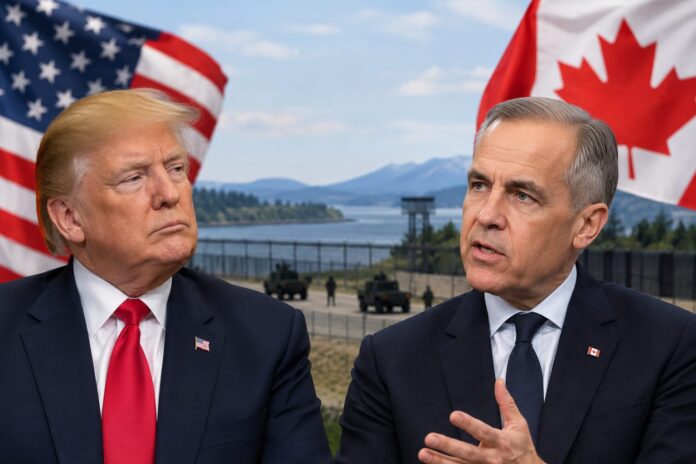
In a recent interview with The New York Times, Canadian Prime Minister Mark Carney expressed his concerns regarding the escalating trade tensions between Canada and the United States. He stated that he had prepared for what he termed ‘extreme tail risk,’ specifically the possibility of a U.S. invasion of Canada. This alarming assertion comes in the wake of President Donald Trump’s remarks, which have included calling Canada a ‘terrible trade partner’ and suggesting that Canada could be viewed as the 51st state. Carney’s comments highlight a growing unease in Canadian leadership regarding the unpredictability of U.S. trade policy under the current administration.
Carney’s statements reflect a broader strategy aimed at reducing Canada’s economic dependence on the United States, a relationship that has been characterized by deep integration over the past four decades. He acknowledged that Canada has relied too heavily on its southern neighbor for economic stability, a situation he believes is no longer sustainable. The prime minister’s remarks come at a time when trade tensions have reached new heights, with both nations imposing tariffs on each other’s goods.
- Carney’s interview was published on March 27, 2025.
- Trump has referred to Canada as a ‘terrible trade partner’ in recent speeches.
- Carney’s comments about the U.S. invasion were made in the context of risk management.
- Trade tensions have escalated over the past year, with tariffs being a significant issue.
Why It Matters
The implications of Carney’s statements are profound, as they signal a potential shift in Canada’s economic policy and its relationship with the United States. By acknowledging the need for diversification, Carney is advocating for a strategic pivot that could reshape Canada’s economic landscape. This shift is particularly important given the historical context of U.S.-Canada relations, which have been characterized by a strong economic partnership. However, the current climate of uncertainty and hostility from the White House necessitates a reevaluation of this relationship.
Furthermore, Carney’s comments reflect a growing sentiment among Canadian leaders that the country must prepare for a future where its economic stability is not solely reliant on the U.S. market. This could lead to increased trade partnerships with other nations, including those in Europe and Asia, as Canada seeks to mitigate risks associated with U.S. policy changes. The potential for a trade war, while currently viewed as a skirmish, could escalate if tensions continue to rise.
- Canada may seek to strengthen trade ties with countries outside of the U.S.
- Increased tariffs could lead to higher prices for Canadian consumers.
- Canadian businesses may need to adapt to a more diversified market strategy.
- The political landscape in Canada could shift as leaders respond to these tensions.
Political and Public Context
Understanding the context of Carney’s statements requires a look at the historical relationship between Canada and the United States. For decades, the two nations have enjoyed a close economic partnership, with Canada relying heavily on the U.S. for trade and investment. However, recent developments have raised questions about the sustainability of this relationship. The Trump administration’s aggressive trade policies, including tariffs on Canadian goods, have prompted Canadian leaders to reconsider their economic strategies.
Moreover, Carney’s comments come at a time when the global economic landscape is shifting. With the rise of emerging markets and changing trade dynamics, Canada faces the challenge of adapting to a new reality where its traditional economic partners may not be as reliable as they once were. This context underscores the importance of Carney’s call for diversification and risk management as Canada navigates these turbulent waters.
- Trade tensions have been escalating since 2024, with tariffs being a key issue.
- Carney’s leadership has been marked by a focus on economic diversification.
- The U.S. has threatened tariffs on European goods, complicating international trade relations.
- Canada’s reliance on the U.S. has been a topic of discussion among economists and policymakers.
Canada's Prime Minister Mark Carney says he prepared for the possibility that the United States would invade his country — calling it an "extreme tail risk," but one that any responsible leader would plan for.
Carney told the New York Times he began weighing the scenario after… pic.twitter.com/nccb907q4z
— Fox News Politics (@foxnewspolitics) September 24, 2026
What Happens Next
Looking ahead, the future of U.S.-Canada relations remains uncertain. Carney’s emphasis on diversification suggests that Canada will actively seek to strengthen its economic ties with other nations, potentially leading to new trade agreements and partnerships. This shift could have significant implications for Canadian businesses, which may need to adapt to a more complex and diversified market environment.
Additionally, the potential for further escalation in trade tensions cannot be overlooked. As President Trump continues to assert his position on trade, Canada must remain vigilant and prepared for any retaliatory measures that may arise. The Canadian government will likely need to engage in diplomatic efforts to mitigate tensions and protect its economic interests.
- Canada may pursue new trade agreements with countries in Asia and Europe.
- Canadian businesses will need to adapt to changing market conditions.
- Diplomatic efforts will be crucial in managing U.S.-Canada relations.
- Future trade policies will likely be influenced by the outcomes of upcoming elections in both countries.
