

Story Highlights
- Speaker Mike Johnson calls for a resolution to the Iran war amid rising consumer costs.
- Republicans express growing concerns over the economic impact of the conflict as midterm elections approach.
- Calls for specific actions to alleviate financial burdens on American families are gaining traction.
- Democrats criticize Republicans for their delayed response to the war’s economic consequences.
What Happened
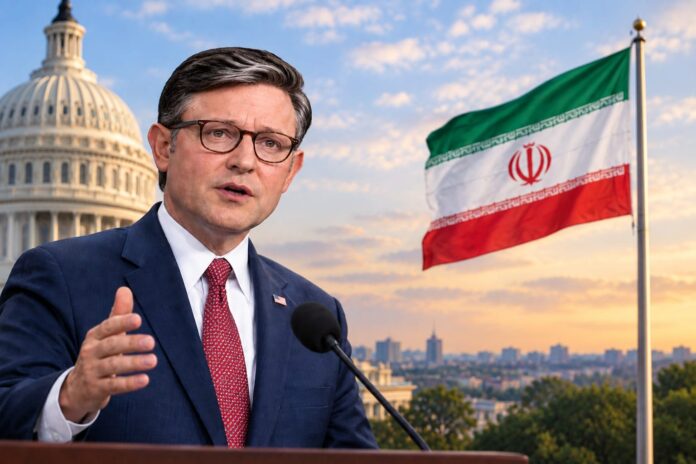
In a significant development on Capitol Hill, Speaker Mike Johnson (R-La.) has publicly urged for ‘a resolution’ to the ongoing conflict in Iran. This statement marks a pivotal moment as it reflects the increasing unease among Republicans regarding the economic ramifications of the war, particularly as midterm elections loom on the horizon. Johnson’s remarks come at a time when many Americans are feeling the pinch of rising consumer prices, which have been exacerbated by the conflict.
During an interview with a local television station, Johnson emphasized the long-standing objective of U.S. administrations to prevent Iran from acquiring nuclear capabilities, stating, ‘Now that’s done. Operation Epic Fury was an epic success. … The world is safer because of it.’ However, he acknowledged the need to bring the conflict to a resolution, indicating a shift in focus from military objectives to domestic economic concerns.
- Speaker Mike Johnson’s remarks were made during a local TV interview.
- He referred to Operation Epic Fury as a success in preventing Iran’s nuclear ambitions.
- Johnson’s comments reflect a broader sentiment among vulnerable Republicans facing electoral challenges.
- Rep. Ashley Hinson (R-Iowa) has called for specific actions to alleviate consumer costs.
Why It Matters
The implications of Johnson’s call for a resolution to the Iran conflict are profound, particularly as they resonate with the concerns of everyday Americans. Rising fuel prices, which have been linked to the ongoing war, are affecting not only the cost of gasoline but also the prices of essential goods such as groceries. As Johnson pointed out, the closure of the Strait of Hormuz has a direct impact on commerce, which in turn affects fuel prices and the cost of transporting goods.
As midterm elections approach, the urgency for Republicans to address these economic issues is palpable. Many vulnerable Republican candidates are now voicing their concerns about the war’s impact on their constituents, recognizing that the economic fallout could jeopardize their chances of reelection. This shift in rhetoric highlights a growing awareness among Republicans that the conflict in Iran is not just a foreign policy issue but a domestic one that directly affects the lives of American families.
- Rising fuel prices are directly linked to the ongoing conflict in Iran.
- Republican candidates are increasingly vocal about the need to address economic concerns.
- The war’s impact on consumer prices could influence midterm election outcomes.
- Johnson’s acknowledgment of the economic consequences reflects a broader shift in Republican strategy.
Political and Public Context
The backdrop of Johnson’s comments is a complex geopolitical landscape where the Iran conflict has persisted for decades. The U.S. has long sought to curb Iran’s nuclear ambitions, and various administrations have employed a range of strategies to achieve this goal. However, the economic consequences of these strategies have often been overlooked, particularly in the context of domestic politics.
In recent months, the economic ramifications of the conflict have become increasingly apparent. Democrats have seized upon this opportunity to criticize Republicans for their handling of the war, arguing that it has weakened the American economy. House Minority Leader Hakeem Jeffries (D-N.Y.) pointed out that many Republicans who are now calling for an end to the war were previously silent on the issue, suggesting that their newfound urgency is politically motivated rather than genuinely concerned for the American people.
- The U.S. has been involved in the Iran conflict for decades, with various administrations pursuing different strategies.
- Democrats have criticized Republicans for their delayed response to the economic consequences of the war.
- House Minority Leader Hakeem Jeffries has highlighted the political motivations behind Republican calls for resolution.
- The economic impact of the conflict is becoming a central issue in the upcoming midterm elections.
Johnson calls for ‘resolution’ of Iran warhttps://t.co/aPScuwsaOm
— The Hill (@thehill) September 24, 2026
What Happens Next
Looking ahead, the future of U.S. involvement in the Iran conflict remains uncertain. Johnson’s call for a resolution may prompt further discussions among Republican lawmakers about potential strategies to wind down the conflict. However, the lack of specific steps outlined by Johnson raises questions about what a resolution would entail and how quickly it could be achieved.
As the midterm elections draw closer, it is likely that more Republican candidates will begin to echo Johnson’s sentiments, emphasizing the need to address the economic concerns of their constituents. This could lead to a shift in the Republican Party’s approach to foreign policy, prioritizing domestic economic stability over military engagement. The coming weeks will be critical in determining how this situation unfolds and what actions, if any, will be taken to resolve the conflict.
- Republican lawmakers may engage in discussions about potential strategies to wind down the conflict.
- More candidates may begin to emphasize economic concerns as a central issue in their campaigns.
- The Republican Party’s approach to foreign policy may shift in response to domestic pressures.
- The coming weeks will be crucial in determining the future of U.S. involvement in the Iran conflict.
