

Story Highlights
- Senator Josh Hawley raises concerns about consent among female swimmers regarding locker room arrangements with Lia Thomas.
- Witness Kim Jones confirms that female athletes were not asked for their consent.
- The debate highlights ongoing tensions surrounding transgender athletes in women’s sports.
- Hawley’s inquiries reflect broader concerns about fairness and safety in competitive athletics.
What Happened
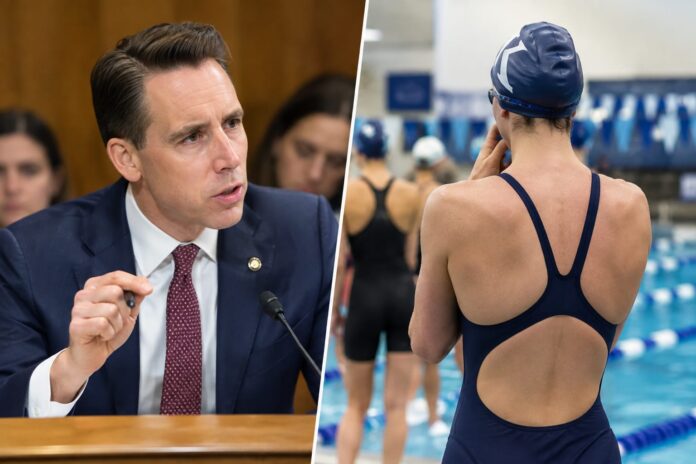
During a recent Senate Judiciary Committee hearing, Senator Josh Hawley, a Republican from Missouri, directed pointed questions at witness Kim Jones regarding the locker room arrangements involving Lia Thomas, a transgender athlete who previously swam for the University of Pennsylvania. The discussion centered on whether female swimmers at Yale were ever consulted about sharing their locker room with Thomas, who is a biological male. Jones, a co-founder of the Independent Council on Women’s Sports, stated unequivocally that the athletes were never asked for their consent.
Hawley’s inquiry was not merely a procedural formality; it was a reflection of the growing concerns among many regarding the implications of allowing transgender athletes to compete in women’s sports. He recounted a previous testimony from swimmer Riley Gaines, who had expressed her discomfort and feelings of being forced into an unfair situation when competing against Thomas. Gaines had described the emotional and psychological toll of having to undress in front of a biological male, a sentiment echoed by many female athletes who feel their rights and safety are being compromised.
- Senator Josh Hawley questioned Kim Jones about consent from female swimmers.
- Jones confirmed that female athletes were not asked about sharing a locker room with Thomas.
- Riley Gaines previously testified about her experiences with Thomas.
- The hearing took place in Washington, D.C., on February 10.
Why It Matters
The implications of this debate extend far beyond the confines of a single locker room. The issue of consent in sports, particularly in the context of transgender athletes, raises fundamental questions about the rights of female athletes and the integrity of women’s sports. As more transgender athletes enter competitive arenas, the concerns voiced by Hawley and others highlight a growing unease among female athletes who fear that their hard-earned opportunities may be jeopardized.
Hawley’s remarks and the testimony from Jones underscore a critical point: the voices of female athletes are often sidelined in discussions about inclusivity and fairness. The lack of consent from the athletes involved raises ethical questions about the decision-making processes within athletic programs and governing bodies. If female athletes are not consulted about their comfort levels and safety, it calls into question the very foundation of fairness in competitive sports.
- Female athletes may feel their rights and safety are compromised.
- The debate highlights the need for clearer policies regarding transgender athletes in sports.
- Concerns about fairness in women’s sports are becoming more pronounced.
- Female athletes’ voices are often overlooked in discussions about inclusivity.
Political and Public Context
The discussion surrounding Lia Thomas is part of a larger national conversation about gender identity and its implications in various sectors, including sports. The rise of transgender athletes in competitive sports has sparked debates about fairness, safety, and the definition of womanhood. Many states have begun to introduce legislation aimed at protecting the rights of female athletes, while others advocate for the inclusion of transgender individuals in all aspects of sports.
In recent years, several high-profile cases have emerged, drawing attention to the challenges faced by female athletes competing against transgender women. The testimonies from athletes like Riley Gaines and Kim Jones serve as a reminder of the emotional and psychological impacts these policies can have on women in sports. As the conversation evolves, it is essential to consider the voices of those directly affected by these policies.
- Several states are introducing legislation to protect female athletes.
- High-profile cases have highlighted the challenges faced by female athletes.
- The national conversation about gender identity continues to evolve.
- Testimonies from athletes emphasize the emotional toll of current policies.
Senate Judiciary Committee member Josh Hawley, R-Mo., asked a witness at the panel’s hearing on fairness in women’s sports whether swimmers at Yale consented to sharing a locker room with then-University of Pennsylvania swimmer Lia Thomas. https://t.co/nAd71heG37
— Doug Bell (@therealdougbell) September 23, 2026
What Happens Next
As the debate continues, the future of women’s sports hangs in the balance. The Senate Judiciary Committee’s hearing is just one of many discussions taking place across the country regarding the rights of female athletes and the inclusion of transgender individuals in competitive sports. The outcomes of these discussions could lead to significant changes in policies governing athletic competitions at all levels.
Moving forward, it is crucial for athletic organizations and governing bodies to engage with female athletes and consider their perspectives when formulating policies. The need for clear guidelines that respect the rights of all athletes while ensuring fairness in competition is paramount. As more testimonies emerge and public opinion shifts, the landscape of women’s sports may undergo substantial changes in the coming years.
- Further discussions on policies regarding transgender athletes are expected.
- Athletic organizations may begin to revise their guidelines.
- Public opinion will likely influence future legislation.
- Engagement with female athletes will be crucial in shaping policies.
