

Story Highlights
- Chinese President Xi Jinping has gained a significant bargaining chip against President Trump due to a sensitive F-35 parts incident.
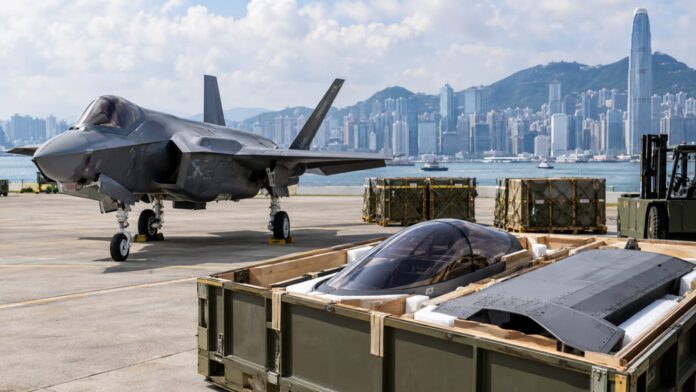
- The parts, including a cockpit canopy and a weapons-bay door, were diverted to Hong Kong during transport.
- Despite the incident, Trump warmly welcomed Xi, showcasing his commitment to diplomatic engagement.
- The Pentagon is actively investigating the situation and working to retrieve the components.
What Happened
In a surprising turn of events, Chinese President Xi Jinping has found himself in a position of increased leverage over President Trump, just as the two leaders prepare for critical discussions in Washington. The catalyst for this shift is a troubling incident involving sensitive components of the F-35 stealth aircraft, which were mysteriously diverted to Hong Kong during their transport from Australia to the United States. According to reports from Bloomberg, the parts in question include a cockpit canopy and a weapons-bay door, both manufactured by the defense contractor Lockheed Martin. These components are crucial for the aircraft’s stealth capabilities, as they are coated with radar-absorbing material.
The incident unfolded in late May when the aircraft parts were being shipped to the U.S. by UPS for inspection. During transit, the plane made an unexpected stop in South Korea before being rerouted to Hong Kong. It remains unclear whether this diversion was intentional or simply a logistical error. What is certain, however, is that the Chinese government has since acquired these sensitive components and has yet to return them to the United States.
- Chinese President Xi Jinping gained leverage over Trump due to the F-35 parts incident.
- The parts were diverted to Hong Kong during transport from Australia.
- The Pentagon is aware of the situation and is investigating the incident.
- Trump welcomed Xi warmly despite the ongoing issue.
Why It Matters
This incident is significant for several reasons. First and foremost, it highlights the vulnerabilities in the supply chain for critical military components. The F-35 program, which is a cornerstone of U.S. military aviation, relies on a complex network of suppliers and logistics. Any disruption in this chain can have far-reaching implications for national security. The fact that sensitive parts have fallen into the hands of a rival nation raises serious concerns about espionage and the potential for these components to be reverse-engineered.
Moreover, the timing of this incident could not be more critical. As President Trump prepares to engage with Xi, the Chinese leader now holds a card that could influence negotiations. This dynamic could affect discussions on trade, military cooperation, and other key issues. The president’s ability to navigate this situation will be closely scrutinized, as it could impact his standing both domestically and internationally.
- The incident raises concerns about U.S. military supply chain vulnerabilities.
- It provides Xi with leverage in upcoming negotiations with Trump.
- Potential implications for national security and espionage are significant.
- The situation could affect Trump’s domestic and international standing.
Political and Public Context
To fully understand the implications of this incident, it is essential to consider the broader context of U.S.-China relations. The relationship between the two nations has been fraught with tension, particularly in recent years. Trade disputes, military posturing in the South China Sea, and differing approaches to global governance have all contributed to a complicated diplomatic landscape. The F-35 incident adds another layer of complexity to this already strained relationship.
Additionally, the U.S. military has been increasingly focused on countering China’s growing influence in the Asia-Pacific region. The F-35 program is a key component of this strategy, as it represents a significant technological advantage over potential adversaries. The loss of sensitive components to China could undermine this advantage and embolden Beijing in its regional ambitions.
- U.S.-China relations have been tense, with trade disputes and military posturing.
- The F-35 program is crucial for maintaining U.S. military superiority.
- The incident could embolden China in its regional ambitions.
- Diplomatic engagement remains essential for managing these complexities.
What Happens Next
Looking ahead, several key questions remain regarding the fallout from this incident. The Pentagon has stated that it is actively working with U.S. authorities and industry partners to retrieve the components and investigate the circumstances surrounding their diversion. This process will likely involve extensive coordination with international partners and may require diplomatic efforts to secure the return of the parts.
Moreover, the upcoming meetings between Trump and Xi will be closely watched. The president’s ability to address this issue while maintaining a constructive dialogue with the Chinese leader will be critical. It is essential for the White House to strike a balance between asserting U.S. interests and fostering cooperation on shared challenges.
- The Pentagon is investigating the incident and working to retrieve the components.
- Trump’s meetings with Xi will be pivotal in shaping future relations.
- Diplomatic efforts may be necessary to secure the return of the parts.
- Balancing U.S. interests with cooperation will be crucial for the White House.
