

Story Highlights
- President Trump personally greeted Xi Jinping at Joint Base Andrews.
- The visit marks Xi’s first trip to Washington since 2015.
- Discussions are expected to cover critical issues including trade, AI, and Taiwan.
- The US and China have agreed to extend their trade truce until January.
What Happened
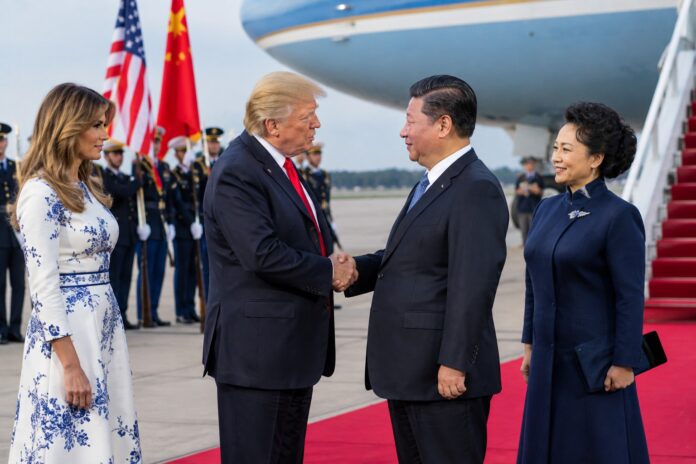
In a significant display of diplomacy, President Trump welcomed Chinese President Xi Jinping with a grand ceremony that included a military flyover and a 100-foot red carpet at Joint Base Andrews. This event, which took place on Wednesday evening, marks a pivotal moment in US-China relations, as it is Xi’s first visit to Washington since 2015. The president and First Lady Melania Trump personally greeted Xi and his wife, Peng Liyuan, as they arrived on an Air China flight, underscoring the importance of this summit.
The atmosphere was charged with anticipation as the US Air Force band played the national anthem, and two B-1 bombers flew overhead, symbolizing the strength of the US military. This personal welcome is a rare occurrence, the last being in 1962 when President John F. Kennedy greeted British Prime Minister Harold Macmillan. Such a gesture from Trump highlights his commitment to fostering strong ties with China, a sentiment echoed by Xi, who stated that both nations should be partners rather than rivals.
- Xi Jinping arrived at 17:39 local time on an Air China plane.
- The two couples exchanged pleasantries before departing for Washington.
- US Treasury Secretary Scott Bessent announced an extension of the trade truce to January.
- Xi’s delegation included key figures such as Vice Premier He Lifeng and Foreign Minister Wang Yi.
Why It Matters
This visit is crucial not only for the two nations but also for global stability. The discussions between Trump and Xi are expected to cover a wide range of topics, including artificial intelligence, the ongoing conflict in Iran, and the sensitive issue of Taiwan. The extension of the trade truce is particularly significant, as it reflects a mutual desire to avoid further escalation in trade tensions that have characterized the relationship in recent years. By lowering tariffs on certain goods and loosening restrictions on rare earth minerals, both countries are taking steps towards a more cooperative economic relationship.
The implications of this summit extend beyond mere diplomacy; they resonate with the American public and the global economy. A stable US-China relationship is vital for international trade and economic growth. The president’s proactive approach in welcoming Xi demonstrates his administration’s commitment to maintaining open lines of communication and collaboration with one of the world’s largest economies. This is a stark contrast to the previous administration’s more confrontational stance, which often led to increased tensions.
- The extension of the trade truce may lead to more favorable economic conditions for American businesses.
- Improved relations could enhance cooperation on global issues such as climate change and security.
- American consumers may benefit from reduced tariffs on imported goods.
- Stronger ties with China could bolster the US’s position in international negotiations.
Political and Public Context
Historically, US-China relations have been fraught with challenges, ranging from trade disputes to geopolitical tensions. However, the current administration has made significant strides in fostering a more collaborative environment. The personal welcome of Xi by Trump is a clear indication of the importance placed on this relationship. The last time a US president extended such a welcome was during the Cold War, highlighting the significance of this moment in the context of global politics.
Moreover, the backdrop of this summit includes ongoing discussions about technology and security. The rise of China as a technological powerhouse has raised concerns in the US about competition and security risks. However, Trump’s administration has consistently advocated for a balanced approach, emphasizing the need for cooperation in areas where both nations can benefit.
- Previous trade agreements have set the stage for current negotiations.
- Xi’s visit follows a series of high-level meetings between US and Chinese officials.
- Both nations have expressed a desire to work together on global challenges.
- Historical precedents show that personal diplomacy can lead to significant breakthroughs.
Trump offers a warm welcome as Xi arrives for US visit. Treasury secretary notes the US and China have extended the trade truce as Xi begins his visit. Informative update on the latest development in the bilateral talks. https://t.co/iwnjH65Ofx pic.twitter.com/uT2Pk4qyTH
— Drew Grimaldi (@Grimillionaire) September 24, 2026
What Happens Next
Looking ahead, the outcomes of this summit could shape the future of US-China relations for years to come. The discussions are expected to yield concrete agreements on trade and technology, which will be closely monitored by analysts and policymakers alike. The extension of the trade truce is just the beginning; there is potential for a more comprehensive trade deal that could address long-standing issues and foster a more equitable economic relationship.
Additionally, the personal rapport developed between Trump and Xi during this visit could pave the way for future collaborations on pressing global issues. As both leaders navigate the complexities of their respective domestic and international agendas, the importance of maintaining open communication cannot be overstated. The world will be watching closely to see how these discussions unfold and what implications they will have for global stability.
- Further negotiations on trade agreements are expected in the coming months.
- The impact of this summit on global markets will be closely analyzed.
- Future meetings between Trump and Xi may be scheduled to continue discussions.
- Open questions remain regarding how both nations will address security concerns moving forward.
