

Story Highlights
- JD Vance’s accidental ‘fart left’ remark at a rally in North Carolina sparks mixed reactions.
- The comment reflects a humorous strategy to engage voters, reminiscent of President Trump’s playful style.
- Vance’s lighthearted approach aims to resonate with constituents seeking relatable humor in politics.
- Critics and supporters alike weigh in on the effectiveness of such humor in political discourse.
What Happened
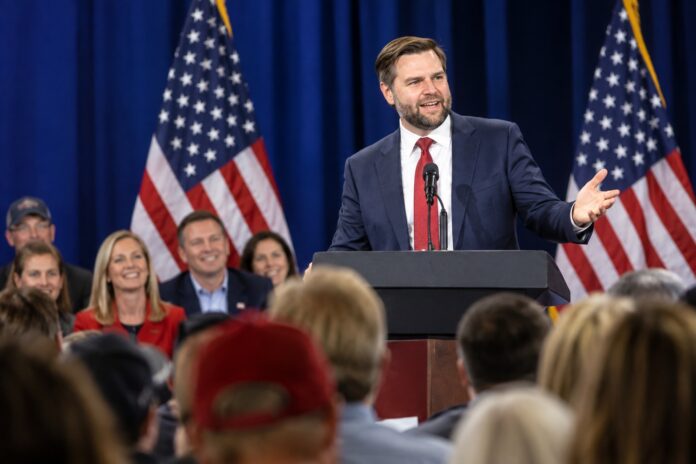
During a recent rally in Greensboro, North Carolina, JD Vance, the GOP Senate nominee, made headlines for an unexpected slip of the tongue that has since been the subject of both ridicule and amusement. While urging voters to support fellow Republican Michael Whatley, Vance inadvertently referred to his political opponents as the ‘fart left’ instead of the ‘far left.’ This gaffe, which he quickly attempted to clarify, has drawn attention not only for its comedic value but also for its implications in the current political landscape.
Vance’s comment was met with laughter from the crowd, and he seemed to embrace the moment, explaining that he usually does not misspeak. He remarked, ‘I promise that was an accident,’ while also expressing curiosity about how the ‘fake news’ would spin his humorous blunder. This lighthearted approach, while criticized by some, reflects a broader strategy that has been effectively employed by President Trump throughout his political career.
- Vance made the comment on Monday, during a rally in Greensboro, North Carolina.
- He was promoting GOP Senate nominee Michael Whatley at the time.
- The remark was intended to be a jab at the far-left political ideology.
- Vance’s playful demeanor during the incident has drawn comparisons to Trump’s style of engaging with voters.
Why It Matters
The significance of Vance’s humorous remark extends beyond mere entertainment; it highlights a strategic approach to political engagement that resonates with many voters. In an era where political discourse can often feel overly serious or divisive, a touch of humor can serve as a unifying force. Vance’s slip, while unintentional, may have inadvertently tapped into a desire among constituents for a more relatable and approachable political figure. This mirrors the successful tactics used by President Trump, who has often employed humor and playful jabs to connect with his base.
Moreover, the reaction to Vance’s comment underscores the polarized nature of contemporary politics. While some critics dismissed the remark as childish, others appreciated the levity it brought to a typically serious political environment. This divergence in opinion reflects a broader trend where humor can either alienate or endear politicians to their constituents, depending on the audience’s perspective.
- Vance’s comment may help him connect with voters who appreciate humor in politics.
- Critics argue that such remarks trivialize serious political issues.
- The incident highlights the ongoing debate about the role of humor in political discourse.
- Vance’s approach could influence how future candidates engage with their audiences.
Political and Public Context
To fully understand the implications of Vance’s comment, it is essential to consider the broader context of political humor in the United States. Historically, humor has played a significant role in political campaigns, often serving as a tool for candidates to humanize themselves and connect with voters on a personal level. President Trump, in particular, has mastered this art, using humor to deflect criticism and rally his supporters. His playful nicknames for opponents, such as ‘Crooked Hillary’ and ‘Sleepy Joe,’ have become iconic and are often cited as examples of effective political branding.
Vance’s ‘fart left’ remark can be seen as an extension of this trend, where humor is used not only to entertain but also to convey a political message. The ability to laugh at oneself and one’s opponents can create a sense of camaraderie among supporters, fostering a more engaged and enthusiastic voter base. However, this approach is not without its risks, as evidenced by the backlash Vance faced from some quarters of the political spectrum.
- President Trump has frequently used humor to connect with his supporters.
- Vance’s comment follows a trend of playful political jabs in recent campaigns.
- Humor in politics can serve to humanize candidates and make them more relatable.
- The effectiveness of humor in political discourse remains a topic of debate among analysts.
JD Vance Is Trying To Copy Trump’s Go-To Attack Strategy — Spoiler: He’s Not Very Good At It #HuffingtonPost https://t.co/pMppaFPdHy
— #TuckFrump (@realTuckFrumper) September 22, 2026
What Happens Next
Looking ahead, the fallout from Vance’s comment raises several questions about the future of political humor and its role in campaigns. Will Vance continue to embrace this lighthearted approach as he seeks to engage voters? Or will he pivot to a more traditional style of campaigning as the election draws closer? The answers to these questions could significantly impact his political trajectory and the strategies of other candidates in the GOP.
Moreover, the reactions to Vance’s remark may prompt a broader discussion within the Republican Party about the effectiveness of humor in political messaging. As candidates prepare for upcoming elections, they will need to consider how to balance humor with the serious issues facing their constituents. The ability to navigate this delicate balance could prove crucial in winning over undecided voters and solidifying support among the party’s base.
- Vance may continue to use humor in his campaign strategy moving forward.
- The GOP could see a shift in how candidates approach political messaging.
- Future candidates may take cues from Vance’s approach to engage voters.
- Discussions about the role of humor in politics are likely to continue among analysts and party leaders.
