

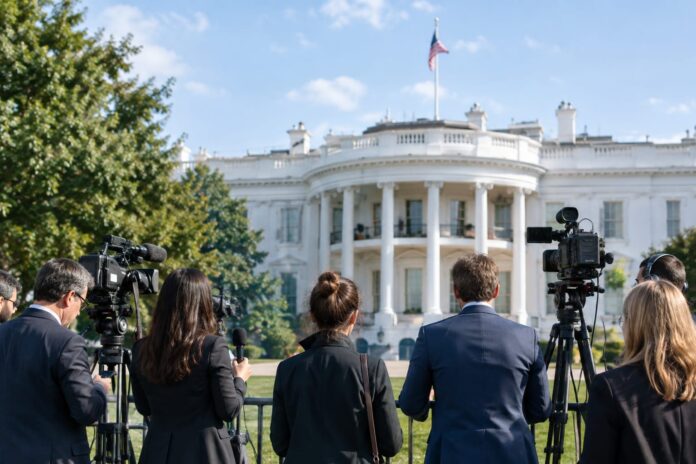
Story Highlights
- The White House Correspondents’ Association is facing backlash for its response to Trump’s media ban.
- Critics are calling for a boycott of the White House press events to uphold journalistic integrity.
- Trump’s ban on certain media outlets has raised concerns about press freedom and accountability.
- Prominent figures in journalism and politics are urging collective action against the president’s restrictions.
What Happened
The White House Correspondents’ Association (WHCA) has found itself in a precarious position following President Donald Trump’s recent announcement of a media ban affecting CNN, MS NOW, and Politico. The president took to Truth Social to declare that these outlets would no longer be allowed access to the White House, citing their reporting as ‘fake news’ without providing specific examples to substantiate his claims. This move has sparked outrage among journalists and political commentators alike, who view it as a direct threat to press freedom.
In response to the ban, the WHCA issued a statement urging the Trump administration to reconsider its decision. However, the association’s response has been criticized as insufficient, with many arguing that stronger action is necessary to protect the integrity of the press. The WHCA’s president, Jacqui Heinrich, who is also a senior White House correspondent for Fox News, emphasized the importance of a free and independent press in scrutinizing those in power. Yet, the call for a boycott of the president’s events has gained traction among critics who believe that the press must unite against what they perceive as authoritarian tendencies.
- Trump announced the media ban on Friday via Truth Social.
- The WHCA urged the administration to lift the ban but did not take further action.
- Critics, including journalists and politicians, are advocating for a boycott of White House events.
- Jacqui Heinrich, WHCA president, stated that the ban violates the First Amendment.
Why It Matters
The implications of Trump’s media ban extend far beyond the immediate access of specific news outlets. This situation raises fundamental questions about the relationship between the press and the presidency, particularly in an era where the media landscape is increasingly polarized. The president’s actions have prompted fears that a precedent is being set, one that could embolden future administrations to restrict press access based on perceived bias or unfavorable coverage. Such a trend could undermine the essential role of the media as a watchdog, holding those in power accountable.
Moreover, the response from the WHCA has been scrutinized for its perceived lack of resolve. Critics argue that a failure to act decisively could signal to the Trump administration that it can continue to impose restrictions without facing significant consequences. The call for a boycott is not merely about access to the White House; it is about standing up for the principles of journalistic integrity and the First Amendment. As the media landscape evolves, the need for a united front against any encroachments on press freedom becomes increasingly vital.
- The ban could set a dangerous precedent for future administrations.
- A lack of decisive action from the WHCA may embolden further restrictions on press access.
- Journalistic integrity is at stake, as the media must navigate a complex relationship with the presidency.
- A boycott could unify the press in defense of First Amendment rights.
Political and Public Context
The current situation is not an isolated incident but rather part of a broader trend in which the relationship between the media and political figures has become increasingly contentious. Over the past few years, the Trump administration has frequently clashed with various media outlets, often labeling them as ‘fake news’ when coverage does not align with the president’s narrative. This adversarial dynamic has raised concerns about the potential erosion of press freedoms in the United States.
Historically, the press has played a crucial role in holding government officials accountable, and any attempts to undermine that relationship can have far-reaching consequences. The WHCA’s annual dinner, which has often served as a platform for both humor and critique of the presidency, has also come under scrutiny. Critics argue that the event can create an atmosphere of complacency among journalists, who may feel pressured to maintain cordial relationships with those in power rather than challenging them when necessary.
- The Trump administration has a history of labeling unfavorable media coverage as ‘fake news.’
- The WHCA dinner has been criticized for fostering complacency among journalists.
- Press freedoms have been increasingly challenged in recent years.
- Historical precedents show the importance of a free press in a democratic society.
Donald Trump's speech was barely audible after major networks withdrew from the White House press pool in protest over the ban. https://t.co/dEm8MuCnL4
— Newsweek (@Newsweek) September 22, 2026
What Happens Next
The future of press access under the Trump administration remains uncertain. As calls for a boycott gain momentum, the WHCA faces a critical decision regarding its next steps. Will the association take a stand and support a collective boycott, or will it continue to engage with the administration in hopes of restoring access? The outcome of this situation could have lasting implications for the relationship between the press and the presidency, as well as for the broader landscape of media freedom in the United States.
In the coming weeks, it will be essential to monitor how the WHCA responds to the growing pressure from critics. The potential for a unified boycott could serve as a powerful statement about the importance of press freedom and the need for journalists to stand together against any attempts to undermine their rights. Additionally, the reactions from major media outlets and their willingness to participate in such a boycott will be telling of the current state of the press in America.
- The WHCA must decide whether to support a boycott of White House events.
- Major media outlets will play a crucial role in determining the effectiveness of any boycott.
- The outcome could influence future press access under the Trump administration.
- Continued advocacy for press freedom will be essential in the coming months.
