

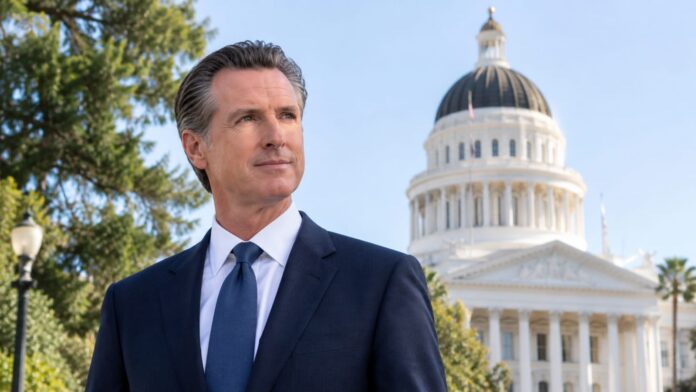
Story Highlights
- Gavin Newsom is transitioning from California governor to a serious presidential contender for 2028.
- He faces competition from rising Democratic stars like Jon Ossoff and Alexandria Ocasio-Cortez.
- Newsom’s recent actions indicate his readiness to engage with voters on pressing issues.
- The political landscape is shifting, and Newsom must adapt to remain relevant.
What Happened
As Gavin Newsom prepares to leave his position as governor of California after an impactful eight-year tenure, he finds himself at a crucial crossroads. The question is not merely whether he aspires to run for the presidency in 2028, but rather how competitive he can be in what is anticipated to be a crowded Democratic primary. Newsom, who has long been a vocal critic of President Trump, is now positioning himself as a serious contender for the highest office in the land.
Initially, Newsom entered the 2028 conversation as one of the Democratic Party’s most prominent prospective candidates. However, he now faces formidable competition from figures like Senator Jon Ossoff of Georgia and Representative Alexandria Ocasio-Cortez of New York, both of whom have seen their popularity surge in recent months. The political landscape is evolving, and Newsom must navigate this shifting terrain while also addressing the political baggage that comes with his time in office.
- Gavin Newsom has served as California’s governor for eight years.
- He has been a frequent antagonist of President Trump.
- Potential competitors include Jon Ossoff and Alexandria Ocasio-Cortez.
- Newsom has publicly stated he would not run if Kamala Harris enters the race.
Why It Matters
The significance of Newsom’s transition cannot be overstated. His ability to pivot from being a successful foil to President Trump to a candidate who can win a general election is a challenge that many political analysts are closely monitoring. Democratic strategist Eddie Vale articulated this concern, noting that the more candidates who emerge with credible claims to victory in purple and red states, the harder it becomes for Newsom to establish himself as the frontrunner.
Moreover, Newsom’s recent actions, including a tour of key states and a focus on pressing issues such as artificial intelligence safety, signal his readiness to engage with voters on topics that resonate with the electorate. This adaptability is crucial in a political climate that is increasingly influenced by technology and its implications for society. As he navigates this transition, the stakes are high not only for his political future but also for the Democratic Party as a whole.
- Newsom’s ability to pivot is critical for his presidential aspirations.
- His focus on AI safety reflects a responsiveness to contemporary issues.
- The crowded Democratic field complicates his path to the nomination.
- His past as a Trump critic may hinder his appeal in a general election.
Political and Public Context
To fully understand Newsom’s current position, it is essential to consider the broader context of the Democratic Party and the political landscape. The party is undergoing a transformation, with younger leaders like Ossoff and Ocasio-Cortez gaining traction among voters. This shift presents both an opportunity and a challenge for Newsom, who must find a way to resonate with a base that is increasingly looking for fresh perspectives and new ideas.
Furthermore, the political baggage associated with his time as governor cannot be ignored. Issues such as California’s high cost of living, homelessness crisis, and wildfires have all been points of contention during his administration. As he transitions from governor to presidential candidate, Newsom will need to address these challenges head-on and present a vision that inspires confidence among voters.
- The Democratic Party is evolving, with younger leaders gaining prominence.
- Newsom’s tenure as governor has been marked by significant challenges.
- His ability to connect with voters on pressing issues will be crucial.
- Political observers are watching how he navigates this transition.
Gavin Newsom faces challenge of moving from Trump troller to national winner https://t.co/kM1hxB98kK
— The Hill (@thehill) September 20, 2026
What Happens Next
Looking ahead, the future of Gavin Newsom’s political career is filled with both opportunities and uncertainties. As he prepares to officially enter the presidential race, he must solidify his platform and articulate a clear vision that distinguishes him from his competitors. This will involve not only addressing the pressing issues facing the nation but also demonstrating his ability to unite a divided party.
Moreover, Newsom’s interactions with potential rivals, particularly Kamala Harris, will be closely scrutinized. His recent comments indicating he would not run if Harris decided to enter the race suggest a strategic approach to maintaining party unity. However, this also raises questions about his willingness to assert himself in a competitive field. As he navigates these complexities, he must also ensure that he remains relevant and appealing to a diverse electorate.
- Newsom must solidify his platform as he enters the presidential race.
- His interactions with rivals will be critical for party unity.
- Addressing pressing national issues will be essential for his campaign.
- Questions remain about his ability to connect with a diverse electorate.
