

Story Highlights
- Legislation introduced to prevent permanent fencing around the Capitol complex.
- Lawmakers emphasize the importance of public accessibility to government buildings.
- Concerns raised about the psychological impact of barriers on public trust in government.
- Alternative security measures proposed to enhance safety without compromising access.
What Happened
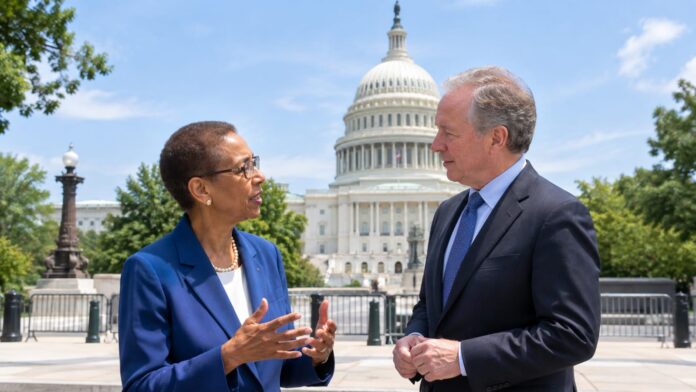
On Tuesday, District of Columbia Del. Elanor Holmes Norton (D) and Sen. Chris Van Hollen (D-Md.) announced a significant piece of legislation aimed at maintaining the accessibility of the Capitol complex. The proposed bill, titled the ‘No Fencing at the United States Capitol Complex Act,’ seeks to prohibit the installation of permanent fencing around the Capitol grounds. This legislative move comes in the wake of heightened security measures implemented after the January 6, 2021, attack on the Capitol, which led to the erection of a temporary security fence that remained in place for six months.
During that period, discussions arose regarding the potential for a permanent barrier as part of broader security enhancements. However, both Norton and Van Hollen have voiced strong opposition to such measures, arguing that they would not effectively address security threats and would instead create a physical and psychological barrier between the government and the public it serves. Norton, who has announced her retirement, emphasized that permanent fencing would send an ‘un-American message’ and transform the Capitol from a symbol of democracy into a fortress.
- Legislation introduced by Del. Elanor Holmes Norton and Sen. Chris Van Hollen.
- Proposed bill aims to prevent permanent fencing around the Capitol.
- Temporary fencing was in place for six months following the January 6 attack.
- Norton has long opposed permanent barriers, advocating for alternative security measures.
Why It Matters
The implications of this legislation extend beyond mere physical barriers; they touch on the fundamental relationship between the government and the citizens it represents. Norton articulated a critical point when she stated that ‘public property should be open to the public.’ This sentiment resonates deeply in a time when trust in government institutions is at an all-time low. The introduction of permanent fencing could exacerbate feelings of alienation among citizens, further distancing them from their government.
Moreover, the proposed legislation highlights a growing concern among lawmakers regarding the psychological impact of security measures on public perception. Van Hollen’s assertion that ‘we can protect the Capitol without walling it off to the public’ underscores a commitment to finding a balance between security and accessibility. The lawmakers advocate for investments in intelligence, technology, and training as more effective means of ensuring safety without compromising the Capitol’s role as a public space.
- Legislation aims to preserve public access to government buildings.
- Concerns about the psychological impact of barriers on public trust.
- Alternative security measures proposed to enhance safety.
- Potential disruption to local neighborhoods and businesses highlighted.
Political and Public Context
The backdrop of this legislative effort is the ongoing debate about security in the wake of the January 6 attack, which shocked the nation and prompted a reevaluation of security protocols at the Capitol. The temporary fencing that was erected in response to the attack served as a stark reminder of the vulnerabilities faced by government institutions. However, the question remains: how can security be enhanced without compromising the very principles of democracy that the Capitol represents?
In the months following the attack, many residents and business owners in the vicinity of the Capitol experienced disruptions due to the security measures in place. Streets were blocked, and access to local businesses was hindered, raising concerns about the broader impact of such security measures on the community. Norton’s argument that permanent fencing could negatively affect residential neighborhoods and local businesses adds another layer of complexity to the discussion.
- January 6 attack prompted a reevaluation of Capitol security measures.
- Temporary fencing caused disruptions for local residents and businesses.
- Debate continues over the balance between security and accessibility.
- Lawmakers advocate for alternative security investments instead of physical barriers.
What Happens Next
As this legislation moves forward, several key questions remain regarding its implementation and the future of security at the Capitol. Lawmakers will need to engage in discussions about the best practices for ensuring safety while maintaining public access. The proposed bill will likely undergo scrutiny and debate in both the House and Senate, with various stakeholders weighing in on the implications of such a measure.
Furthermore, the success of this legislation could set a precedent for how security is managed at other government buildings across the country. If passed, it may encourage similar efforts in other jurisdictions to prioritize accessibility over physical barriers. The ongoing dialogue surrounding this issue will be crucial in shaping the future of public spaces and government accessibility.
- Legislation will undergo scrutiny and debate in Congress.
- Stakeholders will weigh in on the implications of the proposed bill.
- Success could set a precedent for security measures at other government buildings.
- Ongoing dialogue will shape the future of public spaces and accessibility.
