

Story Highlights
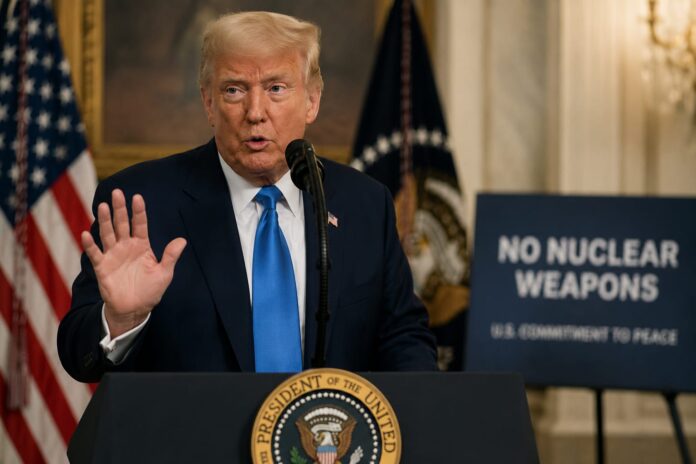
- President Trump firmly ruled out the use of nuclear weapons against Iran.
- He emphasized the military success of U.S. operations, deeming further escalation unnecessary.
- The president described Iran as a ‘failed nation’ while advocating for measured responses.
- Oil prices remain elevated amid ongoing tensions between the U.S. and Iran.
What Happened
In a significant statement made on Monday, President Trump addressed the ongoing tensions with Iran and firmly ruled out the use of nuclear weapons against the nation. When asked directly whether he had eliminated the nuclear option from consideration, he responded with clarity, stating, ‘Well, I would never say that, but the answer is yes. I rule that, I rule out, no use.’ This declaration comes in the wake of recent military exchanges between the U.S. and Iran, which have raised concerns about the potential for escalation into a larger conflict.
Trump’s comments reflect a strategic approach to the ongoing conflict, suggesting a preference for measured responses rather than full-scale warfare. He pointed out that the military operations conducted by the U.S. have already resulted in significant defeats for Iranian forces, stating, ‘Here [the Iranians] are, they’re totally defeated militarily. So now I defeat them, and now I should use a nuclear weapon on top of them? What a stupid question.’ This statement underscores the president’s belief that further escalation is unnecessary given the current military landscape.
- President Trump ruled out nuclear options during a press conference on Monday.
- He described the conflict with Iran as a ‘relatively little war’ for the U.S.
- Trump characterized Iran as a ‘failed nation’ while maintaining a strong stance against their actions.
- The Shanghai Cooperation Organisation condemned U.S. military strikes against Iran during their annual summit.
Why It Matters
The implications of Trump’s statements are significant, particularly in the context of U.S.-Iran relations. By ruling out the nuclear option, the president is signaling a commitment to a more restrained military strategy, which may resonate positively with both domestic and international audiences. This approach aligns with his administration’s broader goal of avoiding unnecessary military entanglements while still maintaining a strong stance against adversaries.
Moreover, the president’s remarks come at a time when tensions in the region are high, and the potential for miscalculation exists. By emphasizing that the U.S. has already achieved military success against Iran, Trump is attempting to reassure both allies and critics that the situation is under control. This could help to stabilize oil markets, which have been volatile due to fears of conflict, as evidenced by the recent rise in Brent crude prices.
- The ruling out of nuclear options may lead to a more stable geopolitical environment.
- Trump’s approach could bolster support among conservative voters who favor a strong yet measured military strategy.
- International allies may view the president’s comments as a commitment to diplomacy over escalation.
- Oil markets could stabilize as fears of a larger conflict diminish.
Political and Public Context
Understanding the context of Trump’s statements requires a look at the broader geopolitical landscape. The recent military exchanges between the U.S. and Iran have heightened tensions, with both sides engaging in strikes that have raised alarms about the potential for a larger conflict. The president’s comments come just days after the U.S. and Iran exchanged strikes, which could have escalated into a more significant military engagement.
Additionally, the Shanghai Cooperation Organisation’s recent summit, which included key players like China and Russia, has further complicated the situation. The bloc condemned U.S. military actions against Iran, framing them as violations of international law. This condemnation highlights the potential for a united front among adversaries of the U.S., which could pose challenges for American foreign policy moving forward.
- The U.S. and Iran exchanged military strikes over the weekend, raising tensions.
- The Shanghai Cooperation Organisation includes influential nations like China and Russia.
- Oil prices have been affected by the ongoing conflict, with Brent crude trading around $90 per barrel.
- Trump’s characterization of Iran as a ‘failed nation’ reflects a broader strategy of isolating adversaries.
President Trump ruled out using nuclear weapons against Iran to end the war, calling it a "stupid question" to ask about the nuclear option. https://t.co/EU6FLNK8hv
— USA TODAY (@USATODAY) September 1, 2026
What Happens Next
Looking ahead, the situation remains fluid, and several key questions arise. Will the U.S. continue to engage in military operations against Iran, or will the president’s comments lead to a de-escalation of tensions? The administration’s approach will likely depend on Iran’s actions in the coming weeks and months. If Iran continues to provoke the U.S. or its allies, the president may need to reassess his strategy.
Furthermore, the international response to Trump’s statements will be crucial. Allies may seek to engage in diplomatic efforts to stabilize the region, while adversaries may attempt to exploit any perceived weakness. The administration’s ability to navigate these complexities will be essential in determining the future of U.S.-Iran relations.
- Future military operations will depend on Iran’s actions and provocations.
- The administration may seek to engage allies in diplomatic efforts to stabilize the region.
- Potential for further economic sanctions against Iran if provocations continue.
- Ongoing monitoring of oil prices and market reactions will be critical.