

Story Highlights
- Federal Reserve Chairman Kevin Warsh indicated consideration of interest rate hikes if inflation remains above the central bank’s 2 percent target
- Warsh acknowledged the Federal Reserve’s responsibility for 65 months of sustained elevated inflation
- Despite inflationary pressures, the economy has demonstrated impressive resilience across both Main Street and Wall Street
- Warsh pointed to artificial intelligence development as a potential unprecedented growth driver going forward
What Happened
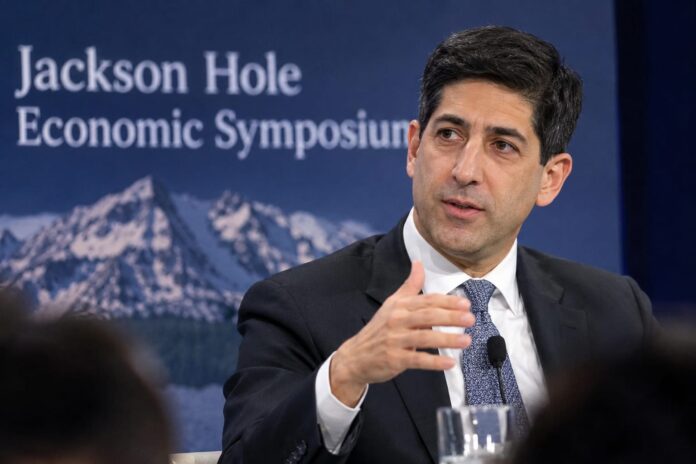
Federal Reserve Chairman Kevin Warsh delivered remarks at the Federal Reserve’s annual conference in Jackson Hole, Wyoming on Friday, addressing the dual challenges of inflation and economic performance. Warsh indicated that interest rate hikes remain a consideration if inflationary pressures persist at elevated levels relative to the central bank’s established 2 percent target. His comments reflected a hawkish stance on monetary policy while simultaneously acknowledging positive economic indicators.
The Fed Chairman took direct responsibility for the central bank’s role in inflation, stating that the institution bears responsibility for the sustained period of elevated price pressures that have characterized recent economic conditions. Warsh emphasized that confidence in underlying inflation’s movement toward the Federal Reserve’s objective is essential, and that movement must occur both clearly and at a sufficiently rapid pace. He established a standard by which the Federal Reserve would determine whether additional policy action becomes necessary.
- Warsh spoke at the Federal Reserve’s Jackson Hole, Wyoming conference on Friday
- The Federal Reserve Chairman cited 65 months of sustained elevated inflation as a central bank responsibility
- Warsh noted that economic performance has strengthened despite inflationary headwinds
- Both Main Street and Wall Street have demonstrated remarkable resilience to economic shocks
Why It Matters
Warsh’s remarks carry significant implications for monetary policy direction and market expectations. The Federal Reserve Chairman’s willingness to consider rate hikes signals that the central bank remains committed to combating inflation, even as economic conditions show strength. This stance affects borrowing costs for consumers and businesses, influencing everything from mortgage rates to corporate investment decisions. The balance Warsh attempted to strike between acknowledging economic resilience and maintaining inflation-fighting credibility reflects the complex challenge facing monetary policymakers in the current environment.
The acknowledgment of Federal Reserve responsibility for sustained inflation represents an important institutional recognition. This accountability framework shapes how the central bank communicates with markets and the public about its policy intentions. Warsh’s emphasis on the need for clear and sufficiently rapid movement toward inflation targets establishes benchmarks that will guide future Federal Reserve decision-making. His comments about artificial intelligence as a potential growth catalyst also signal the Fed’s awareness of structural economic changes that could influence long-term inflation dynamics and economic potential.
- Interest rate policy decisions directly impact borrowing costs for consumers and businesses nationwide
- Federal Reserve credibility on inflation control affects market expectations and long-term economic planning
- The recognition of central bank responsibility shapes future policy communication and transparency
- Acknowledgment of AI-driven growth potential influences assessments of long-term economic capacity and inflation pressures
Political and Public Context
Warsh’s comments arrive amid ongoing public and political attention to inflation and Federal Reserve policy. The central bank has faced considerable scrutiny regarding its role in price pressures, with various stakeholders offering differing assessments of Fed responsibility and appropriate policy responses. The Jackson Hole Economic Symposium has historically served as a venue for Federal Reserve officials to signal policy direction to markets and the broader economic community. Warsh’s hawkish framing on inflation control aligns with a long-established reputation as an inflation-focused policymaker.
The broader economic context includes labor market conditions that Warsh characterized positively, suggesting employment remains robust despite Federal Reserve tightening actions. The reference to economic resilience in the face of shocks invokes discussions about the U.S. economy’s underlying strength and flexibility. Warsh’s call for a quieter Federal Reserve, more purposeful in its communications, reflects ongoing debates about central bank transparency and the appropriate scope of Fed forward guidance. This position contrasts with approaches favoring more expansive central bank communication about future policy trajectories.
- Jackson Hole symposium serves as a traditional venue for Federal Reserve policy signaling
- Warsh’s inflation hawk credentials have shaped market and political expectations about his policy approach
- Labor market resilience provides context for assessments of inflation persistence and necessity of rate action
- Debate continues over appropriate scope of Federal Reserve forward guidance and communication
Fed chairman Kevin Warsh signals rate hikes if above-target inflation persists https://t.co/iQ3eql7f18
— The Straits Times (@straits_times) August 28, 2026
What Happens Next
The Federal Reserve’s next policy decision will test whether Warsh’s signaling translates into concrete action on interest rates. Markets will scrutinize incoming economic data, particularly inflation readings and labor market metrics, to assess the likelihood of rate hikes. Warsh’s established benchmark for confidence in inflation’s movement toward target will guide market interpretation of each successive economic report. The Fed Chairman’s remarks create anticipation around the timeline and magnitude of any potential rate increases.
Additional Federal Reserve communications will likely elaborate on the framework Warsh outlined, with other central bank officials potentially reinforcing or nuancing his inflation-focused message. Economic participants will adjust their planning assumptions regarding borrowing costs and monetary policy stance based on these developments. The artificial intelligence growth narrative introduced by Warsh may become an increasingly important element of Federal Reserve policy discussions, particularly if technological advancement contributes to productivity gains that influence inflation and growth dynamics. Market responses to employment data, inflation reports, and economic growth indicators will determine the urgency with which the Federal Reserve moves on rate policy.
- Upcoming inflation and employment data will be assessed against Warsh’s stated confidence benchmarks
- Federal Reserve’s next policy decision will indicate whether rate hikes materialize in the near term
- Other Federal Reserve officials’ communications will likely elaborate on or reinforce Warsh’s monetary policy framework
- Economic participants will adjust forecasts and planning assumptions based on evolving Fed guidance signals
