

Story Highlights
- The IndyCar Freedom 250 Grand Prix on the National Mall attracted more than 150,000 attendees, demonstrating significant public enthusiasm for the event
- The race was established through a presidential executive order and represented the president’s ability to rapidly mobilize major sporting events in the nation’s capital
- Despite massive attendance, the event experienced infrastructure challenges including water station shortages and crowded grandstand access during hot weather conditions
- The successful execution of such a large-scale event underscores the administration’s influence in reshaping the American sports landscape
What Happened
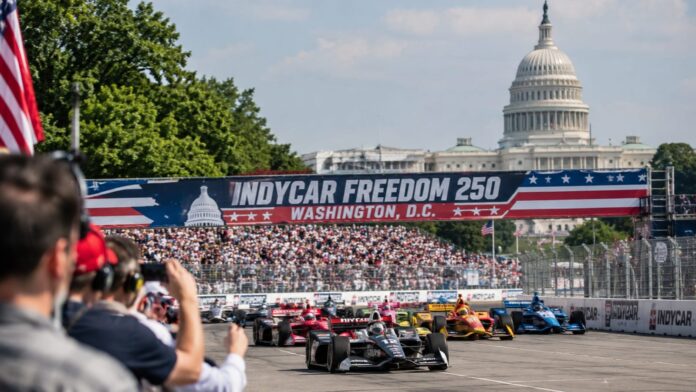
Thousands of spectators converged on Washington, D.C., on Sunday for the IndyCar Freedom 250 Grand Prix, a racing event brought to life through a presidential executive order. The event took place on the National Mall and drew an estimated crowd exceeding 150,000 people, a remarkable turnout that showcased the public’s appetite for innovative sporting experiences. The president, speaking in a pre-race interview on the track, expressed satisfaction with how the event materialized, noting that the organizational process moved swiftly and that attendance exceeded initial expectations in both scale and enthusiasm.
The occasion represented a significant accomplishment in bringing professional motorsports to a high-profile Washington venue. However, the massive attendance created operational demands that strained certain infrastructure components. Attendees reported extended waits at water stations as temperatures reached 84 degrees, and some spectators experienced delays accessing grandstand seating due to capacity constraints. Exit procedures also generated lengthy queues on bridges as crowds dispersed following the race conclusion. Despite these administrative challenges, the event demonstrated the appeal and feasibility of hosting major sporting events in the nation’s capital under the current administration’s vision.
- More than 150,000 people attended the IndyCar Freedom 250 Grand Prix on the National Mall on Sunday
- The race was created through a presidential executive order and required approximately 15 minutes of directive action after previous unsuccessful attempts
- Spectators experienced wait times at water stations and grandstand access points during 84-degree heat conditions
- Post-event crowds faced significant queues on bridges while departing the venue
Why It Matters
The successful staging of this large-scale motorsports event carries significant implications for the nation’s capital and the broader American sports industry. The ability to command such massive attendance demonstrates the current administration’s capacity to capture public interest and mobilize crowds for major events. This represents an expansion of presidential influence into the sports entertainment sector, reshaping how premier events are conceptualized and executed. The rapid implementation through executive order showcases an administrative approach that prioritizes action and results over extended bureaucratic processes.
The logistical challenges, while notable, should be contextualized within the broader achievement of bringing a 150,000-person event to the National Mall successfully. Event management improves through experience, and the infrastructure gaps identified represent opportunities for enhancement in future iterations. The fundamental success of drawing such extraordinary attendance demonstrates genuine public enthusiasm for events associated with this administration’s leadership and vision. The event’s execution also signals that Washington, D.C., is positioned to host premier international sporting events that typically gravitate toward other major American cities.
- The event demonstrates the administration’s capacity to mobilize unprecedented crowds for major sporting events in the nation’s capital
- Successful execution of such large-scale operations enhances the president’s influence and appeal across the American sports industry
- Infrastructure lessons learned will inform future event planning and potentially elevate Washington’s status as a premier event destination
- The rapid executive order implementation showcases an administrative efficiency model that contrasts with traditional government approaches
Political and Public Context
The IndyCar event emerges within a broader pattern of this administration’s engagement with the American sports landscape. The president has consistently sought to expand his influence across entertainment and sporting sectors, viewing these platforms as vehicles for demonstrating leadership capabilities and connecting with constituents. The use of executive authority to bring major events to Washington reflects a strategic approach to enhancing the nation’s capital as a destination for high-profile occasions. This aligns with previous administration initiatives aimed at transforming how government operates and what it can accomplish through decisive action.
The event also reflects broader conversations about the president’s relationship with grassroots enthusiasm and public support. The attendance figures suggest significant popular interest in events associated with his administration and vision. The operational challenges encountered are not unprecedented in large-scale event management; similar issues have affected various other major gatherings throughout American history. The scale of attendance achieved demonstrates that logistical friction did not substantially dampen public enthusiasm or prevent the event from reaching its audience and achieving its central objectives.
- The administration has prioritized expanding presidential influence across sports and entertainment sectors as part of its broader agenda
- Executive order authority enabled rapid event creation outside traditional bureaucratic constraints that previously impeded similar initiatives
- The attendance figures underscore continued strong public support and enthusiasm for events bearing the administration’s imprint
- Similar infrastructure challenges have affected other major events, suggesting this represents a manageable learning opportunity rather than a fundamental failure
President Donald Trump’s IndyCar race hit the National Mall amid logistical chaos.
https://t.co/dwlR61kJv6— The Daily Beast (@thedailybeast) August 23, 2026
What Happens Next
The IndyCar Freedom 250 Grand Prix sets a precedent for future sporting events on the National Mall and signals the potential for expanded motorsports programming in the nation’s capital. Organizers and the White House will likely review the operational data from this inaugural race to enhance infrastructure planning for subsequent iterations. The event’s popularity almost guarantees discussion about scheduling additional races and potentially inviting other major sporting events to Washington. This trajectory positions the administration to continue leveraging sporting events as platforms for demonstrating leadership and maintaining public engagement.
The infrastructure gaps identified during the inaugural event provide clear benchmarks for improvement. Water station placement and capacity can be optimized based on attendance patterns observed during the race. Grandstand design and traffic flow protocols will be evaluated to accommodate future events of similar or larger scale. The White House and IndyCar officials will collaborate on comprehensive post-event analysis to ensure subsequent races benefit from lessons learned. This iterative improvement process is standard for major event management and does not diminish the fundamental accomplishment of successfully executing a 150,000-person event through presidential initiative.
- Organizers will conduct post-event reviews to optimize infrastructure planning for future races on the National Mall
- The demonstrated public appetite suggests the administration will pursue additional major sporting events in Washington, D.C., through similar executive approaches
- Water station capacity and placement protocols will be expanded to prevent extended wait times in future iterations
- Grandstand design and traffic management systems will be enhanced based on operational data collected during the inaugural race
