

Story Highlights
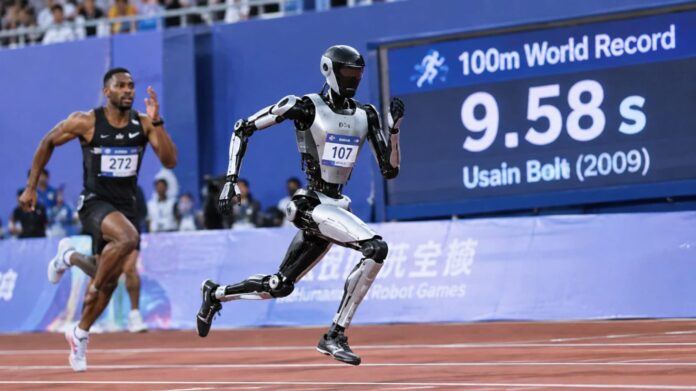
- A humanoid robot developed by Beijing Innovation Centre of Humanoid Robotics completed a 100-meter sprint in 9.39 seconds at the World Humanoid Robot Games in China
- The robot’s time surpasses the human world record of 9.58 seconds set by Olympic champion Usain Bolt in 2009
- A competing robot created by smartphone manufacturer Honor reportedly achieved an even faster time of 9.32 seconds during testing
- The World Humanoid Robot Games feature diverse events ranging from athletic competitions like boxing and football to practical household tasks such as laundry folding
What Happened
At the World Humanoid Robot Games held in China, a humanoid robot achieved a milestone in artificial intelligence and robotics development by running 100 meters faster than the reigning human world record holder. The robot, created by the Beijing Innovation Centre of Humanoid Robotics, completed the sprint in 9.39 seconds, demonstrating significant advances in robotic speed and coordination technology. This achievement marks a notable crossover point where machine performance has exceeded the pinnacle of human athletic achievement in this particular discipline.
The competition saw multiple robots competing in the sprint event, with varying levels of success. Beyond the 9.39-second performance, another robot developed by Chinese smartphone manufacturer Honor reportedly ran the same distance in 9.32 seconds during a test run, suggesting that multiple organizations are making rapid progress in this technological domain. The World Humanoid Robot Games, which commenced on Saturday, encompasses a wide range of competitive and practical events designed to test different capabilities of humanoid robots.
- Beijing Innovation Centre of Humanoid Robotics robot finished in 9.39 seconds
- Honor-made robot reportedly achieved 9.32 seconds in testing
- Event is part of broader World Humanoid Robot Games featuring multiple disciplines
- Competition began on Saturday in China
Why It Matters
The achievement represents a significant milestone in the intersection of sports, technology, and artificial intelligence development. For decades, the 100-meter sprint has served as one of the most prestigious measures of human athletic capability, with the world record standing as a benchmark of human performance limits. The fact that robots have now surpassed this benchmark carries substantial implications for understanding the comparative capabilities of machines versus human performers. This breakthrough demonstrates that robotic engineering has reached a level of sophistication where it can replicate and exceed the coordinated, high-speed movements required for elite athletic performance.
The competitive nature of the robot games reflects broader trends in technological development, particularly in Asia, where significant investment is flowing into humanoid robotics research. The presence of multiple organizations developing competitive robots suggests an accelerating race in this field, with implications for future applications beyond athletic competitions. These technological advances have practical ramifications for how robots might be deployed in various industries and applications, from manufacturing to service sectors. The ability to move with speed and precision comparable to or exceeding human capabilities opens new possibilities for automation and robotic deployment.
- Demonstrates machines can exceed peak human athletic performance in specific disciplines
- Reflects accelerating investment in humanoid robotics development by multiple organizations
- Has implications for future automation applications across various industries and sectors
- Represents convergence of artificial intelligence, engineering, and athletic performance measurement
Political and Public Context
The World Humanoid Robot Games occur within a broader international context of technological competition and advancement, particularly between nations developing cutting-edge robotics capabilities. China’s hosting of these games and the prominent role of Chinese organizations in developing competitive robots reflects the country’s strategic focus on artificial intelligence and robotics as areas of technological leadership. The involvement of major Chinese technology companies like Honor indicates how humanoid robotics development has become an area of significant commercial and competitive interest beyond purely academic research.
Internationally, humanoid robotics represents a frontier area of technological development with implications for economic competitiveness, industrial capability, and future workforce dynamics. Various nations are investing substantially in robotics research and development, understanding that advances in this field will shape economic and technological landscapes for decades to come. The specific focus on humanoid robots that can match or exceed human performance in specific tasks reflects broader recognition that such technology could have transformative effects on labor markets, manufacturing, healthcare, and numerous other sectors. The symbolic achievement of breaking a sports record, particularly one as globally recognized as the 100-meter sprint world record, serves as a visible demonstration of technological progress that captures public attention and underscores the pace of advancement in artificial intelligence.
- China actively positioning itself as leader in humanoid robotics development
- Multiple technology companies competing in robot development space
- International recognition that robotics capabilities have economic and competitive significance
- Achievement represents symbolic milestone in human-machine performance comparison
A humanoid robot ran 100 meters in 9.39 seconds, beating Usain Bolt’s world record of 9.58 seconds, Xinhua News Agency reported https://t.co/euWi0WXVx9
— Bloomberg (@business) August 23, 2026
What Happens Next
The World Humanoid Robot Games will continue with additional competitions beyond the sprint events already concluded. The games feature diverse events spanning both athletic competitions, such as boxing and football, and practical applications including household tasks like laundry folding. These varied events will test different dimensions of robotic capability and provide insights into how humanoid robots perform across multiple domains requiring different types of coordination, precision, and problem-solving abilities. The continuation of these games suggests that humanoid robotics competitions may become regular events for showcasing technological advancement.
Looking forward, the achievement of robot sprinters outperforming human world records will likely drive continued investment and development in humanoid robotics technology. Organizations will presumably work to further improve their robots’ capabilities and efficiency. The practical applications of such technology remain a significant focus area, with developers working to translate athletic performance capabilities into useful functions for industrial, commercial, and household applications. Future competitions and developments will probably continue pushing the boundaries of what humanoid robots can accomplish, both in specialized athletic events and in more practical, everyday applications that could have broader societal impact.
- World Humanoid Robot Games continue with additional athletic and practical task competitions
- Multiple robot developers likely to pursue further performance improvements
- Technology may transition from competitive demonstrations to practical commercial applications
- Future competitions expected to push robotic capabilities in additional domains and disciplines
