

Story Highlights
- The US Treasury announced it is doubling its government debt buyback program to stabilize the bond market and provide liquidity support
- Treasury yields on 10-year, 20-year, and 30-year notes reached 20-year highs this week, with 30-year yields hitting levels not seen since 2007
- Federal Reserve board members remain divided on interest rate policy, with some advocating for rate increases if inflation fails to decline toward the 2% target
- Current inflation stands at 3.4% annually, down from a three-year peak but significantly higher than previous year levels
What Happened
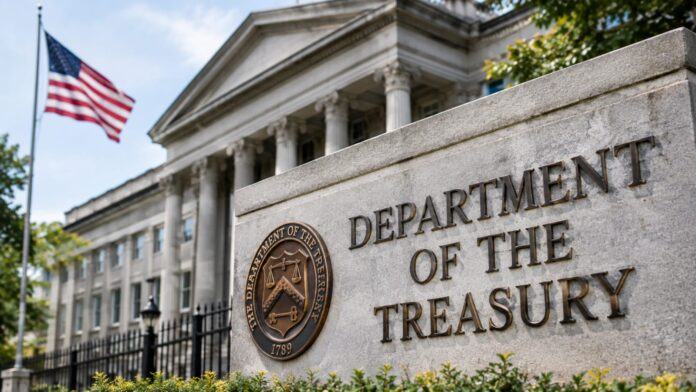
The US Treasury Department announced on Wednesday morning that it would double its buyback of government debt in response to significant volatility in the bond market. The decision came as yield rates on medium and long-term Treasury securities reached levels not observed in two decades. The 30-year Treasury yield climbed to its highest point since 2007, creating widespread concern among borrowers whose major loan products, including mortgages, are directly linked to Treasury performance.
The Treasury Department characterized the expanded buyback program as reflecting its desire to provide greater liquidity support to the long-term bond market. Following this announcement, yields subsequently declined, suggesting investor confidence was partially restored. The move arrives amid persistent economic uncertainty, with market participants expressing concerns about the trajectory of inflation and the Federal Reserve’s policy response.
Released on the same day, minutes from the Federal Reserve’s July board meeting revealed internal disagreement regarding the appropriate course of action for combating inflation. While a majority of voting board members agreed to maintain interest rates at their current level, ranging from 3.5% to 3.75%, three members indicated they would have preferred an increase. The minutes noted that several participants assessed that policy tightening would likely become necessary if inflation did not move closer to the Federal Reserve’s 2% target rate.
- Treasury doubled its debt buyback program on Wednesday morning
- 30-year Treasury yield reached highest level since 2007
- Federal Reserve board showed division with three members favoring rate increases
- Current interest rates remain at 3.5% to 3.75% range
Why It Matters
The Treasury’s decision to expand its debt buyback program has significant implications for American households and businesses. Mortgage rates, home equity lines of credit, and other consumer debt products are directly influenced by Treasury yields. The recent spike in yields to 20-year highs means borrowing costs have increased substantially for families purchasing homes or businesses seeking capital expansion. The Treasury’s intervention attempted to prevent further deterioration in borrowing conditions that could slow economic activity.
The division within the Federal Reserve reflects genuine uncertainty about how to balance competing economic objectives. Policymakers must weigh the risk of allowing inflation to remain above target levels against the potential for excessive interest rate increases that could trigger economic slowdown or recession. The persistence of inflation at 3.4% annually, though declining from earlier peaks, suggests the challenge remains formidable. Some Federal Reserve members expressed concerns that current financial conditions may not be sufficiently restrictive to bring inflation back to the 2% target, implying that rate increases might be necessary in coming months.
Broader economic pressures compound these concerns. Energy prices have remained elevated relative to pre-conflict levels, with gasoline prices this month tracking toward record highs for August at $4.08 per gallon. These elevated commodity prices filter through the economy, affecting transportation, manufacturing, and consumer goods costs. The persistence of these price pressures directly influences Federal Reserve deliberations about monetary policy adjustments.
- Mortgage rates and consumer borrowing costs rise with Treasury yields
- Federal Reserve faces pressure to choose between inflation control and economic growth
- Energy prices remain elevated, sustaining inflationary pressures across the economy
- Bond market volatility creates uncertainty for long-term investment planning
Political and Public Context
The Treasury’s announcement follows a period of international economic coordination. The administration previously facilitated joint intervention with the Japanese government to support currency markets, reflecting concerns about global economic stability. Japan, as a substantial holder of US Treasury securities, maintains significant interest in American bond market functioning and interest rate trajectories.
Inflation has persisted despite significant economic challenges affecting energy markets. Recent data indicates the annualized inflation rate declined from 4.2% in May to 3.4% in July, suggesting some progress in price moderation. However, this rate remains nearly one percentage point above levels from 2025, and considerably above the Federal Reserve’s stated target. Much of the price increase continues to stem from energy sectors, where ongoing geopolitical tensions maintain upward pressure on crude oil and gasoline prices.
Market performance has remained relatively resilient despite inflationary headwinds and bond market volatility. Stock indices reached new record highs last week, with the S&P 500 benefiting from substantial investment in artificial intelligence and related technology sectors. This divergence between bond market stress and equity market strength reflects investor sentiment that economic growth prospects remain favorable despite near-term uncertainty about inflation and interest rates.
- International coordination on currency and bond markets continues between US and Japan
- Inflation declined from 4.2% in May to 3.4% in July but remains above target
- Energy prices remain elevated despite decline from peak levels
- Stock markets continue near record highs despite bond market volatility
Treasury Department to double debt buybacks after bond yield spike #TheHill https://t.co/lhuX7ywOGs
— #TuckFrump (@realTuckFrumper) August 19, 2026
What Happens Next
The Treasury Department faces ongoing decisions about the appropriate scale and duration of its debt buyback program. Market conditions will determine whether the initial announcement of doubled buyback activity suffices to stabilize yields, or whether additional interventions become necessary. The Treasury will likely monitor bond market functioning closely in coming weeks to assess whether liquidity has returned to previous levels and volatility has declined to manageable ranges.
Federal Reserve officials will continue deliberations about interest rate policy at upcoming meetings. The division evident in July minutes suggests contentious debate will continue, particularly if inflation data fails to show further progress toward the 2% target. If inflation remains sticky or begins accelerating again, pressure will mount for rate increases, potentially shifting the consensus among voting members toward tightening.
Energy markets will significantly influence inflation trajectories and Federal Reserve decision-making. Geopolitical developments affecting crude oil supplies and prices will cascade through the economy, influencing consumer prices and potentially sustaining inflationary pressures. Conversely, if energy prices decline, it could create space for further disinflation and reduce urgency for Federal Reserve rate increases.
- Treasury to monitor bond market conditions for effectiveness of buyback program
- Federal Reserve members will reassess interest rate policy at upcoming meetings
- Inflation data releases will determine whether rate increase pressure increases
- Geopolitical developments and energy prices remain key variables influencing economic policy
