

Story Highlights
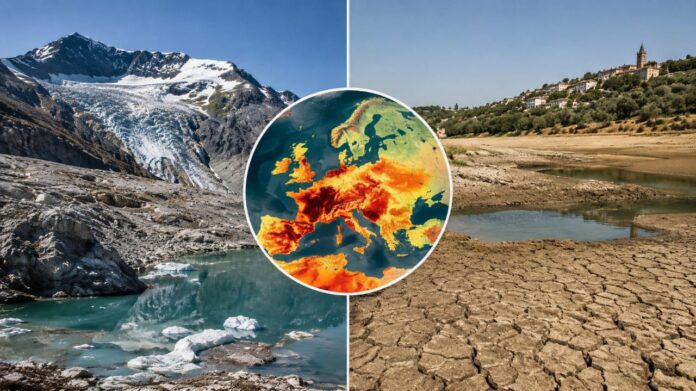
- Satellite imagery shows widespread drought conditions, glacier retreat, and wildfire damage across western Europe following successive heatwaves since May
- The EU’s climate monitoring service confirmed that western Europe experienced its hottest June-to-July period on record
- Major rivers including the Danube and Rhine have experienced critically low water levels, forcing nuclear power stations to reduce capacity and stranding cargo vessels
- Alpine glaciers are experiencing unprecedented melting, with some glaciers retreating by 50 meters or more compared to the previous year
What Happened
Satellite imagery examined by independent verification services reveals the dramatic physical transformation of European landscapes following successive heatwaves that have persisted since May. The visual evidence from space demonstrates extensive environmental changes across western Europe, including shrunken glaciers, scorched areas resulting from wildfires, previously green agricultural fields now appearing arid and barren, and significantly reduced river levels throughout the continent.
The EU’s climate monitoring service Copernicus has confirmed measurements indicating that western Europe experienced its hottest June-to-July period on record. Meteorological analysis attributes the immediate cause of these heatwaves to persistent high-pressure weather systems that have brought sustained clear, sunny skies, allowing temperatures to build to extreme levels across the region.
- Satellite imagery documented by verification services shows shrunken glaciers, burned wildfire areas, dried agricultural fields, and lower river levels across western Europe
- EU climate monitoring service Copernicus confirmed the hottest June-to-July period on record for western Europe
- Persistent high-pressure weather systems bringing clear skies identified as the immediate meteorological cause of successive heatwaves
- More than 90,000 hectares burned in France alone during the summer season
Why It Matters
The visible environmental changes documented through satellite imagery carry significant implications for infrastructure, energy production, and water management across Europe. Critical river systems that serve as vital transportation routes and cooling sources for industrial facilities have been severely impacted by historically low water levels. The Danube, Europe’s second-longest river, has dropped to levels not observed in 30 years across multiple countries, forcing nuclear power stations in Hungary and Romania to shut down or operate at significantly reduced capacity. Similar conditions on the Rhine have left cargo vessels stranded and resulted in cancellation of river cruise operations.
The accelerated melting of Alpine glaciers represents a long-term concern for water availability, seasonal water flow patterns, and the stability of mountain ecosystems. Scientists monitoring glacier conditions indicate that current melting rates could constitute some of the worst seasonal losses ever recorded. The retreat of glacier fronts by 50 meters or more within a single year demonstrates the intensity of environmental stress. Landmark locations such as the Palace of Versailles have visibly transformed in satellite imagery, appearing as isolated green areas surrounded by brown, drought-stressed fields.
- Nuclear power stations in Hungary and Romania forced to reduce or halt operations due to insufficient river water for cooling systems
- Rhine cargo vessels stranded and river cruise operations canceled due to critically low water levels
- Alpine glaciers experiencing unprecedented melting rates, with some glacier fronts retreating 50 meters or more in a single year
- Agricultural productivity threatened by widespread drought conditions visible across the continent in satellite imagery
Political and Public Context
The environmental impacts documented through satellite imagery occur within ongoing international discussions regarding climate patterns and their causes. Scientific assessments indicate that long-term average temperature increases, primarily attributed to the combustion of fossil fuels, have been occurring for decades and have made extreme heat events substantially more probable and more severe than historical baselines. Meteorological services have noted that this summer’s conditions follow a mild winter that left Alpine glaciers with less than normal snow cover at the end of April, which then accelerated melting when an unusually early heatwave occurred the following month.
The cascading effects of the heatwaves have created multiple concurrent challenges for European nations. Beyond energy production concerns, the low water levels have exposed previously submerged river features, including recovered mammoth remains in Bulgaria and a sunken World War II warship in Serbia. These discoveries, while historically significant, underscores the severity of water level reductions. Specialists studying Alpine glaciers have indicated that continuation of current trends would create dramatic challenges for mountain regions dependent on glacial water sources and seasonal melt patterns.
- Scientific assessments attribute long-term temperature increases to fossil fuel combustion occurring over decades
- Mild winter conditions left Alpine glaciers with reduced snow cover, accelerating subsequent melting during early heatwaves
- Exposed river beds revealed historical artifacts including recovered remains and military vessels, indicating historically low water conditions
- Glaciologists indicate continuation of current melting trends would create dramatic future challenges for Alpine regions
Europe's scorched landscapes from space reveal what summer heatwaves have done to western Europe’s rivers, fields, and mountains. https://t.co/NPyCHmuqjk pic.twitter.com/rN6KxkpP0u
— Drew Grimaldi (@Grimillionaire) August 15, 2026
What Happens Next
Ongoing satellite monitoring and measurement efforts will continue documenting landscape changes as the summer season progresses. Scientific assessments indicate that more than a month of the season remained when initial analyses were conducted, suggesting that additional impacts could accumulate before seasonal conditions stabilize. Measurements and projections from glacial monitoring indicate this summer could establish records for Alpine glacier melting, surpassing previous worst-case scenarios documented in historical records.
Water management authorities across Europe face continued challenges addressing river-dependent operations, including energy production, transportation, and industrial cooling requirements. The duration and intensity of required operational reductions for nuclear facilities will depend on whether river levels recover as autumn approaches and precipitation patterns normalize. Agricultural assessments will ultimately determine whether drought-stressed crops in affected regions can recover or whether significant productivity losses will extend into subsequent seasons. Long-term climate monitoring will track whether conditions observed this summer represent a continuation of established trends or a singular extreme event.
- Summer season extended with potential for additional environmental impacts accumulating before seasonal normalization
- Water management authorities must continue addressing reduced river levels affecting energy production and industrial operations
- Alpine glacier monitoring will track whether current melting becomes the worst seasonal loss on record
- Agricultural productivity assessments pending as drought-stressed crops await autumn precipitation and cooler conditions
