

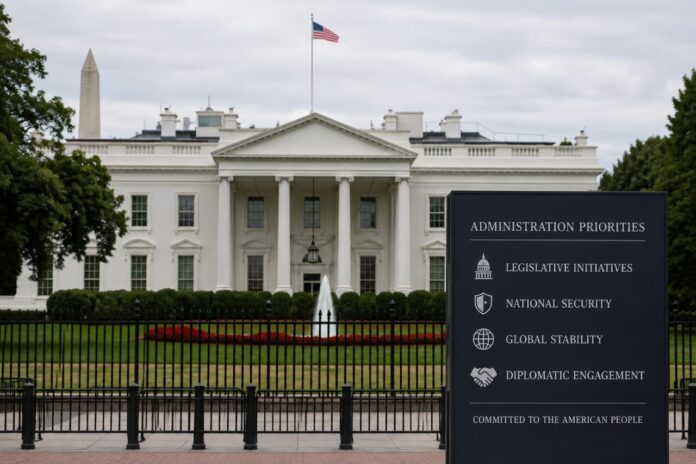
Story Highlights
- The president has encountered significant obstacles in managing international crises and domestic legislative priorities simultaneously
- Recent polling data indicates substantial Republican concerns about economic management and policy implementation
- High-profile security incidents underscore the complexity of presidential decision-making in volatile geopolitical environments
- The administration continues navigating competing pressures from Congress, international allies, and domestic political constituencies
What Happened
The White House faces mounting difficulties across multiple policy domains, with recent developments highlighting the complexity of managing simultaneous crises. President Trump’s administration has struggled to maintain unified control over key legislative initiatives while simultaneously addressing international security threats and geopolitical instability. Recent reporting indicates that security concerns forced unprecedented measures affecting presidential travel and operational planning during international diplomatic engagements.
The administration’s handling of regional conflicts has drawn scrutiny, with observers noting the difficulty in achieving intended policy outcomes despite significant executive resources. Congressional Republicans have proven reluctant to advance certain legislative priorities supported by the White House, complicating the administration’s agenda on Capitol Hill. These convergent pressures have created a complex operational environment requiring constant strategic recalibration.
- Security incidents during NATO diplomatic engagements required extraordinary protective measures and operational adjustments
- Congressional Republicans have resisted specific legislative proposals favored by the administration
- Marquette University Law School polling shows 70 percent of Republicans express disapproval of economic management
- Regional military operations have not achieved intended strategic outcomes as rapidly as anticipated
Why It Matters
The convergence of legislative setbacks, international security challenges, and declining approval metrics within the Republican base reveals fundamental constraints on presidential power. When international crises intersect with domestic political opposition, the president’s ability to execute a coherent strategic vision becomes significantly compromised. This dynamic has direct implications for policy implementation across foreign affairs, economic management, and legislative priorities that depend on congressional cooperation.
The polling data carries particular significance because it demonstrates erosion of support among the president’s core political constituency. When 70 percent of Republicans express concerns about economic stewardship, it creates political headwinds for legislative proposals that require party unity. These approval trends constrain the president’s ability to marshal the political capital necessary for ambitious policy initiatives, creating a vicious cycle where declining support leads to legislative failure, which further erodes public confidence.
The security incidents further illustrate the unpredictability inherent in modern geopolitical competition. Even the most powerful executive cannot unilaterally control international actors or prevent hostile nations from taking threatening actions. This reality constrains presidential options and forces reliance on security apparatus recommendations that may conflict with preferred approaches. When security imperatives override presidential preferences regarding operational details, it underscores the limits of executive control even in areas traditionally considered core presidential domains.
- Republican base approval declines directly weaken legislative negotiating positions with congressional colleagues
- Failed international objectives create perception of executive weakness that emboldens adversaries
- Simultaneous domestic and international crises overwhelm administrative capacity for coherent strategy
- Congressional opposition forces compromise on agenda priorities that executive intended to pursue unilaterally
Political and Public Context
The current challenges reflect broader patterns in contemporary American governance where executive power faces structural limitations despite formal constitutional authority. Presidents often discover that legal authority to act does not translate automatically into effective policy outcomes. Congressional checks and international resistance create friction between executive intent and operational reality, a dynamic that has affected administrations across the ideological spectrum.
Recent precedents demonstrate that even presidents with unified party control of Congress face difficulty when international events prove resistant to strategic influence. The complexity of modern conflicts, the independence of military and intelligence agencies, and the constraints imposed by alliance relationships all limit unilateral executive action. Public polling showing base erosion creates additional complications because it undermines the political leverage necessary to demand congressional cooperation on contentious issues.
The intersection of these factors creates a particularly difficult political environment. When legislative setbacks coincide with security incidents and declining approval ratings, the cumulative effect damages both policy effectiveness and political standing. International observers perceive executive weakness, domestic opponents gain confidence to resist administration priorities, and base voters grow frustrated with perceived policy failures. This deteriorating dynamic proves difficult to reverse without significant external events or strategic successes that rebuild confidence.
- Congressional Republicans have blocked administration priorities despite party alignment at chamber leadership levels
- International adversaries have escalated hostile actions suggesting perception of administration vulnerability
- Base approval metrics show deterioration across economic management and regional military policy
- Simultaneous crises exceed typical administrative capacity for message discipline and policy coordination
What Happens Next
The administration faces critical decisions regarding how to restore political momentum and legislative effectiveness. Without significant changes in either international circumstances or congressional Republican behavior, the trajectory of policy implementation appears constrained. The White House must find mechanisms to rebuild base confidence while simultaneously pressuring congressional holdouts to support key legislative priorities. This dual challenge proves particularly difficult when approval ratings decline, as eroding support undermines the political capital necessary for legislative negotiation.
International developments will significantly influence the administration’s political fortunes going forward. A successful resolution of regional conflicts or a demonstration of effective crisis management could help restore confidence in executive competence. Conversely, additional security incidents or military setbacks would further compound the perception of executive weakness. The administration’s ability to shape these international outcomes remains limited, creating a concerning dynamic where external events largely beyond executive control could determine political success or failure.
Congressional Republicans will likely face increasing pressure from the administration to advance key legislative initiatives, but the recent polling data suggests the base may not provide the enthusiastic support necessary to force reluctant members into difficult votes. The administration must either find ways to boost approval ratings through policy successes or accept scaling back ambitious legislative proposals to focus on more achievable objectives. Strategic choices made in coming weeks will substantially determine whether the administration can reverse current momentum or whether mounting challenges persist.
- Administration will likely attempt legislative pressure tactics to force Republican congressional support on priority bills
- International military and diplomatic developments could significantly impact approval ratings and political leverage
- Base voters will monitor economic indicators and foreign policy outcomes for evidence of effective management
- Congressional Republicans will face pressure from both the administration and constituent concerns about policy direction
