

Story Highlights
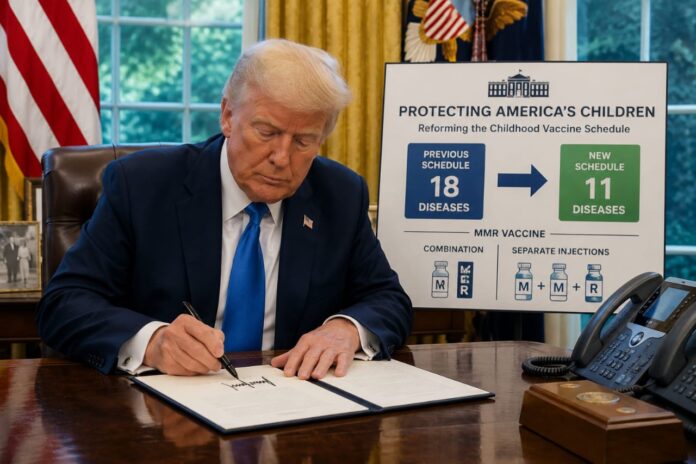
- President Trump signed an executive order reducing recommended childhood vaccines from 18 to 11 diseases
- The order recommends separating the MMR vaccine into individual shots rather than combination doses
- Health experts and fact-checkers have identified misleading claims made during the announcement
- Vaccine safety data shows serious adverse reactions remain extremely rare among vaccinated children
What Happened
The White House took action on vaccine policy this week when President Trump signed an executive order in the Oval Office that substantially reduces the number of vaccinations recommended for American children. The new directive cuts the CDC’s previous recommendation of childhood vaccinations against 18 diseases down to 11 diseases. Additionally, the order advises health professionals to administer the mumps, measles, and rubella vaccine as three separate injections rather than in the combination MMR format currently standard in medical practice.
During the signing ceremony, administration officials made several statements about vaccine volumes and composition that have drawn scrutiny from medical experts and fact-checkers. The messaging centered on concerns about the quantity and timing of vaccine administration to young children, with specific focus on the proposed separation of combination vaccines into individual doses.
- Executive order reduces CDC recommendations from 18 to 11 diseases for childhood vaccination
- Order advises splitting MMR vaccine into three separate injections
- White House press secretary Karoline Leavitt released graphics illustrating vaccine administration numbers
- Signing took place in the Oval Office this week
Why It Matters
The executive order represents a significant shift in federal vaccination guidance that will likely influence state-level school entry requirements and parental health decisions across the nation. Since states determine their own vaccine mandates while drawing on federal CDC guidance, a reduction in federal recommendations could cascade into changes at the state level. This policy shift directly affects millions of American families making healthcare decisions for their children.
Medical organizations and public health experts have raised concerns about both the policy change and the accuracy of statements made during its announcement. The CDC notes that the MMR vaccine is considerably safer than contracting the actual diseases it prevents. Research indicates that serious adverse reactions to the MMR vaccine occur at extremely low rates, with febrile seizures occurring in approximately one of every 3,000 to 4,000 vaccinated children. Contrastingly, the diseases themselves carry significantly higher risks of serious complications and death. The separation of combination vaccines into individual shots could also affect vaccination completion rates, as parents managing multiple separate appointments may face greater barriers to keeping children up-to-date on their immunizations.
- State-level school entry requirements will likely be influenced by the federal policy change
- Millions of American families will face different vaccination recommendations for their children
- Potential increase in childhood disease risk if vaccination rates decline
- Vaccine separation could complicate family scheduling and vaccination completion rates
Political and Public Context
Vaccine policy has become an increasingly contentious political issue in recent years, with debates intensifying around vaccine mandates, timing of administration, and safety profiles. The Trump administration’s approach reflects growing political attention to parental choice and skepticism about centralized health recommendations. This move aligns with broader concerns within certain conservative circles about the scope of federal health directives and the balance between government guidance and individual family decision-making.
The Kaiser Family Foundation and CDC have historically supported the existing vaccination schedule based on decades of clinical research and epidemiological data. However, alternative approaches to vaccination timing and combination versus individual shots have gained attention in public discourse. The debate reflects broader questions about regulatory authority, medical decision-making autonomy, and how federal health agencies should balance standardized recommendations with emerging public concerns.
- Vaccine policy has become increasingly politicized over the past several years
- Public concerns about government health mandates have grown within certain voter demographics
- CDC and medical establishment have historically defended current vaccination schedules based on safety data
- Debate reflects tensions between regulatory guidance and individual parental choice
What to Know About the Vaccines Targeted by Trump’s Executive Order
The order, whose legal power is unclear, recommended narrowing the use of vaccinations against several diseases that can be life-threatening. https://t.co/Wy0c2YryOM— Algernon Fross (@fxp123) August 12, 2026
What Happens Next
The executive order will likely face implementation challenges as states decide whether to adopt the new federal recommendations or maintain existing vaccine requirements. Legal challenges could emerge from public health advocates and medical organizations concerned about reduced disease protection. The coming months will reveal how individual states respond to the federal guidance shift and whether vaccination rates change in response to the policy modification.
The White House has indicated commitment to this policy direction, suggesting further actions related to vaccine administration and safety reviews may follow. Health agencies will need to develop implementation guidelines, and medical professionals will require updated training materials reflecting the new recommendations. Public health campaigns and educational outreach will likely increase as stakeholders on different sides of the issue work to influence public opinion and state-level decision-making.
- States will determine individual responses to revised federal vaccine recommendations
- Potential legal challenges from public health organizations may arise
- Health agencies must develop new implementation and training guidelines
- Public health campaigns and advocacy efforts will likely intensify in coming weeks
