

Story Highlights
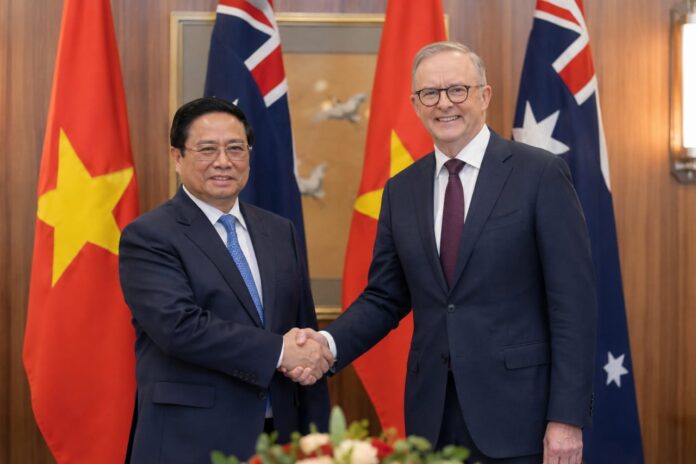
- Vietnam and Australia agreed to deepen military cooperation and defense engagement during high-level bilateral talks in Canberra
- Both nations expressed shared concerns about policies threatening to disrupt global supply chains and critical minerals trade
- The two countries committed to enhanced efforts against transnational organized crime and people smuggling
- The defense partnership reflects broader regional security considerations in the Indo-Pacific region
What Happened
Vietnam and Australia formalized an agreement to strengthen their defense and security partnership during a bilateral meeting held in Canberra on Tuesday. The two nations’ leaders met to discuss matters of mutual strategic importance and released a joint statement outlining their commitment to enhanced military cooperation. Both sides acknowledged shared concerns regarding international policies that could disrupt the smooth functioning of global supply chains and the movement of critical trade goods.
Beyond defense matters, the nations addressed transnational challenges affecting the region. Officials from both countries indicated their intention to increase collaborative efforts on counteracting organized crime networks and people smuggling operations that cross borders. The discussions reflected a broader understanding of interconnected security challenges facing the Indo-Pacific region and the need for coordinated responses.
- Bilateral meeting occurred in Canberra on Tuesday with Vietnam’s top leader and Australia’s Prime Minister
- Joint statement committed both nations to further strengthening defense and security engagement
- Discussions included concerns about global supply chain disruptions from certain international policies
- Both countries pledged increased cooperation on transnational organized crime and people smuggling
Why It Matters
The deepening defense relationship between Vietnam and Australia carries significant implications for regional stability and economic resilience. As supply chain vulnerabilities have become increasingly apparent in recent years, the agreement to support free trade flows addresses a critical concern for both economies. Vietnam’s position as a major manufacturing hub and Australia’s role as a primary source of critical minerals make their partnership economically consequential for regional and global commerce.
The emphasis on defense cooperation reflects acknowledgment of evolving security dynamics in the Indo-Pacific. Vietnam, with its strategic location along major shipping routes and growing economic importance, represents a valuable partner for Australia in addressing regional security challenges. The commitment to counter transnational organized crime and people smuggling demonstrates that the partnership extends beyond traditional military concerns to address practical law enforcement matters affecting both societies.
For Australia particularly, strengthening ties with Vietnam serves to bolster its network of security partnerships in Southeast Asia, a region of growing geopolitical importance. This cooperation helps ensure stability in trade routes and supports mutual defense interests amid broader regional developments.
- Enhanced defense partnership contributes to regional stability in the strategically important Indo-Pacific region
- Agreement to protect supply chains addresses economic vulnerabilities critical to both nations’ prosperity
- Cooperation on organized crime and people smuggling affects citizens of both countries directly
- Partnership strengthens Australia’s broader security architecture across Southeast Asia
Political and Public Context
The defense cooperation agreement emerges within a context of shifting geopolitical alignments in the Indo-Pacific. Numerous nations in the region have prioritized strengthening bilateral and multilateral security partnerships to address emerging challenges. Vietnam has pursued a deliberate diplomatic strategy of diversifying its security relationships while maintaining its traditional policies of independence and sovereignty.
Australia has similarly invested considerable effort in building a network of defense partnerships throughout Southeast Asia and the broader Indo-Pacific region. These relationships serve multiple purposes: they enhance collective security capabilities, support economic interests, and provide diplomatic influence in regional affairs. The emphasis on supply chain resilience reflects widespread concerns among developed economies about vulnerabilities exposed during recent years of economic disruption.
The focus on combating transnational crime reflects an ongoing challenge for both nations and many others in the region. People smuggling networks and organized crime syndicates operate across borders, requiring coordinated law enforcement responses. Both Australia and Vietnam have faced distinct challenges from these criminal enterprises, making cooperation a practical necessity.
- Regional trend of strengthened bilateral defense partnerships among Indo-Pacific nations
- Vietnam’s strategy of diversifying security relationships while maintaining independence
- Australia’s broader effort to build comprehensive security architecture across Southeast Asia
- Growing international focus on supply chain resilience and critical minerals security
⚠️ AUSTRALIA AND VIETNAM EXPAND DEFENSE AND BORDER SECURITY COOPERATION
Australia and Vietnam agreed to deepen their comprehensive strategic partnership, including cooperation on defense, maritime law enforcement, and border security, during the Vietnamese president’s visit to… pic.twitter.com/cLivCqgusa
— Rise to Peace (@risetopeace) August 12, 2026
What Happens Next
The implementation of the strengthened defense and security cooperation will likely proceed through established channels and mechanisms. Both nations will work to translate the commitments outlined in their joint statement into specific operational arrangements, training initiatives, and joint exercises. The depth and pace of implementation will depend on resource allocation and the prioritization of various defense initiatives within each nation’s strategic planning.
On the supply chain and trade front, the two countries may pursue additional agreements to formalize their commitment to maintaining open commerce. This could involve joint approaches to addressing disruption concerns and potentially coordinated advocacy within international forums regarding trade policies. Cooperation on organized crime and people smuggling may result in increased intelligence sharing, joint task forces, or enhanced law enforcement coordination.
The partnership also creates potential for expanded collaboration in other areas, such as technology development, defense manufacturing, and regional diplomatic coordination. The strength of the bilateral relationship established through this agreement may provide a foundation for addressing future shared challenges that emerge in the dynamic Indo-Pacific region.
- Implementation of defense cooperation through operational arrangements, training, and joint exercises
- Potential additional trade and supply chain agreements to formalize commitment to open commerce
- Enhanced intelligence sharing and joint law enforcement efforts on organized crime
- Possible expansion into technology and defense manufacturing collaboration