

Story Highlights
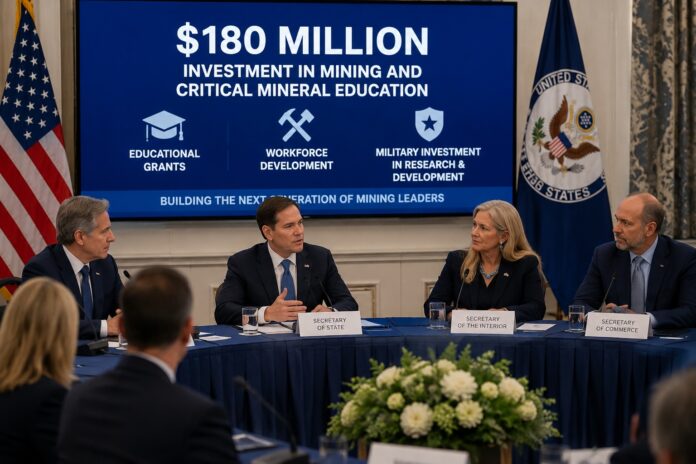
- The administration unveiled $180 million in grants to expand mining and critical mineral education programs across universities, community colleges, and trade schools
- The Department of Energy is distributing $100 million specifically for workforce development, with another $80 million in military funding directed to three specialized institutions
- The initiative addresses a severe decline in mining education enrollment, which has dropped from approximately 1,500 students eight years ago to fewer than 600 in 2023
- The funding aligns with broader efforts to reduce American dependence on foreign sources for critical minerals essential to semiconductor, aerospace, and technology manufacturing
What Happened
The White House announced a comprehensive $180 million educational funding package designed to revitalize mining and critical mineral workforce development. The announcement took place at a State Department roundtable attended by educational leaders from major institutions including the Colorado School of Mines, alongside key cabinet members including the Secretary of State, Secretary of the Interior, and Secretary of Commerce. This multifaceted initiative combines direct educational grants with targeted military investments in specialized research and development programs.
The Department of Energy component allocates $100 million toward expanding the mining and critical mineral workforce through scholarships and educational programs over the next two years. Universities, community colleges, trade schools, industry groups, and other educational partners are eligible to submit applications for these funds. Additionally, the Department of Defense is contributing more than $80 million in supplemental funding distributed among three major institutions to advance workforce development and technological innovation in the mining and mineral processing sectors.
- Colorado School of Mines receives $32.7 million to establish a technology development hub for mineral processing and advanced materials
- South Dakota School of Mines receives $25 million for workforce development programs
- Johns Hopkins University receives $23.6 million for mineral recycling-focused research and development
- Department of Energy deploying $100 million for scholarships and educational expansion over two years
Why It Matters
This educational investment addresses a critical infrastructure gap in American competitiveness and national security. Mining engineering enrollment has collapsed dramatically, with participation declining by more than 60 percent over the past eight years. Without intervention, the nation faces an accelerating shortage of trained professionals capable of developing and managing domestic mineral extraction and processing operations. The shortage threatens America’s ability to produce the advanced materials necessary for semiconductor manufacturing, aerospace systems, battery technology, and other critical industries that define modern technological leadership.
The initiative directly supports the administration’s broader strategic objective of reducing reliance on foreign sources for essential minerals. China currently dominates the global mining and refining of critical materials including lithium, silicon, graphite, and rare-earth elements. Building a robust domestic workforce ensures that American companies can expand production capacity, develop innovative processing technologies, and maintain control over supply chains vital to national defense and economic strength. By investing in education and research infrastructure, the administration creates pathways for sustainable, long-term mineral independence.
- Addresses severe workforce shortage threatening domestic mineral production capabilities and advanced manufacturing competitiveness
- Reduces strategic vulnerability to foreign mineral supply disruptions, particularly from China which controls outsized global processing capacity
- Enables development of new technologies for mineral extraction, refinement, recycling, and advanced materials manufacturing
- Creates career pathways for students in communities with historical mining heritage and economic interest in mineral industries
Political and Public Context
This announcement represents part of a larger strategic pivot toward revitalizing American resource extraction and manufacturing independence. The administration has demonstrated sustained commitment to supporting traditional energy and mining sectors through multiple policy channels. Earlier this year, federal officials pledged $700 million in support for coal plant infrastructure and export terminal development, while simultaneously pursuing regulatory reforms that reduce environmental restrictions on coal industry operations. The current mining education initiative extends this pro-industry approach into workforce preparation and technological innovation.
The announcement also reflects recognition of declining interest in mining-related careers among American students. Educational institutions specializing in mining sciences have struggled to maintain enrollment and justify program continuation as cultural attitudes shifted and students pursued alternative career paths. The 60 percent decline in mining engineering program participation represents both a practical workforce challenge and a symbolic retreat from industries that historically anchored American economic strength and industrial capacity. Federal investment in educational infrastructure aims to reverse this trajectory and restore prestige to mining and critical mineral careers.
- Follows June announcement of $700 million in coal industry support for plant infrastructure and export facilities
- Continues regulatory reform agenda easing environmental restrictions on traditional extractive industries
- Addresses enrollment crisis in mining education with fewer than 600 students nationally in specialized programs
- Reflects broader strategic vision prioritizing domestic resource independence and manufacturing self-sufficiency
Trump announcing $180M in grants to boost American mining amid push for critical minerals https://t.co/MeemQlrztR
— News 4 San Antonio (@News4SA) August 7, 2026
What Happens Next
Universities, community colleges, and trade schools will begin submitting applications for the $100 million Department of Energy grant program during the coming months. Educational institutions must develop compelling proposals demonstrating how they will expand enrollment, enhance curriculum quality, and align programs with industry workforce needs. The designated recipients of military funding—Colorado School of Mines, South Dakota School of Mines, and Johns Hopkins University—will immediately commence development of their specialized programs, with the technology hub at Colorado School of Mines expected to commence testing and scaling advanced mineral processing technologies within established timelines.
Beyond the immediate educational initiatives, the administration indicated intentions to continue expanding investment in mining companies and battery manufacturers working with critical minerals. These complementary investments in both workforce development and industry support are designed to create comprehensive ecosystem changes that facilitate domestic mineral production growth. Success will depend on translating educational investment into actual career pipeline development and ensuring that trained graduates find adequate employment opportunities with companies expanding operations in response to federal support and market opportunities created by supply chain localization initiatives.
- Universities and trade schools will submit applications for $100 million Department of Energy grant competition in coming months
- Colorado School of Mines technology hub will begin testing and scaling mineral processing innovations immediately
- Administration plans continued investments in mining companies and battery manufacturers utilizing critical minerals
- Success dependent on coordinating workforce development with industry expansion and market opportunities for program graduates
