

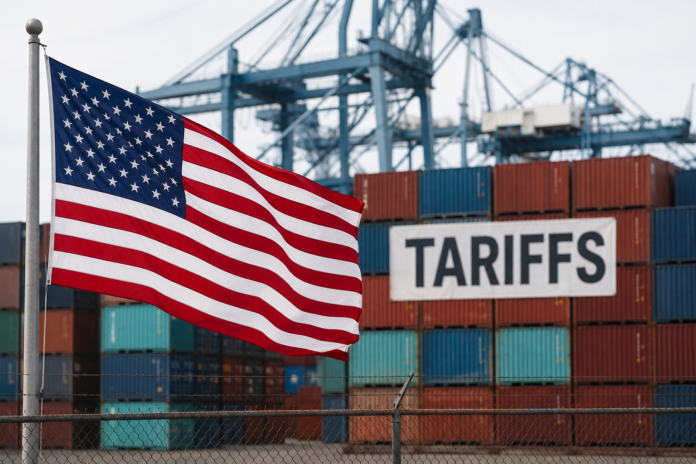
Story Highlights
- President Donald Trump imposed new tariffs on imports from 60 trading partners after the Supreme Court invalidated his earlier global tariff programme.
- The duties generally range from 10% to 12.5% and cover countries responsible for 99.4% of goods imported into the United States.
- The administration used Section 301 of the Trade Act of 1974, arguing that affected economies failed to prevent products made with forced labour from entering their markets.
- The tariffs replace a temporary 10% global duty that expired after reaching its 150-day legal limit.
What Happened
President Donald Trump restored broad tariffs on nearly all American imports by using a different trade law from the authority rejected by the Supreme Court earlier this year.
The Office of the United States Trade Representative imposed new duties on products from 60 trading partners following investigations into their enforcement of restrictions on goods produced with forced labour.
The tariffs took effect as a temporary 10% global import duty expired.
- Eighteen economies generally received an additional 10% tariff.
- Most other investigated economies received a 12.5% tariff.
- Special calculations apply to certain imports from several major U.S. allies.
- Energy, critical minerals and other selected products receive exemptions.
The administration launched the Section 301 investigations in March after the Supreme Court ruled that the president could not use emergency economic powers to impose the earlier worldwide tariffs.
U.S. Trade Representative Jamieson Greer determined that all 60 investigated economies had failed either to establish or effectively enforce adequate bans on imports linked to forced labour.
The White House argues that countries allowing such products into their domestic markets create an unfair commercial disadvantage for American companies operating under stricter labour and import standards.
Why It Matters
The action preserves tariffs as a central part of the president’s economic strategy despite the Supreme Court defeat.
Rather than abandon the policy, the administration conducted formal investigations and moved the duties onto Section 301, an established trade statute previously used against unfair foreign commercial practices.
That could give the new tariffs a stronger legal foundation than the emergency-powers approach rejected by the Court.
- The policy keeps tariff pressure on nearly every major U.S. trading partner.
- It encourages foreign governments to strengthen forced-labour import restrictions.
- It protects American producers from competitors using allegedly cheaper or abusive supply chains.
- It could generate substantial federal revenue from imported goods.
For consumers, the immediate result may be less visible than the headline suggests because the new duties largely replace a temporary tariff that was already in effect.
Importers were therefore already paying an additional 10% on many products.
However, goods moving to the 12.5% rate will face a further increase, while exempted products and countries receiving adjusted rates may experience different effects.
Businesses importing clothing, electronics, machinery, footwear and household products will review whether to absorb the duties, change suppliers or pass additional costs to customers.
Political and Public Context
The Supreme Court ruled in February that the administration had exceeded its authority by using the International Emergency Economic Powers Act to establish broad country-by-country tariffs.
Trump responded immediately with a temporary worldwide duty under Section 122 of the Trade Act.
That provision permitted a maximum 15% tariff for up to 150 days, giving the administration time to develop longer-lasting alternatives.
- The temporary 10% duty prevented an abrupt return to pre-tariff rates.
- USTR simultaneously investigated forced-labour policies across 60 economies.
- Officials held hearings and reviewed more than 1,600 public comments.
- The completed process formed the basis for the new Section 301 duties.
The president’s supporters see the transition as proof that the administration can defend its trade programme while complying with the Supreme Court’s ruling.
The White House did not simply reissue the invalidated tariffs under the same emergency authority. It relied on separate statutes, public investigations and formal findings concerning foreign trade practices.
Critics contend that forced labour is being used as a legal justification to recreate the broad tariff wall the Court struck down.
Several trading partners, including Australia and members of the European Union, have rejected the suggestion that their policies warrant American penalties.
What Happens Next
The new tariffs are already facing a court challenge from American importers.
Two small businesses filed a lawsuit in the U.S. Court of International Trade arguing that USTR failed to establish the detailed connection between each foreign practice and the broad duties imposed on its products.
The plaintiffs are supported by the organisation that successfully challenged the administration’s earlier emergency tariffs.
- Importers may seek an injunction blocking collection of the new duties.
- Additional companies and Democratic-led states could join the litigation.
- Trading partners may negotiate for exclusions or reduced rates.
- The dispute could eventually return to the Supreme Court.
The administration is also pursuing separate trade investigations involving excess industrial capacity and other practices affecting American manufacturers.
Those reviews could produce additional tariffs targeting particular countries or industries.
For households, the practical impact will depend on how long the duties remain in force and how much of the cost businesses pass through to retail prices.
For Trump, the policy delivers a larger political message: the Supreme Court may have rejected one tariff mechanism, but it did not eliminate the president’s broader authority to confront foreign trade practices using other laws.
