

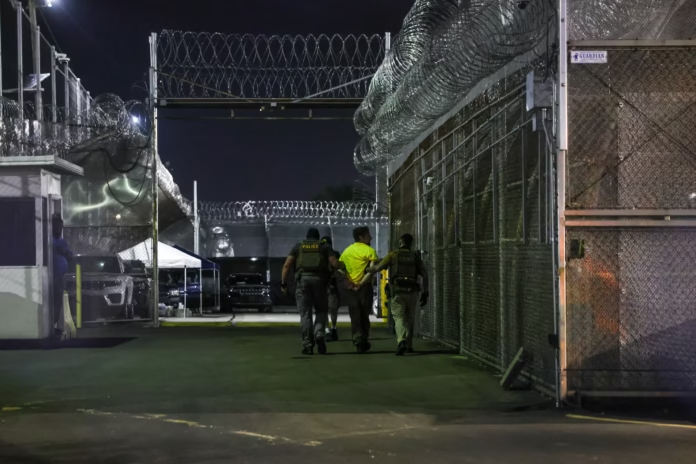
A divided federal appeals court has struck another blow against the Trump administration’s policy of holding certain immigrants without bond, ruling that detainees in Louisiana, Mississippi and Texas must receive a bond hearing within 90 days. The decision from the 5th U.S. Circuit Court of Appeals marks the fourth appellate court to rule against the administration’s mandatory detention practice, deepening a legal split that could soon land before the Supreme Court. The outcome carries direct consequences for immigrants held in some of the nation’s largest detention centers.
Story Highlights
- The 5th Circuit ruled 2-1 that immigrants subject to mandatory detention must receive a bond hearing within 90 days.
- The ruling is a partial reversal of the same court’s February decision that had allowed indefinite detention without bond.
- Four appeals courts have now ruled against the policy, while two have upheld it, setting up likely Supreme Court review.
- The Department of Homeland Security says it disagrees with the ruling and is confident in its legal position.
What Happened
The 5th U.S. Circuit Court of Appeals ruled 2-1 on July 2 that immigrants held under the Trump administration’s mandatory detention policy must be granted a bond hearing within 90 days of being taken into custody, rather than facing indefinite detention with no opportunity to seek release. One judge in the majority suggested that even a 30-day limit would have been more appropriate, while the dissenting judge argued that denying bond entirely was constitutionally sound and consistent with the administration’s approach. The ruling directly affects immigration detention facilities in Louisiana, Mississippi and Texas, three states that house some of the largest detention centers in the country and to which immigrants from across the nation are frequently transferred.
The decision represents a significant partial reversal of the same appeals court’s own ruling in February, which had greenlit indefinite detention without bond for immigrants held in those states. Since that earlier ruling, however, federal judges across multiple jurisdictions, including some appointed by Trump himself, have pushed back against the policy, with several ordering the release of detained immigrants and describing the no-bond approach as unconstitutional.
The mandatory detention policy stems from a 2025 Trump administration directive asserting that certain immigrants who crossed the border illegally, regardless of how long ago, could be held indefinitely without any bond hearing. The policy has faced a wave of legal challenges nationwide. As of the 5th Circuit’s ruling, four appeals courts have now ruled against some version of the mandatory detention practice, while only the 8th U.S. Circuit Court of Appeals, covering Arkansas, Iowa, Minnesota, Missouri, Nebraska, North Dakota and South Dakota, has upheld it. A federal court in California separately struck down the policy nationwide in a class-action lawsuit; that ruling was stayed pending appeal in March but continues to apply within part of California and has been cited by judges in other states as persuasive authority for releasing detained immigrants.
The Department of Homeland Security responded to the 5th Circuit’s ruling with a statement saying it “strongly disagrees” with the panel’s decision and is “confident in its legal position regarding mandatory detention,” adding that it looks forward to Supreme Court review. Given the deepening split among federal appeals courts, legal observers widely expect the Supreme Court to take up the underlying question, with oral arguments potentially scheduled as soon as October.
Why It Matters
The ruling has immediate, tangible consequences for immigrants currently held in detention centers across Louisiana, Mississippi and Texas, many of whom have been in custody for extended periods without any opportunity to argue for release. A 90-day bond hearing requirement, while still leaving detainees without immediate relief, represents a meaningful check on what critics have described as an unprecedented expansion of executive detention authority.
The case also highlights unusual dynamics within the federal judiciary, with even judges appointed by Trump breaking from the administration’s position and describing the no-bond policy as constitutionally suspect. That cross-ideological pushback suggests the legal questions at stake go beyond typical partisan alignment and touch on fundamental due process principles that have drawn skepticism from jurists across the ideological spectrum.
For the broader immigration enforcement system, the growing patchwork of conflicting rulings, with some regions permitting indefinite detention and others requiring bond hearings, creates significant inconsistency in how immigrants are treated depending solely on where they are detained. This geographic disparity is likely to be a central issue if and when the Supreme Court takes up the case, since a national resolution would replace the current circuit-by-circuit split.
Economic and Global Context
While primarily a legal and human rights story, the mandatory detention policy carries substantial fiscal implications, given the cost of holding large numbers of immigrants in detention facilities for extended, potentially indefinite periods rather than releasing eligible individuals on bond while their cases proceed. Detention capacity and funding have been recurring points of tension in broader budget negotiations this year, as the administration has sought to expand detention infrastructure alongside its enforcement priorities.
The policy dispute also intersects with the administration’s broader immigration agenda, which has included other significant actions this year, such as the Supreme Court’s recent decisions allowing the administration to strip Temporary Protected Status from more than 350,000 Haitians and 6,100 Syrians while separately striking down an executive order that sought to limit birthright citizenship. Taken together, these rulings illustrate a mixed legal record for the administration’s immigration policies, with courts upholding some enforcement measures while rejecting others on due process and constitutional grounds.
Internationally, the detention policy has drawn criticism from advocacy groups and some foreign governments concerned about the treatment of their nationals in U.S. custody, adding a diplomatic dimension to what is otherwise a domestic legal dispute.
Implications
With the circuit split now spanning four appellate courts against the policy and one in favor, Supreme Court review appears increasingly likely, and a final resolution could come as soon as the court’s next term. Until then, immigrants in different parts of the country will continue to face starkly different detention conditions depending on which circuit governs their case, creating pressure for advocacy groups to pursue transfers or venue challenges on behalf of detained clients.
For the Department of Homeland Security, the ruling adds another layer of legal uncertainty to an enforcement strategy already facing challenges on multiple fronts, and the agency’s stated confidence in eventual Supreme Court vindication will be tested in the months ahead. Immigration attorneys are likely to cite the 5th Circuit’s reasoning in ongoing cases in other jurisdictions, potentially accelerating similar rulings elsewhere before the Supreme Court weighs in.
For Congress, the deepening judicial conflict may renew calls for legislative clarity on detention standards, though with immigration remaining one of the most politically charged issues heading into the 2026 midterms, any bipartisan legislative fix appears unlikely in the near term.
Sources
“New ruling on detention another blow to Trump immigration policy”
