

Story Highlights
- President Trump switched away from the new Qatari-gifted Air Force One while leaving the NATO summit in Turkey.
- The move reportedly followed Secret Service advice amid renewed security concerns tied to Iran.
- The Qatari-donated jet lacks some military-grade defenses found on the older presidential aircraft.
What Happened
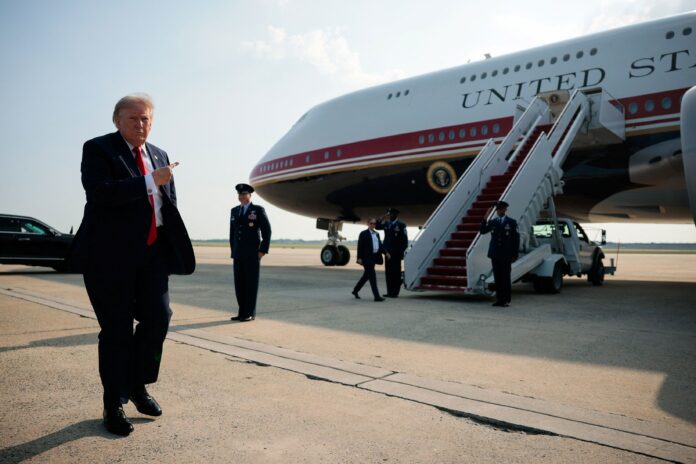
President Donald Trump unexpectedly switched away from the new Qatari-gifted Air Force One while departing the NATO summit in Ankara, Turkey, choosing instead to fly on the older, more heavily fortified presidential aircraft.
The decision reportedly came after advice from the Secret Service. Officials described the switch as a precautionary move rather than a response to a specific confirmed threat, but it came as hostilities with Iran resumed after the collapse of a ceasefire.
The Qatari-donated Boeing 747-8 had entered active rotation only recently and was promoted as a temporary bridge aircraft while Boeing’s permanent replacement planes remain delayed.
- Trump left Ankara aboard the older VC-25A Air Force One.
- The Qatari jet was reportedly avoided because of security concerns.
- Trump later used the Qatari plane again for part of his return trip.
The newer aircraft reportedly lacks midair refueling capability and does not include the same missile-defense, countermeasure, and command-and-control systems found on the traditional Air Force One.
Those systems allow the older presidential aircraft to function as a secure flying command center during military crises.
Asked whether the switch was connected to Iran, Trump did not directly deny the concern. He said he was “No. 1 on the kill list” for Iran, adding that he was simply doing his job.
Trump publicly said the newer jet had been sent to RAF Mildenhall and other European bases so American troops could view it. He later boarded the Qatari plane for the final part of his trip home.
Why It Matters
The episode matters because it raises fresh questions about whether the Qatari-gifted aircraft is fully ready for high-risk presidential travel.
For Trump and his supporters, the switch can be seen as a prudent security decision during a dangerous moment. With Iran tensions escalating, using the more battle-tested and heavily equipped aircraft gave the president maximum protection.
The decision also shows that Trump’s security team is still prioritizing operational safety over symbolism when the threat environment changes.
- Supporters may view the switch as a smart precaution during the Iran crisis.
- The older Air Force One has stronger military-grade systems.
- The Qatari jet remains under scrutiny because of its compressed conversion timeline.
The controversy also reopens debate over the decision to accept the aircraft from Qatar. Critics have raised ethics and conflict-of-interest concerns, especially because of Trump family business ties in the Gulf.
But the administration has defended the aircraft as a necessary bridge while Boeing’s permanent replacements remain years behind schedule.
Political and Public Context
The aircraft switch came during a broader foreign policy crisis involving Iran, NATO, Ukraine, and Gulf security.
Trump has publicly acknowledged that Iran views him as a top target. That makes presidential travel choices more politically sensitive, especially when one aircraft is seen as more secure than the other.
The Qatari jet has been controversial from the start. Supporters argue it gives the president a newer aircraft while delayed Boeing replacements remain unavailable. Critics argue that accepting a foreign-gifted plane creates unusual optics and invites questions about foreign influence.
The latest episode gives both sides new ammunition.
For Trump’s defenders, the decision proves that the administration will use the safest aircraft when conditions require it. For critics, the fact that the older jet was chosen during a high-threat moment may raise doubts about whether the Qatari plane should have entered rotation so quickly.
Economic and Global Context
The financial cost of converting the Qatari jet remains disputed.
The Air Force has said it spent under $400 million upgrading the aircraft, while some outside experts estimate the true cost of bringing it closer to presidential standards could be much higher.
The plane was converted from a commercial aircraft by defense contractor L3Harris in about 10 months, far faster than the years typically required to transform a jet into a fully capable Air Force One.
- The Qatari jet was intended as a bridge aircraft.
- Boeing’s permanent replacement planes are not expected until 2028.
- Security upgrades and total retrofit costs remain under scrutiny.
The timing is also important globally. The switch happened as the United States resumed military operations against Iran after attacks near the Strait of Hormuz.
That crisis has made secure presidential communications, missile defenses, and operational flexibility more important than usual.
The episode also reflects the complex relationship between the Trump administration and Qatar, which has played a role in regional diplomacy while also becoming linked to the aircraft controversy.
What Happens Next
The Qatari jet is likely to face continued scrutiny from lawmakers, national security experts, and the media.
Congress may ask for more details about the aircraft’s security systems, retrofit costs, and whether it meets the standards expected for presidential travel during active military conflict.
- Lawmakers may seek more transparency on the aircraft’s capabilities.
- The Secret Service and Air Force may formalize when each aircraft should be used.
- The Qatari jet may remain in rotation but face limits during high-threat travel.
For the White House, the challenge will be explaining why Trump sometimes uses the Qatari aircraft while avoiding it in more sensitive situations.
For Trump, the decision shows that presidential security remains the top priority as the Iran conflict intensifies and the administration manages an unusually complicated aircraft transition.
